



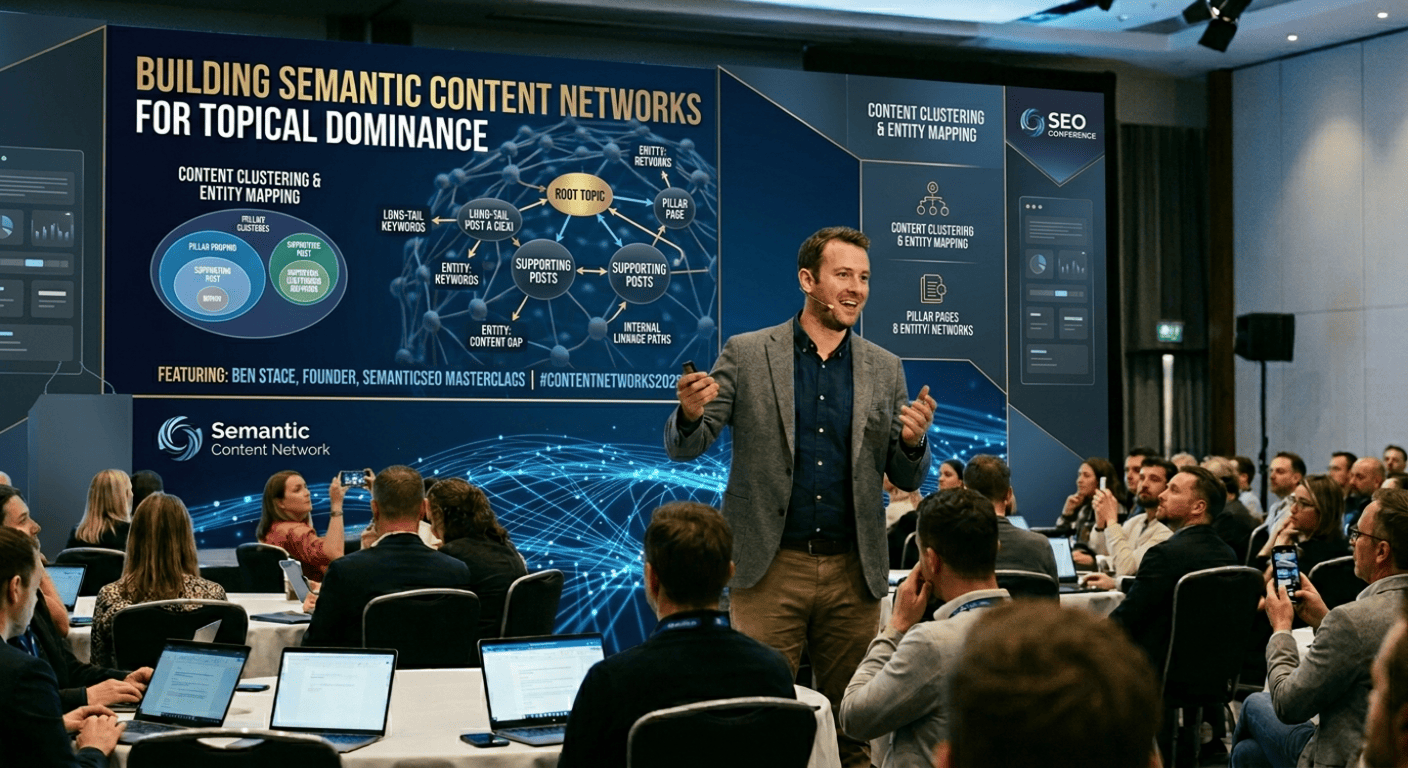
String-matching algorithms no longer govern the search landscape in 2026. With the absolute dominance of Google’s AI Overviews, Perplexity, and Retrieval-Augmented Generation (RAG) frameworks, traditional keyword stuffing is officially dead. Today, search engines function as discovery engines that process data through semantic vectors and entity metrics.
Enter Semantic Content Networks by Ben Stace. This advanced architectural framework has shifted the paradigm from traditional siloed topic clusters to interconnected knowledge ecosystems. For platforms like Techniver, mastering this methodology is now essential to capture visibility in modern AI-assisted search environments.
What Are Semantic Content Networks by Ben Stace?
A Semantic Content Network (SCN) is an advanced entity-based information architecture that maps, organizes, and links content assets based on their ontological relationships rather than surface-level keyword themes. Developed as a response to deep learning search algorithms, Ben Stace’s framework treats a website not as a collection of isolated URLs, but as a proprietary Knowledge Graph.
Instead of simply asking, “What keywords should this page target?” an SCN framework asks:
- What core entities define this subject?
- What are the semantic distances between these concepts?
- How can machine-learning models parse our content nodes with minimal computational friction?
Key characteristics of Semantic Content Networks include:
- Entity-Based Content Architecture
- Contextual Internal Linking
- Structured Semantic Relationships
- Topic Ecosystem Development
- Search Intent Alignment
Why Semantic Content Networks Matter More in 2026
The shift from Lexical Search (exact keyword matching) to Semantic Search (intent and contextual meaning) reached its maturity in 2026.
The Shift From Keywords to Entities
Modern Large Language Models (LLMs) and search bots dissect content via Natural Language Processing (NLP) and Entity Recognition. An entity is any well-defined, distinct object, concept, or person. When an LLM evaluates web copy, it converts sentences into vector embeddings, numerical representations of semantic meaning.
If your content assets are fragmented, AI bots cannot establish topical boundaries. Ben Stace’s Semantic Content Framework solves this by explicitly outlining the nodes (pages) and edges (links) between concepts, aligning your site architecture perfectly with how modern AI search architectures parse data.
The Evolution of Ben Stace’s Semantic Content Framework
The concept behind Semantic Content Networks by Ben Stace emerged as search engines became more advanced in understanding context, meaning, and relationships between topics. Traditional SEO strategies were largely built around keyword targeting, backlink acquisition, and individual content pieces designed to rank for specific search terms. While these tactics delivered results in the past, modern search algorithms now evaluate content through a much broader lens. As Google continues shifting toward entity-based search and AI-powered understanding, semantic frameworks have become essential for building sustainable topical authority and long-term organic visibility.
How Search Engines Evolved
Search engines have undergone a major transformation over the past decade. Instead of simply matching keywords, modern algorithms analyze intent, entities, contextual relevance, and topic relationships to provide more accurate search results. Technologies such as Google BERT, Google MUM, the Helpful Content System, AI Overviews, and Large Language Models (LLMs) have accelerated this shift toward semantic understanding. These innovations prioritize meaning and context, making semantic content architecture more valuable than traditional keyword-focused SEO approaches.
Core Pillars of Semantic Content Networks by Ben Stace
Building a highly resilient SCN requires executing four structural pillars flawlessly:
1. Granular Topic Mapping
Before writing a single word, you must map out your primary topical entity and every micro-concept linked to it. This involves running N-gram analysis and extracting entity clusters from top patent documents or high-authority industry resources to ensure there are no topical gaps.
2. Semantic Content Nodes
Every URL in your network acts as a specific Semantic Content Node. Each node must have a singular, clear semantic purpose, addressing a precise user intent, answering nuanced informational queries, or mapping out transactional entity attributes without overlapping or cannibalizing other nodes.
3. Contextual Internal Linking (The “Edges”)
In an SCN, internal links are not just for user navigation; they are explicit semantic connectors. Links must be embedded within rich contextual paragraphs where the surrounding text provides heavy thematic signals to the destination URL.
4. Machine-Readable Structured Data
To bridge the gap between human language and machine processing, robust Schema Markup (JSON-LD) must be deployed across every node. Utilizing specific properties like about, mentions, and sameAs connects your localized content straight to authoritative global knowledge bases like Wikidata.
How Semantic Content Networks Improve SEO Performance
As search engines become increasingly focused on context and topical authority, Semantic Content Networks offer significant advantages for both SEO performance and user engagement. By organizing content around meaningful relationships rather than isolated keywords, websites can create stronger authority signals and improve visibility across a wider range of search queries.
Why Semantic Content Networks Deliver Better SEO Results
A well-structured Semantic Content Network helps search engines understand the depth of expertise within a website. The interconnected nature of semantic content improves crawl efficiency, enhances content discovery, and increases the likelihood of ranking for related searches. This approach also supports visibility in AI-powered search experiences where context and relationships are often more important than exact keyword matches.
| Semantic SEO Benefit | Impact on Search Performance |
| Topical Authority | Establishes expertise across an entire subject area rather than individual keywords |
| Entity Relevance | Helps search engines understand relationships between topics, concepts, and entities |
| Internal Link Equity | Distributes authority throughout the content network and improves indexation |
| AI Search Visibility | Increases opportunities for inclusion in AI Overviews and AI-generated answers |
| Knowledge Graph Alignment | Strengthens semantic signals used by modern search systems |
| Long-Tail Search Coverage | Expands visibility across a broader range of related search queries |
| User Experience Improvement | Encourages deeper engagement through logical content pathways |
| Content Discoverability | Makes it easier for both users and search engines to find related resources |
| Semantic Context Building | Reinforces topical relationships that support higher relevance scores |
| Future-Proof SEO Strategy | Aligns with evolving search technologies focused on meaning and intent |
How AI Systems and LLMs Interpret Semantic Content Networks
The rise of AI-powered search has changed how information is analyzed, understood, and presented to users. Modern systems such as ChatGPT, Gemini, Claude, and Google’s AI Overviews do not rely solely on keywords when evaluating content. Instead, they focus on understanding the relationships between entities, concepts, and topics. This shift makes Semantic Content Networks by Ben Stace particularly valuable because they are designed around meaning, context, and topical connections rather than isolated keywords.
What AI Models Look For When Evaluating Content
Large Language Models (LLMs) process information by identifying entities, mapping relationships, and evaluating contextual relevance. They analyze how different concepts connect within a topic and whether the content demonstrates expertise and trustworthiness. Source credibility, semantic consistency, and knowledge graph alignment also play important roles in determining how content is interpreted. Because Semantic Content Networks are built around these principles, they provide the signals AI systems need to understand and reference content effectively.
Semantic Content Networks vs Traditional Topic Clusters
Many digital marketers mistake semantic networks for standard hub-and-spoke topic clusters. The operational differences, however, are massive:
| Feature | Traditional Topic Clusters | Semantic Content Networks (Ben Stace) |
| Primary Focus | Target Keywords & Categories | Entities, Relationships, and Vector Distance |
| Linking Strategy | Generic sitewide or sidebar links | Hyper-contextual links embedded within semantic text |
| Search Engine Alignment | Lexical matching (Google PageRank) | Semantic Knowledge Graphs & LLM Vector Spaces |
| AI Overview Readiness | Low (Often filtered out as repetitive) | High (Directly feeds RAG data pipelines) |
Why Semantic Content Networks Are More Effective
Traditional topic clusters help organize content, but they often lack the deeper semantic relationships required by modern search systems. Semantic Content Networks connect topics through meaning rather than simple categorization. This allows search engines and AI systems to understand how concepts relate to one another, creating stronger authority signals and better search performance across a wider range of queries.
Real-World Applications of Semantic Content Networks
Semantic Content Networks are not limited to a specific industry. Businesses of all sizes use this framework to improve content organization, strengthen topical authority, and increase organic visibility. By creating interconnected knowledge ecosystems, organizations can establish themselves as trusted resources within their industries while improving user experience and search performance.
Industries Benefiting Most From Semantic Content Networks
Many industries have successfully adopted semantic frameworks because they help demonstrate expertise and improve content discoverability. SaaS companies use them to organize product education and customer resources. Healthcare websites rely on semantic structures to connect medical topics and improve information accuracy. Legal firms benefit by creating comprehensive content ecosystems around practice areas and legal services. E-commerce businesses use semantic networks to strengthen category relationships and product relevance, while finance brands and local service businesses use them to build authority within highly competitive markets.
Common SCN Mistakes to Avoid
- Creating Thin Content Nodes: Publishing short, fluff-filled articles that offer no unique data attributes or clear insights will trigger quality algorithms.
- Irrelevant Internal Linking: Blindly linking every page to one another without establishing a clear contextual or semantic relationship dilutes your link equity.
- Neglecting Search Intent Calibration: If a node is mapped as a purely informational concept, stuffing it with commercial calls-to-action creates a behavioral mismatch that hurts organic rankings.
Step-by-Step Guide to Building a Semantic Content Network
To successfully implement this framework and inject real topical authority into your domain, follow this execution roadmap:
Step 1: Establish Your Root Entity
Identify the core macro-topic you want to dominate. For instance, if your domain is focused on modern digital discovery, your root entity might be Generative Engine Optimization.
Step 2: Extract Sub-Entities and LSI Keywords
Use NLP mapping tools to gather related semantic terms, latent semantic indexing (LSI) variants, and conversational user queries. Avoid generic keyword lists; focus on capturing the actual components, processes, and tools related to your root entity.
Step 3: Architect the Content Nodes
Create dedicated landing pages, deep-dive guides, and case studies for each sub-entity. Ensure every page has a distinct structural purpose and high structural information density.
Step 4: Implement Hyper-Contextual Internal Linking
This is where most sites fail. Do not use generic anchors like “click here” or “read more”. Your anchor text must explicitly state the target entity, surrounded by contextually rich paragraphs.
Step 5: Inject Advanced JSON-LD Schema
Deploy an advanced nested Schema. Tell search engines exactly what your page is about and specify the exact entities it mentions using verified Wikidata URLs.
Step 6: Monitor and Expand
A Semantic Content Network should continue evolving. Regular updates, content expansion, and entity refinement help maintain topical authority and adapt to changing search behaviors.
Why Semantic Content Networks Are Essential for AI Search Optimization
AI search systems increasingly depend on semantic understanding rather than keyword matching. As search engines integrate generative AI and conversational search experiences, websites need content structures that clearly communicate meaning and context. Semantic Content Networks provide this foundation by organizing information around entities, relationships, and topical depth.
Benefits for AI Search Visibility
Websites built around semantic frameworks are often better positioned for AI-generated search experiences. These networks improve entity recognition, strengthen topical authority, and enhance knowledge graph associations. They also increase the likelihood of appearing in AI Overviews, answer engines, and conversational search results where context and expertise play a critical role.
Is Ben Stace’s Semantic Content Network Strategy Still Relevant in 2026?
As search technology continues evolving, many SEO professionals wonder whether semantic frameworks remain effective. The answer lies in the direction modern search engines are taking. Google and AI systems increasingly prioritize contextual understanding, entity relationships, and topical expertise when evaluating content quality and relevance.
Why the Strategy Continues to Work
The principles behind Semantic Content Networks by Ben Stace align closely with how today’s search systems process information. By focusing on meaning, relationships, and knowledge organization, this framework supports long-term visibility across both traditional search results and AI-powered experiences. As entity-based search becomes more prominent, websites that invest in semantic content architecture are likely to maintain stronger authority and sustainable organic growth throughout 2026 and beyond.
Final Verdict
Semantic Content Networks by Ben Stace are the definitive blueprint for organic search survival in 2026. By transitioning your content strategy away from disconnected keyword targeting and moving toward fully mapped, highly contextual entity networks, you build an unshakeable digital ecosystem.
For forward-thinking platforms like Techniver, deploying hyper-contextual internal links, utilizing rich machine-readable schema, and building robust semantic content nodes is the ultimate way to secure top-tier search visibility, outpace competitors, and ensure long-term indexing inside AI search engines.
Frequently Asked Questions About Semantic Content Networks by Ben Stace
What Are Semantic Content Networks by Ben Stace?
Semantic Content Networks by Ben Stace is a content strategy framework that connects related topics, entities, and content assets into a structured knowledge ecosystem. Instead of focusing only on keywords, this approach helps search engines understand relationships, context, and topical relevance. The goal is to improve topical authority, user experience, and organic search visibility.
How Do Semantic Content Networks Improve SEO Performance?
Semantic Content Networks improve SEO by strengthening topical authority, enhancing internal linking structures, and helping search engines understand entity relationships. By creating interconnected content around a subject, websites can rank for a wider range of relevant searches while improving crawlability and content discoverability. This approach also supports long-term organic growth.
Are Semantic Content Networks Better Than Traditional Topic Clusters?
While traditional topic clusters focus primarily on keywords and content categories, Semantic Content Networks focus on meaning, context, and entity relationships. This makes them more effective for modern search engines and AI-powered search experiences. They provide deeper semantic signals that help establish expertise and authority across an entire topic ecosystem.
Do Semantic Content Networks Help With Google AI Overviews?
Yes, Semantic Content Networks can support visibility in Google AI Overviews because they provide the contextual signals AI systems use to understand information. Strong entity relationships, comprehensive topical coverage, and well-structured content improve the likelihood of being recognized as a trusted source. This can increase opportunities for inclusion in AI-generated search results.
Why Is Entity SEO Important in Semantic Content Networks?
Entity SEO is a core component of Semantic Content Networks because modern search engines rely heavily on entities to understand content. By clearly defining people, places, products, organizations, and concepts, websites help search systems establish meaningful relationships between topics. This improves semantic relevance and strengthens topical authority.
Is Ben Stace’s Semantic Content Network Strategy Still Relevant in 2026?
Yes, the principles behind Semantic Content Networks by Ben Stace remain highly relevant in 2026. As search engines continue moving toward AI search, entity-based understanding, and contextual relevance, semantic content architecture has become even more important. Businesses that implement these strategies are better positioned to achieve sustainable rankings, stronger authority, and long-term visibility in both traditional and AI-powered search environments.