



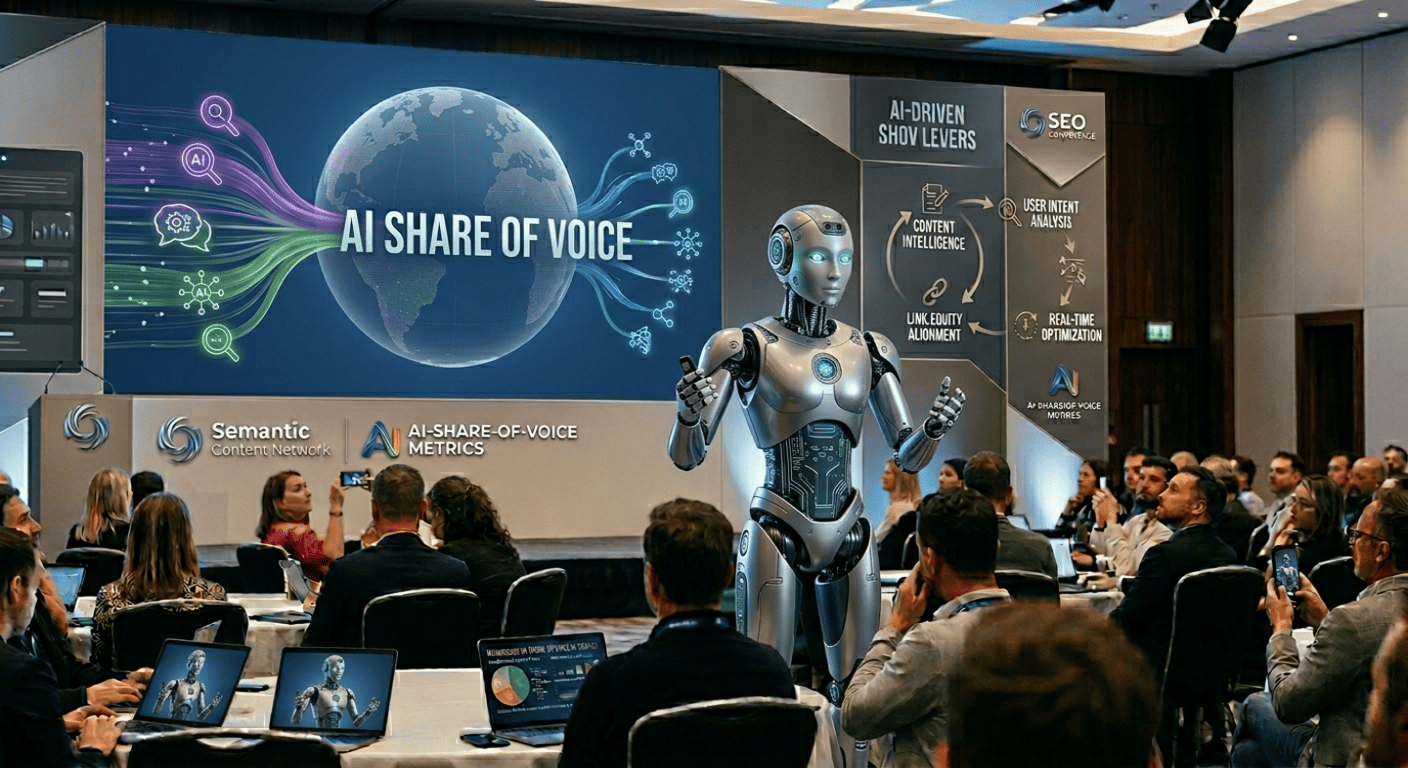
The digital marketing landscape has officially shifted from the “blue links” era to an era of synthesis. In 2026, user discovery doesn’t just happen on traditional SERPs; it thrives within the conversational interfaces of ChatGPT, Gemini, Perplexity, Claude, and Google’s AI Overviews.
With zero-click searches dominating the web, ranking position #1 is no longer the ultimate victory. The real win? Becoming the definitive answer synthesized by Large Language Models (LLMs). This seismic shift introduces a critical performance metric for modern brands: AI Share of Voice (AI SoV).
If your brand isn’t being pulled into the LLM context window during a user’s research phase, you are practically invisible. Let’s break down how AI systems calculate your brand’s presence and how you can optimize your digital footprint to dominate AI-driven discovery.
What Is AI Share of Voice?
AI Share of Voice (AI SoV) is a metric that measures the frequency, prominence, and sentiment of a brand’s mentions within AI-generated responses compared to its direct competitors.
Unlike traditional Share of Voice, which calculates ad spend or organic click-through rates (CTR), AI SoV analyzes Retrieval-Augmented Generation (RAG) outputs. It determines how often an AI engine pulls your brand entity from the web to fulfill a natural language query.
Why AI Share of Voice Is Different From Traditional SEO
Traditional SEO is inherently transactional, focusing on algorithms like PageRank, keywords, and backlink volume to drive traffic to a specific URL. AI Share of Voice, however, is Entity-Centric.
Key differences include:
| Optimization Layer | Traditional SEO | AI Share of Voice (GEO/AEO) |
| Core Target | Search Engine Crawlers (Googlebot) | LLMs & Vector Databases |
| Primary Metric | Keyword Rankings, Organic Traffic, CTR | Mention Rate, Citation Frequency, Sentiment |
| Ranking Unit | Individual URLs & Meta Tags | Brand Entities & Knowledge Graph Nodes |
| Content Goal | Skimmable Answers & High CTR | Information Gain & Fact-Based Authority |
A site can easily rank in the top 3 on Google for a high-volume keyword but get completely bypassed by Gemini if the model deems its content lacks unique data or trusted entity associations.
Why AI Share of Voice Matters in 2026
The growth of AI-powered search experiences has fundamentally changed how users discover information online. Instead of clicking through multiple search results, many users now rely on AI-generated summaries to find answers, compare brands, and make purchasing decisions. As a result, being visible within AI responses has become just as valuable as achieving top rankings in traditional search engines. Businesses with a strong AI Share of Voice are more likely to build trust, increase brand awareness, and influence customer decisions throughout the buying journey.
The Rise of AI Search Platforms
AI-powered discovery is rapidly becoming a mainstream method of finding information. Modern users frequently interact with AI assistants and search experiences that deliver direct answers rather than lists of links, creating new opportunities for brands to gain visibility.
Major AI search platforms include:
- ChatGPT
- Gemini
- Claude
- Perplexity
- Google AI Overviews
- SearchGPT
These platforms play an increasingly important role in how consumers research products, services, software solutions, and brands before making decisions.
Key Metrics Used to Measure AI Share of Voice
To audit your brand’s footprint across platforms like ChatGPT or Perplexity, you must track these four KPIs:
Mention Rate
The percentage of test prompts within a specific niche where your brand is explicitly named. If a user asks ChatGPT for the “best enterprise CRM for remote teams,” how many times out of 100 iterations does your product appear?
Key insights provided by Mention Rate:
- Measures overall brand visibility across AI platforms.
- Identifies topics where a brand is frequently recognized.
- Helps compare visibility against competitors.
- Reveals opportunities to improve topical authority and AI presence.
Brand Positioning
AI models list recommendations based on confidence intervals. Being the first recommended entity in a bulleted list carries higher authority than being buried in a paragraph. Simultaneously, the model’s sentiment (e.g., recommending a brand with caution vs. highly praising it) heavily impacts user conversion.
Factors influencing Brand Positioning include:
- Topical expertise and authority.
- Content quality and relevance.
- Brand trust signals.
- Entity recognition strength.
- Consistent industry presence.
Comparative Share
This benchmarks your LLM visibility directly against your top three market competitors, highlighting topical gaps where your competition is preferred by AI engines.
Benefits of tracking Comparative Share:
- Identifies market leaders in AI visibility.
- Highlights gaps between competitors.
- Supports competitive benchmarking.
- Measures the effectiveness of AI optimization efforts.
AI Citation Frequency
Platforms like Perplexity and Google AI Overviews rely on inline citations. Tracking how often your content acts as the foundational source or anchor text for an AI answer is crucial for measuring your factual authority.
Why AI Citation Frequency Matters:
- Indicates content trust and reliability.
- Strengthens brand authority signals.
- Improves visibility within AI-generated answers.
- Helps establish expertise in a specific niche.
What Influences AI Share of Voice?
AI systems do not randomly choose which brands to mention. Instead, they evaluate a wide range of signals that help determine relevance, authority, and credibility. Understanding these factors is essential for businesses seeking to improve their AI visibility and increase their Share of Voice across AI-powered search platforms.
Topical Authority
Topical Authority refers to how comprehensively a brand covers a particular subject area. Brands that consistently publish high-quality content across an entire topic ecosystem are more likely to be recognized as trusted sources by AI systems.
Why Topical Authority matters:
- Demonstrates subject matter expertise.
- Improves brand recognition within AI models.
- Increases visibility across related queries.
- Supports long-term AI search performance.
Entity Recognition
Entity Recognition helps AI systems identify and understand specific brands, people, products, organizations, and concepts. Strong entities are easier for AI models to connect with relevant topics, increasing the likelihood of mentions and recommendations.
Benefits of strong Entity Recognition:
- Improves brand discoverability.
- Strengthens semantic relevance.
- Enhances knowledge graph associations.
- Supports better AI visibility.
Brand Mentions Across the Web
Consistent mentions on authoritative websites provide important trust signals that influence how AI systems evaluate a brand. The more frequently a brand is referenced by credible sources, the stronger its authority becomes.
Key advantages of external brand mentions:
- Improve brand credibility.
- Increase digital authority signals.
- Strengthen entity relationships.
- Support AI recommendation potential.
Content Freshness
AI systems often favor content that reflects current information and recent developments. Regularly updating content helps maintain relevance and improves the likelihood of being referenced in AI-generated answers.
Why content freshness matters:
- Provides updated information.
- Improves content relevance.
- Supports AI trust signals.
- Enhances user experience.
Knowledge Graph Signals
Knowledge graphs help AI systems understand relationships between entities, topics, and organizations. Brands with strong knowledge graph associations often achieve greater visibility because AI models can more easily verify their relevance and authority.
Benefits of strong Knowledge Graph signals:
- Improve entity understanding.
- Strengthen contextual relevance.
- Increase AI confidence in brand information.
- Support broader AI search visibility.
How AI Models Decide Which Brands to Mention
Modern AI systems do not simply retrieve information from a single website or database. Instead, they synthesize information from multiple trusted sources, evaluate entity relationships, and determine which brands are most relevant to a user’s query. The decision-making process relies on a combination of authority, relevance, trust, and contextual understanding.
Core Signals AI Systems Evaluate
When deciding which brands to mention, AI models analyze several important factors that influence visibility and recommendation potential.
Key signals include:
- Relevance to the user’s question.
- Depth of topical coverage.
- Authority within a specific niche.
- Entity relationships and recognition.
- Trustworthiness of sources.
- Consistency of brand mentions.
- Content quality and accuracy.
- Knowledge graph connections.
- User intent alignment.
- Overall digital reputation.
Brands that consistently perform well across these areas are more likely to achieve a higher AI Share of Voice, gain more AI-generated mentions, and strengthen their visibility across platforms such as ChatGPT, Gemini, Claude, Perplexity, and Google AI Overviews.
How AI Models Decide Which Brands to Mention
Modern AI systems such as ChatGPT, Gemini, Claude, and Perplexity do not simply retrieve information from a single webpage. Instead, they analyze vast amounts of data, evaluate entity relationships, assess source credibility, and identify the most relevant information to answer a user’s query. When generating responses, AI models prioritize brands that consistently demonstrate expertise, authority, trustworthiness, and topical relevance. This is why some brands appear repeatedly in AI-generated answers while others remain virtually invisible despite having strong traditional SEO performance.
Core Ranking Signals Used by AI Systems
AI models rely on multiple signals to determine whether a brand deserves visibility within AI-generated responses. These factors help AI systems assess relevance, credibility, and overall usefulness for users.
Key ranking signals include:
- Relevance to User Intent – How closely the content matches the user’s question or search objective.
- Contextual Authority – The depth of expertise demonstrated across a topic or industry.
- Entity Relationships – Connections between brands, products, people, and concepts within the knowledge ecosystem.
- Brand Trust Signals – Reputation, reviews, citations, and recognition from authoritative sources.
- Content Quality – Accuracy, originality, comprehensiveness, and usefulness of information.
- Citation Consistency – Consistent references across trusted websites and publications.
- Topical Depth – The ability to cover an entire subject area rather than isolated topics.
- Knowledge Graph Associations – Verified relationships that help AI systems understand brand identity.
- Freshness Signals – Updated and relevant content that reflects current information.
- Source Reliability – Trustworthy sources that provide verifiable and credible information.
These signals collectively influence whether a brand is mentioned, recommended, or cited within AI-generated responses.
How to Improve AI Share of Voice
Increasing AI Share of Voice (AI SoV) requires more than traditional SEO optimization. Brands must establish themselves as trusted entities while building authority across multiple channels. A long-term strategy focused on expertise, credibility, and content quality can significantly improve AI visibility.
Create Original Research and Data
AI systems often prioritize unique information because it provides additional value and differentiates content from generic resources. Original studies, surveys, industry reports, and proprietary data can increase the likelihood of citations and mentions.
Benefits include:
- Increased authority and trust.
- Higher citation potential.
- Stronger competitive differentiation.
- Improved visibility across AI platforms.
Build Strong Topical Authority
Topical authority is one of the strongest signals AI systems use when evaluating expertise. Brands that comprehensively cover a subject area are more likely to be viewed as reliable sources.
Advantages of topical authority:
- Improved brand recognition.
- Greater visibility across related topics.
- Increased trustworthiness.
- Better AI recommendation potential.
Strengthen Entity SEO
Entity SEO helps AI systems understand exactly who a brand is, what it does, and how it relates to other entities. Strong entity signals improve discoverability across search engines and AI platforms.
Key entity optimization strategies:
- Consistent brand information.
- Structured data implementation.
- Knowledge graph optimization.
- Accurate entity associations.
Earn High-Quality Brand Mentions
External mentions from authoritative publications, industry websites, and trusted sources strengthen credibility and reinforce authority signals.
Why brand mentions matter:
- Improve digital reputation.
- Increase trust signals.
- Strengthen entity recognition.
- Support AI visibility growth.
Optimize for AI Overviews
Google AI Overviews increasingly influence how users consume information. Content designed for direct answers, clarity, and expertise is more likely to be included.
Best practices include:
- Answer questions directly.
- Use clear content structures.
- Demonstrate expertise.
- Maintain content accuracy.
AI Share of Voice Across Different AI Platforms
Not all AI systems evaluate content in the same way. Each platform uses unique methods to assess relevance, authority, and trustworthiness. Understanding these differences can help brands tailor their optimization strategies.
ChatGPT Visibility
ChatGPT tends to prioritize authoritative information, strong topical coverage, and widely recognized entities. Brands with established expertise and extensive content ecosystems often achieve greater visibility.
Important factors include:
- Topical authority.
- Entity recognition.
- Content quality.
- Brand credibility.
Gemini Visibility
Gemini relies heavily on Google’s understanding of entities, knowledge graphs, and trusted web sources. Strong search visibility and entity optimization can positively influence brand presence.
Key visibility factors:
- Knowledge graph presence.
- Trusted web citations.
- Entity relationships.
- Semantic relevance.
Perplexity Visibility
Perplexity frequently references sources directly within its responses. As a result, content credibility and source authority play an especially important role.
Factors affecting visibility:
- Source quality.
- Citation authority.
- Research-backed content.
- Information accuracy.
Claude Visibility
Claude places significant emphasis on contextual understanding and content quality. Brands that provide comprehensive, balanced, and trustworthy information are more likely to appear.
Important signals include:
- Contextual relevance.
- Information depth.
- Source trustworthiness.
- User value.
Common Mistakes That Reduce AI Visibility
Many organizations struggle to improve AI Share of Voice because they focus solely on traditional SEO metrics while overlooking the factors that influence AI systems.
Weak Topical Coverage
Publishing only a few articles around a topic often limits authority signals and reduces visibility opportunities.
Common consequences:
- Reduced expertise perception.
- Lower AI mentions.
- Limited search visibility.
Poor Entity Optimization
When brand information is inconsistent across websites and platforms, AI systems may struggle to understand the entity accurately.
Potential issues include:
- Weak entity recognition.
- Inconsistent brand associations.
- Reduced AI trust signals.
Thin Content
Low-value content rarely earns citations, backlinks, or AI recommendations because it lacks depth and usefulness.
Problems caused by thin content:
- Poor user engagement.
- Reduced authority.
- Lower citation potential.
Outdated Information
AI systems increasingly prioritize fresh and accurate information when generating responses.
Risks of outdated content:
- Reduced credibility.
- Lower relevance scores.
- Missed visibility opportunities.
Lack of Brand Authority
Brands with limited external recognition often struggle to compete against established industry leaders.
Common challenges include:
- Weak trust signals.
- Limited citations.
- Reduced AI recommendations.
The Future of AI Share of Voice
AI Share of Voice is rapidly becoming one of the most important performance indicators in digital marketing. As AI-powered search continues to expand, businesses will increasingly measure success through AI mentions, citations, recommendations, and conversational visibility rather than relying solely on rankings and traffic.
What Brands Should Expect
The future of search will be heavily influenced by AI-generated answers and conversational experiences. Brands that invest in authority building, entity optimization, original research, and AI visibility strategies today will be better positioned to dominate tomorrow’s search landscape.
Future trends include:
- Greater importance of entity-based SEO.
- Increased reliance on AI-generated recommendations.
- More emphasis on brand authority signals.
- Growth of AI citation tracking tools.
- AI Share of Voice is becoming a standard marketing KPI.
AI Share of Voice Success Factors at a Glance
| AI Visibility Factor | Why It Matters | Impact on AI Share of Voice |
| Topical Authority | Demonstrates expertise across a subject | High |
| Entity SEO | Improves brand recognition by AI systems | High |
| Brand Mentions | Strengthens trust and authority signals | High |
| Content Quality | Helps AI identify valuable information | High |
| Knowledge Graph Presence | Supports entity relationships | Medium to High |
| Citation Consistency | Builds credibility across sources | High |
| Content Freshness | Maintains relevance and accuracy | Medium |
| Original Research | Increases citation opportunities | High |
| AI Overview Optimization | Improves visibility in AI-generated answers | Medium to High |
| Digital Authority | Enhances trustworthiness and recognition | High |
Final Verdict: Why AI Share of Voice Matters in 2026
In 2026, organic traffic is shifting into conversational assistance. Measuring your success solely through traditional analytics tools will leave you blind to how customers actually discover products today. By shifting your focus toward AI Share of Voice, building an ironclad entity graph, and prioritizing topical authority, you ensure that when an AI model is asked for an industry recommendation, your brand is the only logical answer.
Frequently Asked Questions About AI Share of Voice
What Is AI Share of Voice and Why Is It Important?
AI Share of Voice (AI SoV) measures how often a brand is mentioned, cited, or recommended by AI-powered platforms such as ChatGPT, Gemini, Claude, and Perplexity. It has become increasingly important because more users now rely on AI-generated answers instead of traditional search results. A higher AI Share of Voice can improve brand awareness, credibility, and customer trust while increasing visibility across emerging AI search experiences.
How Can Businesses Improve Their AI Share of Voice?
Improving AI Share of Voice requires a combination of high-quality content, strong topical authority, and effective entity optimization. Brands that consistently publish expert content, earn mentions from trusted sources, and build a strong digital presence are more likely to be recognized by AI systems. Regular content updates and authoritative brand signals can also significantly improve AI visibility over time.
Does AI Share of Voice Affect SEO Performance?
While AI Share of Voice is different from traditional SEO metrics, the two are closely connected. Brands with strong topical authority, quality content, and trusted entity signals often perform better in both search engines and AI-powered platforms. Improving AI visibility can strengthen brand recognition, increase citations, and support long-term organic growth across multiple digital channels.
Which AI Platforms Influence AI Share of Voice the Most?
Several AI platforms contribute to a brand’s AI Share of Voice, including ChatGPT, Gemini, Claude, Perplexity, and Google AI Overviews. Each platform uses different methods to evaluate content and authority, but they all prioritize relevance, credibility, and expertise. Businesses that optimize for multiple AI ecosystems can achieve broader visibility and a stronger competitive advantage.
What Is the Future of AI Share of Voice?
AI Share of Voice is expected to become a standard digital marketing KPI as AI-powered search continues to grow. Future success will depend on a brand’s ability to build authority, strengthen entity recognition, and create content that AI systems trust and reference. Organizations that invest early in AI visibility strategies are likely to gain a significant advantage as conversational search and AI-generated recommendations become more common.