



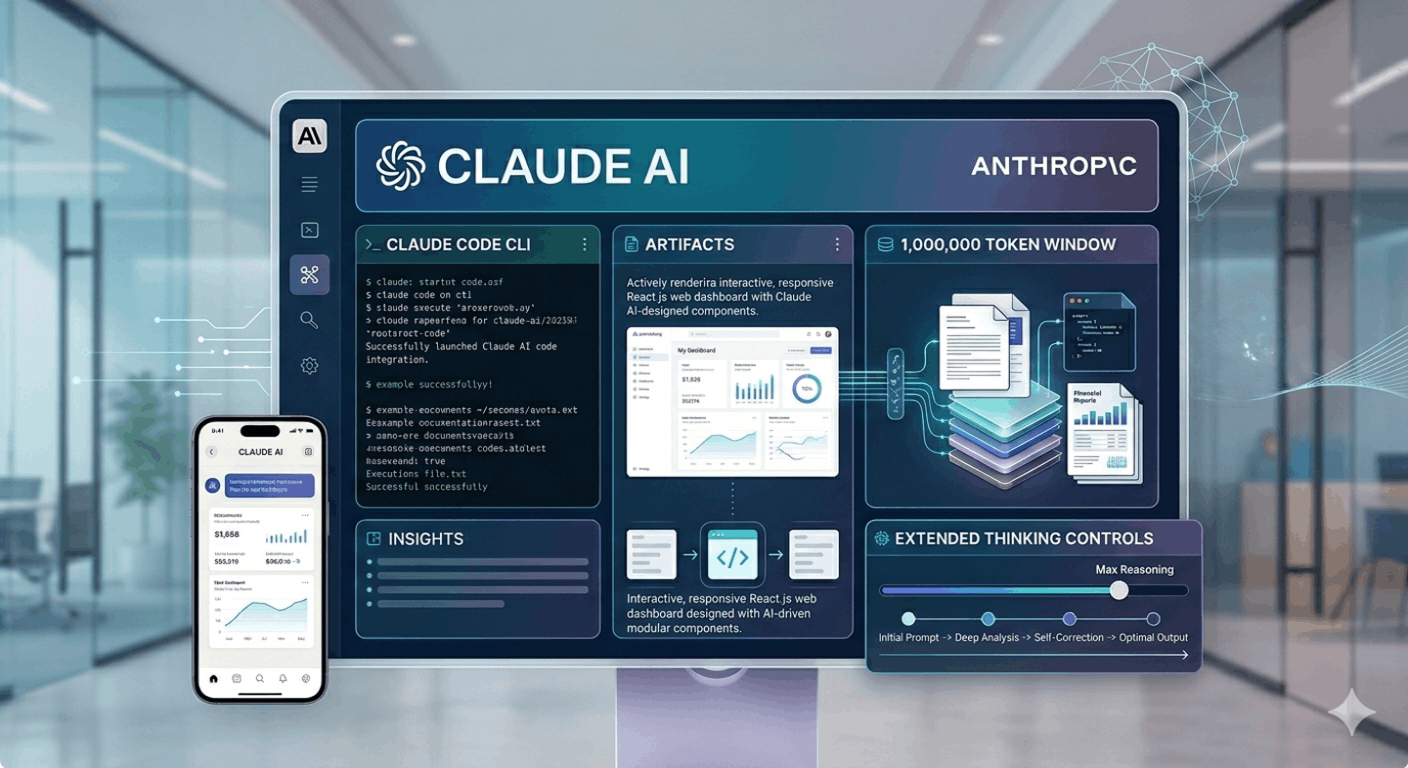
Claude AI is a generative AI assistant developed by Anthropic. It can generate text, analyze documents, write and review code, answer questions, and assist with highly complex reasoning tasks through natural language interactions. While many AI assistants offer similar core capabilities, Claude AI is globally recognized for its massive million-token context windows, specialized workspace environments, cutting-edge hybrid reasoning, and industry-leading developer tooling. Understanding how Claude AI works, which models are available, and where it differs from other AI platforms can help users determine whether it is suitable for their personal, professional, or development workflows.
The Claude 4, Fable 5 & Hybrid Reasoning Model Family
To understand Claude AI’s current power, you must look at its latest generations—specifically the Claude 4 lineup and the newly announced Mythos-class architecture. Anthropic’s ecosystem focuses on Hybrid Reasoning, allowing users to toggle or scale how deeply a model thinks before responding.
- Claude Fable 5: Launched on June 9, 2026, as Anthropic’s premier frontier model under the Mythos architecture class. It represents a massive leap in long-horizon autonomy, end-to-end knowledge work, and advanced system delegation, capable of handling complex tasks that take humans days or weeks to execute.
- Claude Mythos 5: Released alongside Fable 5 in limited availability through Project Glasswing. It shares identical core capabilities but operates without standard safety classifiers for enterprise-specific custom integrations.
- Claude Opus 4.8: The enterprise flagship workhorse for heavy-duty engineering. It introduces an advanced Effort Control layer, enabling the model to dynamically scale its Adaptive Thinking to troubleshoot, self-correct, and solve intricate multi-file codebases.
- Claude Sonnet 4.6: The production sweet spot for day-to-day operations. It delivers top-tier coding, advanced visual intelligence, and reliable browser-level automation.
- Claude Haiku 4.5: Anthropic’s fastest, ultra-low-latency model optimized for high-volume API automation.
Anthropic Claude Models: Full Comparison Matrix (2026)
| Model Tier & Version | Primary Use Case & Specialization | Context Window | Target Audience |
| Claude Fable 5 | Long-horizon autonomy, multi-step parallel subagents | 1,000,000 Tokens | Enterprise Teams & AI Researchers |
| Claude Opus 4.8 | Heavy Reasoning, Deep Logic, Repository-scale Engineering | 1,000,000 Tokens | Data Scientists, Engineers & Analysts |
| Claude Sonnet 4.6 | Multi-file Coding, Visual Analysis, UI Automation | 200,000 Tokens (1M Beta) | Software Developers & Content Agencies |
| Claude Haiku 4.5 | High-speed data parsing, light coding, fast automation | 200,000 Tokens | High-volume API Integrations & Apps |
How Claude AI Processes Massive Datasets
Most generic AI articles focus purely on surface-level context lengths. The practical benefit of Claude’s modern architecture is its native capability to process up to a 1,000,000-token context window on frontier models like Claude Fable 5 and Claude Opus 4.8.
Context Compaction & Information Integrity
To prevent information degradation over long, multi-turn interactions, Anthropic utilizes an underlying optimization framework called Context Compaction. When a user uploads entire code repositories, massive compliance legal briefs, or years of corporate financial histories, Claude maintains near-perfect recall (the “Needle in a Haystack” metric) across extended chat loops without dropping minor contextual details.
What Are Claude AI Artifacts?
Artifacts represent a major shift in user interface design for generative AI, splitting the standard chat interface into a dual-panel workspace.
When Claude generates complex code scripts, dynamic text documents, web pages, interactive data visualizations, or SVG diagrams, the output is rendered in a dedicated workspace panel next to the chat window.
Example Workflow: If you ask Claude to design a frontend interactive dashboard, the Artifacts window displays the live, functional application interface. You can test buttons, view UI alignments, and request specific modifications instantly without scrolling through endless code blocks.
Claude AI Projects & Memory Architecture
Projects allow Pro, Team, and Enterprise users to organize separate chats, instructions, and extensive documentation under unified corporate workspaces. Instead of continuously copying and pasting foundational files or system background metrics into every new prompt, Projects preserve a persistent knowledge base.
Within a customized Project, users can feed specialized knowledge files (style guides, brand tone protocols, internal library documentation) and set overriding Custom Instructions. This feature is heavily integrated with Claude’s native Memory Tool, which securely learns distinct structural preferences over time to optimize ongoing research, continuous software development sprints, and content operations.
Claude AI for Next-Gen Software Development
Claude AI has become the premier choice for professional engineering teams due to its structural consistency across massive multi-file modifications. Beyond general chat, developers utilize Claude Code, an agentic command-line interface (CLI) tool powered directly by the Claude architecture.
The Claude Code CLI
Beyond web interfaces, developers rely heavily on Claude Code, an agentic command-line interface (CLI) tool powered directly by the Claude model family.
- File Tree Exploration: Securely browses and maps local code repositories.
- Autonomous Patching: Writes and applies multi-layered code patches.
- Terminal Execution: Runs local test suites, detects compiler errors, and self-corrects bugs autonomously before proposing a final Git commit.
On industry benchmarks like SWE-bench, this agentic capability enables Claude to resolve complex, production-grade codebase errors with minimal human oversight.
Advanced API & Developer Capabilities
Anthropic provides enterprise-grade API control layers that enable fluid system integration for modern business automations:
- Adaptive Thinking Effort Controls: Developers can programmatically adjust the reasoning budget via the
effortparameter (e.g., setting it tomaxorxhigh). This forces the model to allocate more computational steps to double-check its logic on highly complex edge cases, or scale it down to optimize for processing speed. - Computer Use Functionality: An agentic API layer where Claude visually interprets an operating system interface. It can track cursor coordinates, click buttons, drag assets, and type commands to automate legacy desktop workflows.
- Advanced Prompt Caching: Reduces overall API latency and slashes token processing overhead by up to 90% by securely caching static system instructions and repetitive reference documentation blocks between consecutive API calls.
Claude AI vs ChatGPT
The choice between Claude and ChatGPT depends on operational priorities and system architecture needs:
| Feature / Capability | Claude AI (Anthropic) | ChatGPT (OpenAI) |
| Best Suited For | High-context codebase analysis, complex multi-step reasoning, and structural writing. | Real-time web browsing, multimodal media creation, and casual voice tasks. |
| Workspace UI | Native Artifacts panel for live code rendering, document editing, and visual iterations. | Inline code boxes with standard markdown outputs. |
| Programming | Agentic terminal executions via Claude Code CLI; superior multi-file logic tracking. | Exceptional single-script generation and fast script troubleshooting. |
| Content Generation | Nuanced, human-first writing style that avoids generic AI tropes and satisfies EEAT. | Highly structured, fast, but occasionally formulaic text outputs. |
| Multimodal Inputs | Advanced vision processing for technical blueprints, dense charts, and UI mockups. | Native graphic synthesis via DALL-E 3 alongside advanced voice modes. |
Limitations of Claude AI
Despite its advanced logical capabilities, users should remain aware of key architectural limitations:
- No Native Image Generation: Claude lacks a graphic synthesis engine like DALL-E 3 or Midjourney; its multimodal focus is strictly analytical (processing incoming images, blueprints, and documents).
- Dependent Web Browsing: Natively, Claude focuses on deep processing of internal or uploaded datasets. Real-time news indexing and live web queries require specific enterprise platform integrations or client extensions.
- Potential Hallucinations: Like all Large Language Models (LLMs), Claude can occasionally generate inaccurate data or misinterpret ambiguous prompts. High-stakes financial, medical, or legal outputs should always be human-verified.
Overall Experience & Pricing Tiers
Claude AI provides a premium, production-ready environment tailored for professionals who require analytical precision over simple chat responses.
Anthropic offers three core structural tiers to access this ecosystem:
- Claude Free / Pro: Access via web interface and mobile applications, with the Pro tier ($20/month) offering higher rate limits, priority access to Fable 5 and Opus 4.8, and full Project workspaces.
- Claude Team: Designed for organizations requiring shared Project environments, higher usage capacity, and centralized user management.
- Anthropic Console (API): A pay-as-you-go developer platform featuring Prompt Caching, Effort Controls, and complete integration access for external software builds.
Final Thoughts
In 2026, Claude AI has officially moved beyond the boundaries of a standard conversational chatbot, establishing itself as an enterprise-grade execution engine. The deployment of the Claude 3.7 architecture alongside advanced Extended Thinking frameworks proves that Anthropic is prioritizing deep, multi-step logical precision over surface-level speed. Whether you are a content writer utilizing persistent Project workspaces, an operations manager leveraging Artifacts for real-time visual collaboration, or a software engineer deploying autonomous scripts directly via the Claude Code CLI, Claude AI offers an unmatched, logically consistent ecosystem. For workflows where multi-file context tracking, architectural clarity, and precise reasoning are paramount, Claude remains the premier choice in the global generative AI market.
Claude AI Frequently Asked Questions (2026 SEO Schema)
What is the latest version of Claude AI available in 2026?
As of June 2026, the latest and most powerful tier in Anthropic’s ecosystem is Claude Fable 5, built on the cutting-edge Mythos-class architecture for long-horizon autonomous tasks. Alongside it, the active enterprise flagship is Claude Opus 4.8, which launched in late May 2026, featuring advanced hybrid reasoning capabilities. For standard, day-to-day production workloads, developers utilize the balanced Claude Sonnet 4.6, while high-volume automation runs on the ultra-fast Claude Haiku 4.5 API model.
What makes Claude Fable 5 different from previous Opus models?
Claude Fable 5 represents a major step-change in AI capabilities by introducing highly stable, asynchronous multi-step execution. Unlike older model iterations that require constant human oversight, Fable 5 can independently run complex software engineering migrations or data workflows across huge enterprise codebases for extended periods. It also features a default 1-million-token context window and sophisticated vision intelligence designed to analyze multi-layered charts, UI dashboards, and dense technical figures.
How do the new Adaptive Thinking Effort Controls work in Claude AI?
Introduced alongside recent model updates, Effort Controls allow users to manually or programmatically adjust the exact computational reasoning budget allocated to a prompt. By toggling these settings up to ‘xhigh’ or ‘max’, you force models like Claude Opus 4.8 and Fable 5 to think deeper, reflect on logic, and actively double-check their outputs before replying. Conversely, choosing a lower effort tier scales back tokens, maximizing response speed and preserving user rate limits for simpler tasks.
What is Claude Code, and how do software engineers use it?
Claude Code is a viral, agentic command-line interface (CLI) tool that allows developers to run the Claude architecture directly inside their local terminal setups. It goes far beyond standard chatbot interfaces by granting the AI secure permission to browse local file trees, run test suites, and deploy multi-file code patches automatically. With the inclusion of dynamic workflows in mid-2026, engineering teams now use it to manage massive, codebase-scale system migrations with minimal oversight.
How large is the context window for Claude AI models in 2026?
Top-tier models, specifically Claude Fable 5 and Claude Opus 4.8, now feature a massive 1,000,000-token context window available by default across major API platforms. This immense memory capacity allows users to process thousands of pages of financial reports, complete legal histories, or entire multi-service codebases in a single prompt session. Furthermore, backend optimization via Context Compaction ensures that information doesn’t degrade or lose accuracy during exceptionally long chat loops.
Can Claude AI generate images or browse the live web natively?
Claude AI does not feature a native visual graphic generation engine like OpenAI’s DALL-E 3, focusing instead on processing input vision data like UI screenshots and dense document charts. While it requires specialized connection modules or specific platform extensions for live web index fetching, its core strength lies in processing massive internal datasets. For deep text generation, human-like copy editing, and heavy logical analysis, it consistently matches or outperforms competing web-connected frameworks.
What are Claude AI Projects, and how do they utilize the Memory Tool?
Projects allow subscription users to build centralized, persistent workspaces for distinct research tasks, coding sprints, or content creation workflows. By uploading specialized knowledge files, style guides, or technical parameters into a Project, you eliminate the need to repeatedly copy-paste foundational background data into new chats. This environment works directly with Claude’s native Memory Tool, which safely logs structural preferences over multiple chat sessions to optimize ongoing operations.
Is Claude AI better than ChatGPT for programming and writing tasks?
The preference between the two platforms depends entirely on your specific workflow requirements and system deployment needs. Claude dominates in multi-file coding architecture tracking, highly autonomous terminal tasks, and maintains an organic, human-like prose style across long content pieces. ChatGPT wins when your priority centers around real-time search engine coverage, native image creation, and interactive, low-latency vocal conversations using advanced voice modes.