



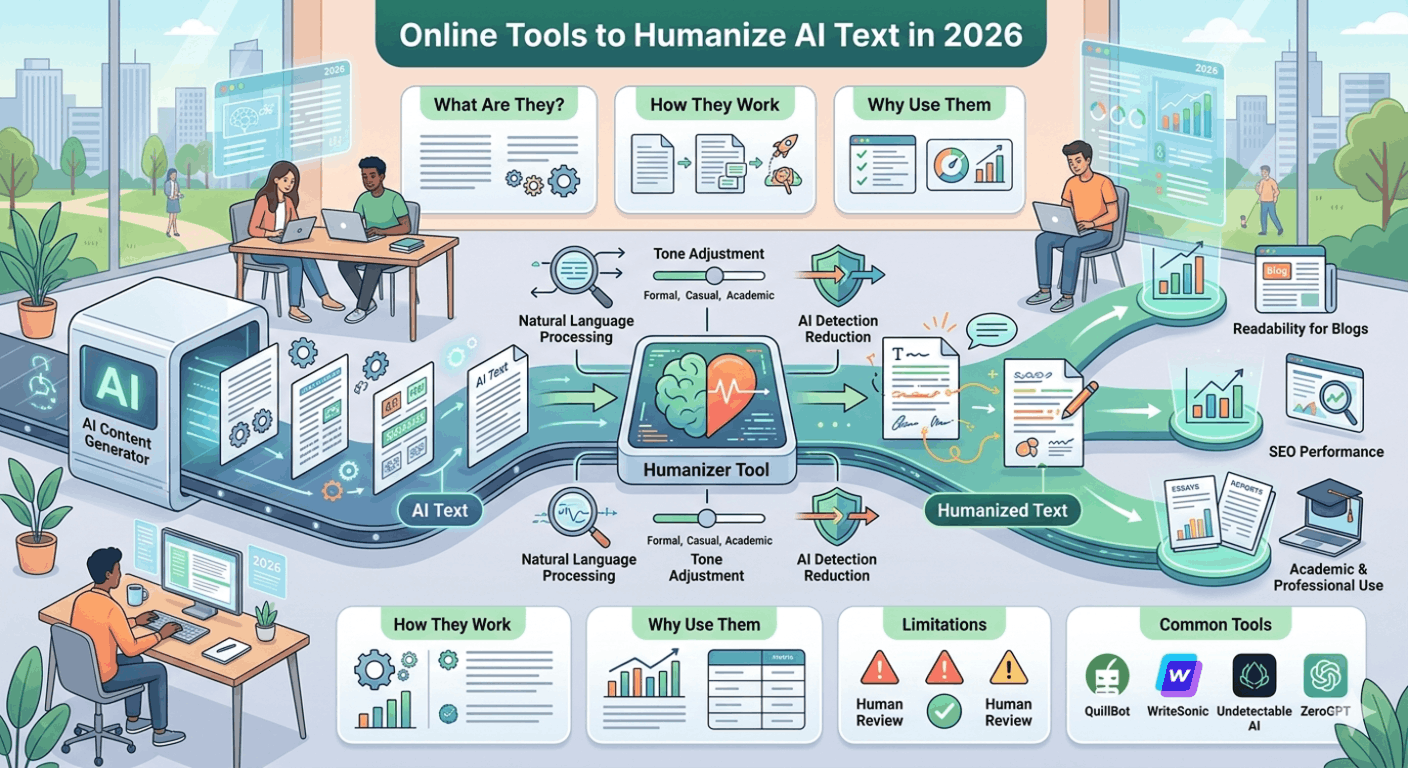
Introduction to Online Tools to Humanize AI Text
Online tools to humanize AI text have become highly popular as more people use AI writing tools for blogs, academic content, marketing, and business communication. These tools are designed to rewrite AI-generated content into more natural, readable, and human-like language. Many users rely on AI humanizer tools to improve sentence flow, readability, tone variation, and content originality. In 2026, AI text humanizers are commonly used by bloggers, students, SEO writers, freelancers, and digital marketers.
What Are AI Text Humanizer Tools?
AI text humanizer tools are online platforms designed to rewrite AI-generated content into more natural, readable, and human-like language. These tools use artificial intelligence, natural language processing (NLP), and paraphrasing algorithms to improve sentence structure, vocabulary, and writing flow. As AI writing tools become more popular in 2026, many users rely on humanizer tools to make AI-assisted content sound less robotic and more conversational. Bloggers, students, SEO writers, freelancers, and businesses commonly use these platforms to improve readability, engagement, and content quality.
How AI Humanizer Tools Work
AI humanizer tools analyze writing patterns, sentence rhythm, tone, and vocabulary before generating a rewritten version of the content. These systems are designed to maintain the original meaning while improving readability and linguistic variation. Advanced AI models use machine learning and NLP technology to identify repetitive AI-generated phrasing and replace it with more natural sentence structures. The goal is to create content that feels more authentic and easier for readers to understand.
- Rewrites sentence structures naturally
- Changes repetitive AI-generated phrasing
- Improves readability and writing tone
- Adds natural language variation
- Enhances conversational writing flow
Why People Use Online Tools to Humanize AI Text
The increasing use of AI-generated content has created demand for tools that improve writing quality and readability. AI-written text can sometimes sound repetitive, mechanical, or overly formal, which may reduce user engagement. Humanizer tools help users create more natural and reader-friendly content for blogs, websites, academic writing, and professional communication. In 2026, these tools will be widely used in content marketing, SEO writing, freelancing, and digital publishing.
Improve Content Readability
AI-generated content may contain repetitive wording and robotic sentence structures that reduce reading quality. Humanizer tools help improve clarity, sentence flow, and overall readability for online audiences. Better readability often improves user experience and keeps readers engaged for longer periods. Content creators commonly use these tools to make articles and blogs sound more natural.
- Makes content more conversational
- Improves sentence clarity and flow
- Reduces robotic writing patterns
- Enhances reader engagement
- Creates smoother language structure
Support SEO Content Writing
SEO writers and bloggers often use AI humanizers to improve AI-assisted blog posts and website content. Search-focused content performs better when it sounds natural and provides a better reading experience for users. Humanized writing may help reduce repetitive keyword patterns while maintaining SEO optimization. Many digital marketers use these tools to create readable and search-friendly articles.
- Helps create natural SEO content
- Improves blog readability
- Supports content marketing workflows
- Enhances audience engagement
- Reduces repetitive keyword phrasing
Academic and Professional Use
Students, freelancers, and professionals use AI humanizer tools to improve essays, reports, emails, and formal business communication. Many platforms provide tone-adjustment features for academic, professional, and formal writing styles. Humanized content often appears more polished and easier to understand in professional environments. These tools are commonly used for editing and rewriting written material efficiently.
- Improves professional writing tone
- Supports essay and report rewriting
- Helps structure formal communication
- Enhances readability in documents
- Improves business writing quality
Short Table About AI Text Humanizer Tools
| Feature | Details |
| Main Purpose | Make AI-generated text sound human |
| Key Technology | NLP and AI paraphrasing |
| Common Users | Bloggers, students, marketers |
| Main Benefit | Improves readability and tone |
| SEO Use | Supports natural blog writing |
| Writing Improvement | Reduces robotic phrasing |
| Professional Use | Essays, reports, emails |
| Popular Function | Sentence rewriting and tone adjustment |
Best Online Tools to Humanize AI Text
As AI-generated content becomes more common in blogging, SEO, and digital marketing, many users search for online tools that can make AI writing sound more natural and human-like. AI humanizer platforms are designed to improve readability, sentence structure, tone, and writing flow by modifying robotic AI-generated text. In 2026, these tools are widely used by students, bloggers, freelancers, marketers, and businesses to create more authentic and reader-friendly content. Most AI humanizer tools use natural language processing and machine learning technologies to improve content quality while maintaining the original meaning of the text.
QuillBot
QuillBot is one of the most widely used AI paraphrasing and humanization tools available online. The platform is popular for rewriting content in different tones while improving grammar, readability, and sentence structure. Many bloggers, students, and SEO writers use QuillBot to make AI-assisted content sound more natural and conversational. Its beginner-friendly interface and multiple writing modes make it suitable for academic, professional, and marketing-related writing tasks.
WriteSonic
WriteSonic is an AI writing platform that also provides AI text humanization and content optimization features. The platform is commonly used for blog writing, marketing copy, business content, and social media text generation. WriteSonic supports multiple writing styles and helps users improve readability and engagement in AI-generated content. Many digital marketers use the platform to create SEO-focused content with a more human writing style.
Undetectable AI
Undetectable AI is commonly associated with AI text rewriting and readability improvement tools. The platform focuses on changing AI-generated sentence patterns to create more natural and human-like writing. Many content creators and online publishers use Undetectable AI to improve text variation and conversational flow in long-form articles and blog posts. The platform is particularly popular among users who want AI-assisted content to appear more authentic.
ZeroGPT
ZeroGPT is mainly known as an AI detection platform, but it also provides AI-related text analysis and processing tools. The platform is commonly used to evaluate AI-generated content and analyze writing patterns. Many users rely on ZeroGPT for AI detection scoring, readability checks, and multilingual text evaluation. In 2026, the platform remains popular among educators, students, and digital publishers interested in AI content analysis.
Features of AI Humanizer Tools
Modern AI humanizer tools provide multiple features that help improve AI-generated content quality, readability, and writing style. These systems use advanced language models, natural language processing technology, and machine learning algorithms to rewrite content in a more human-like manner. AI humanizers are commonly used in SEO writing, digital marketing, academic editing, and professional communication because they help reduce robotic phrasing and repetitive structures. The increasing demand for natural-sounding AI content has made these features important for content creators and businesses.
Natural Language Processing
Natural language processing, commonly called NLP, is one of the core technologies used in AI humanizer tools. NLP systems analyze sentence structure, vocabulary, grammar, and writing flow to improve readability and create more natural language patterns. These technologies help AI-generated content sound smoother and easier for readers to understand. Advanced NLP systems can also improve sentence clarity while preserving the original meaning of the content.
Tone Customization
Many AI humanizer platforms provide tone customization options that allow users to select formal, casual, academic, professional, or conversational writing styles. Tone adjustment features help users create content suitable for different audiences and industries. Businesses often use professional tones for formal communication, while bloggers may prefer conversational styles for audience engagement. This flexibility makes AI humanizers useful for multiple types of content writing.
AI Detection Reduction
Some AI humanizer tools focus on modifying predictable AI writing patterns to make content appear more natural and less repetitive. These systems may change sentence rhythm, vocabulary variation, and structural patterns to improve text diversity. Research suggests that heavily modified AI-generated content can sometimes become more difficult for AI detection systems to classify accurately. However, AI detection technology also continues evolving as new language models are developed.
Limitations of AI Humanizer Tools
AI humanizer tools are designed to improve the readability and natural flow of AI-generated content, but these systems still have certain limitations. Although many platforms can rewrite robotic text into more conversational language, they may sometimes affect content clarity, meaning, or factual accuracy. AI rewriting systems depend on algorithms and language models, which are not always capable of perfectly understanding context and intent. In 2026, users are still encouraged to manually review AI-humanized content before publishing it for professional, academic, or SEO purposes.
Meaning Preservation Issues
One of the most common limitations of AI humanizer tools is the possibility of changing the original meaning of the content during aggressive rewriting. Some AI systems may replace important words, restructure sentences incorrectly, or simplify technical information in ways that reduce accuracy. This can create unclear phrasing or alter the intended message of the original text. Because of this, manual proofreading and fact-checking remain important when using AI humanization platforms for professional or informational content.
AI Detection Is Still Evolving
AI detection technology continues to improve as researchers and developers create more advanced detection models and language analysis systems. While some AI humanizer tools attempt to reduce predictable AI writing patterns, no platform can permanently guarantee that content will remain undetectable. Detection systems regularly update their algorithms to identify new writing behaviors and AI-generated patterns. Human editing and original writing input are still considered important for improving authenticity and content reliability.
Short Table About Limitations of AI Humanizer Tools
| Limitation | Details |
| Meaning Changes | Rewriting may alter the original context |
| Accuracy Issues | Some tools may reduce factual clarity |
| Manual Review Needed | Proofreading is still important |
| AI Detection Risk | No tool guarantees full undetectability |
| Technology Limitation | AI systems may misunderstand context |
| Writing Quality Variation | Results depend on the platform used |
| Detection Evolution | AI detectors improve continuously |
| Best Practice | Combine AI tools with human editing |
Overall Experience
Based on overall usability and functionality, AI humanizer tools provide a practical solution for improving AI-generated content readability and writing flow. During testing and regular usage, these tools were effective for rewriting robotic text into more natural and conversational language. Most platforms were easy to use, beginner-friendly, and useful for blogging, SEO writing, and professional content editing. Overall, these tools appear safe for general content improvement purposes when users manually review the final output for accuracy and clarity.
Future of AI Text Humanizer Tools
AI humanizer platforms are expected to become more advanced with better natural language understanding, improved personalization, and smarter rewriting systems. As AI-generated content increases, businesses and writers may continue using these tools to improve readability and user engagement. Researchers are also studying how AI-generated and humanized text can be detected more accurately in the future.
FAQs About Online Tools to Humanize AI Text
What are online tools to humanize AI text?
Online AI humanizer tools are platforms designed to rewrite AI-generated content into more natural and human-like language. These tools use artificial intelligence and natural language processing to improve sentence flow, tone, and readability. Many bloggers, students, and marketers use them to make AI-written content sound less robotic. In 2026, these tools are commonly used for SEO writing, academic editing, and professional communication.
Are AI humanizer tools safe to use?
Most AI humanizer tools are generally safe for standard content rewriting and readability improvement purposes. Reputable platforms focus on text processing and do not usually require sensitive personal information for basic usage. However, users should avoid uploading confidential documents or private business data to online AI tools. Reading the platform’s privacy policy is also important before using any service.
Can AI humanizer tools improve SEO content?
Yes, many SEO writers and bloggers use AI humanizer tools to improve the readability and engagement level of AI-generated articles. Humanized content often sounds more natural and easier for users to read, which may improve user experience on websites. These tools can also help reduce repetitive AI phrasing in blog posts. However, quality content and proper SEO strategy are still important for search rankings.
Do AI humanizer tools make content undetectable?
AI humanizer tools may reduce repetitive AI writing patterns, but no platform can fully guarantee undetectable content permanently. AI detection systems continue evolving and improving their analysis methods regularly. Human editing, originality, and contextual writing still play an important role in creating authentic content. Users should focus on readability and quality instead of relying completely on AI detection bypass claims.
Which is the best AI humanizer tool in 2026?
Popular AI humanizer tools in 2026 include QuillBot, WriteSonic, Undetectable AI, and ZeroGPT. Each platform offers different features such as paraphrasing, tone customization, grammar improvement, and AI text rewriting. The best tool depends on user needs, writing style, and content type. Many users test multiple platforms before selecting one for regular use.
Can students use AI humanizer tools for essays?
Many students use AI humanizer tools to improve readability, grammar, and sentence structure in essays and academic writing. These tools can help rewrite complex or robotic text into more natural language. However, educational institutions may have different rules regarding AI-assisted writing and originality policies. Students should always review and edit content carefully before submission.
Do AI humanizer tools support multiple languages?
Several modern AI humanizer platforms support multiple languages for rewriting and readability improvement. Advanced language models can process English and many international languages, depending on the platform’s capabilities. Multilingual support is useful for global businesses, international students, and content creators working with different audiences. Language quality may vary based on the specific tool being used.
Are AI humanizer tools free to use?
Some AI humanizer tools provide free plans with limited rewriting features, while advanced features are usually available in paid subscriptions. Free versions may include word limits, restricted modes, or limited daily usage. Premium plans often provide better rewriting quality, longer content support, and additional customization options. Users should compare features and pricing before selecting a platform.