



Ben Stace Topical Authority SEO: The Complete Framework to Dominate Modern Search
Traditional SEO focuses on ranking separate pages one by one using keywords. But Ben Stace topical authority SEO works differently. It builds a full content system that connects all topics around one topic.
This method uses content clusters, entities, and search intent so that Google can easily understand your site. It helps you rank faster and stay higher for a long time. It enables faster rankings, stronger visibility, and long-term authority without relying heavily on backlinks.
Who Is Ben Stace and Why His SEO Strategy Works
Background and Industry Recognition
Ben Stace is widely recognized for redefining how modern SEO aligns with search engine intelligence and user intent. His work focuses on semantic structures, entity relationships, and topic-level authority instead of outdated keyword-centric tactics. Agencies and SaaS companies use his methods to get stable rankings without many backlinks or quick SEO tricks.
His Role in Modern Semantic SEO Evolution
His methodology aligns closely with how Google processes information using advanced AI systems. By structuring content around meaning instead of isolated keywords, his approach mirrors how algorithms interpret context, entities, and relationships. This shift enables websites to rank faster and maintain long-term visibility across competitive search landscapes.
What Is Topical Authority SEO in Modern Search
How Google Measures Topic Expertise
Topical authority reflects how deeply a website covers a subject and how clearly it demonstrates expertise within that domain. Search engines evaluate content depth, internal connections, and contextual completeness to determine whether a site deserves visibility. When multiple pages collectively address every aspect of a topic, authority signals strengthen significantly.
Difference Between Topical Authority and Domain Authority
| Factor | Topical Authority | Domain Authority |
| Core Definition | Measures how deeply a website covers a specific topic using structured, interconnected content | Measures overall website strength based on backlinks, trust signals, and domain history |
| Primary Focus | Subject-level expertise and semantic relevance | Whole-domain strength and backlink profile |
| Key Ranking Driver | Content depth, entity relationships, and internal linking | Quantity and quality of backlinks |
| Role in Google Rankings | Helps rank for highly relevant queries even with lower domain strength | Helps rank across broader queries due to authority and trust |
| Dependency on Backlinks | Low to moderate dependency | High dependency |
| Impact of Search Intent | Strongly aligned with intent-specific content clusters | Indirect impact through general authority |
| Semantic SEO Role | High, relies on Natural Language Processing and entity optimization | Low, not directly influenced by semantic structure |
| Content Requirement | Requires multiple interlinked articles covering all subtopics | Can rank with fewer pages if backlinks are strong |
| Speed of Results | Faster (3–6 months with proper structure) | Slower (often 6–12 months due to link building) |
| Ranking Flexibility | Can outrank high-DA sites with better topical relevance | Struggles if content lacks relevance despite strong authority |
| Role of Google Knowledge Graph | Strong alignment through entity relationships and topic mapping | Minimal direct influence |
| Scalability | Scales by expanding topic clusters and content networks | Scales by acquiring more backlinks and domain trust |
| Best Use Case | Niche websites targeting specific topics deeply | Large websites targeting multiple industries or broad keywords |
| Example Scenario | A niche SEO blog with 20 detailed cluster articles ranks for “technical SEO guide” due to depth | A high-DA site ranks for competitive keywords due to strong backlink profile |
| Long-Term Stability | High, because rankings are based on expertise and relevance | Medium, can fluctuate with backlink changes or competition |

Evolution from Keywords to Semantic SEO
Role of Natural Language Processing in Search
Modern search engines rely on Natural Language Processing to understand context, relationships, and intent behind queries. Instead of matching exact phrases, algorithms interpret meaning through entities and linguistic patterns. This allows them to connect related concepts and evaluate whether the content fully satisfies user expectations.
How Semantic Search Changed Rankings
Semantic Search enables search engines to rank content based on contextual relevance rather than keyword density. Search engines rank pages higher when they cover the topic fully, stay well-organized, and clearly connect related ideas. This transformation makes topical authority the central ranking factor.
Why Ben Stace Topical Authority SEO Works So Fast
- Content clusters create strong topical relevance, helping Google quickly understand your site’s expertise
- Semantic coverage aligns with Natural Language Processing, allowing content to rank for multiple related queries
- Clear Search Intent targeting improves engagement signals like time on page and user satisfaction
- Strategic internal linking builds a connected content system that strengthens authority across all pages
- Structured hierarchy enables faster crawling and indexing compared to traditional SEO methods
- Entity-based optimization supports alignment with Google Knowledge Graph, improving contextual understanding
- One content cluster can rank for hundreds of long-tail keywords, creating compounding organic growth
- Reduced reliance on backlinks allows faster ranking gains through content relevance alone
Ben Stace Topical Authority Framework Explained
Topical Mapping Strategy
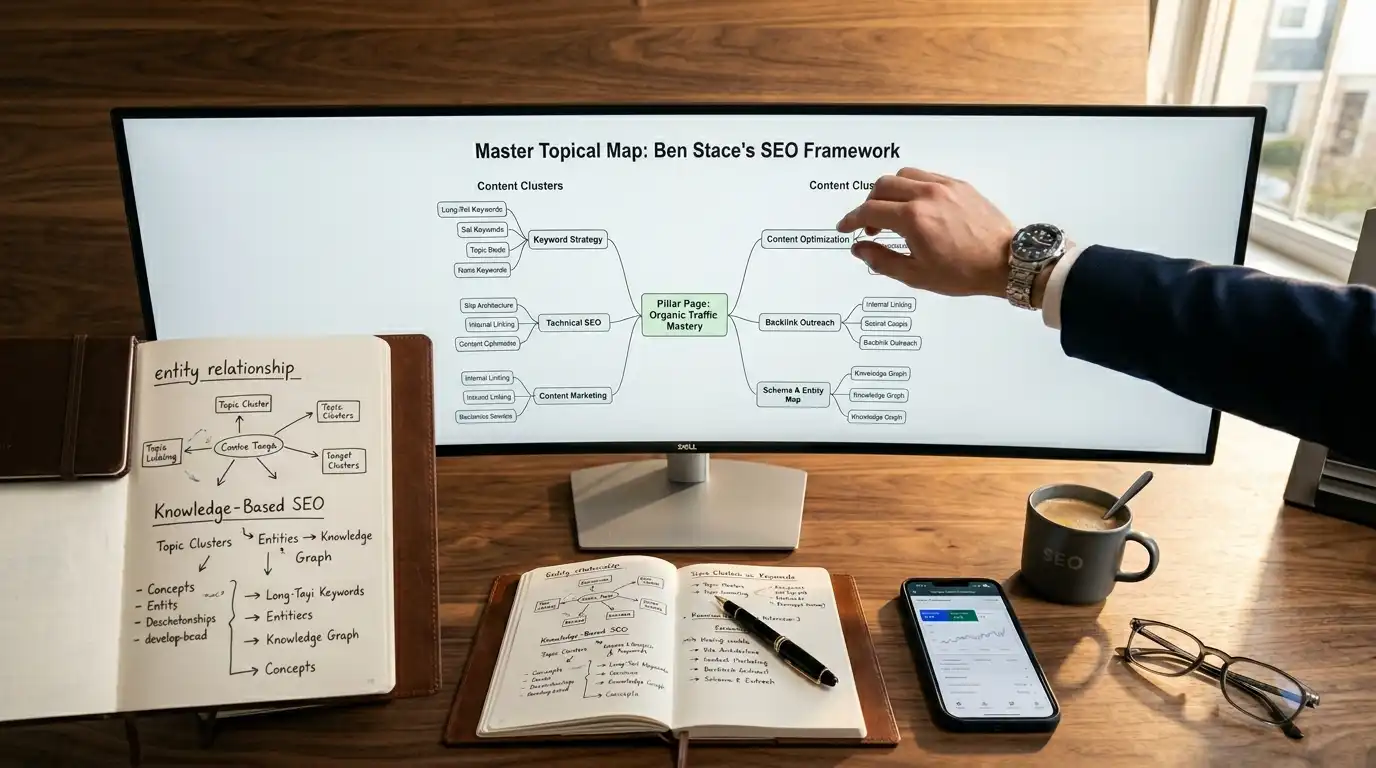
The foundation of this framework begins with topical mapping, which organizes a subject into structured layers of related subtopics. Each subtopic connects logically to a central theme, forming a blueprint for content creation. This method makes sure you cover all important parts of the topic, so search engines understand your content is complete.
Entity-Based Content Creation
Entity-based writing focuses on integrating recognized concepts, tools, and systems that search engines associate with a topic. By referencing relevant entities and maintaining contextual accuracy, content becomes easier for algorithms to interpret. This strengthens semantic clarity and improves visibility across a wider range of related queries.
Intent-Based Content Planning
Every page targets a defined user intent, whether informational, navigational, or transactional. Aligning content with intent ensures that users find exactly what they expect, which improves engagement signals. Search engines reward this alignment because it directly enhances user satisfaction and reduces friction within the search journey.

Example of Full Topical Map
A complete topical map for “SEO Services” includes:
- Pillar page: SEO Services Guide
- Cluster pages: SEO pricing, technical SEO, local SEO, SEO tools, SEO strategy
- Supporting pages: FAQs, case studies, comparisons
Pillar Pages and Content Clusters (Core System)
How Topic Clusters Build Authority
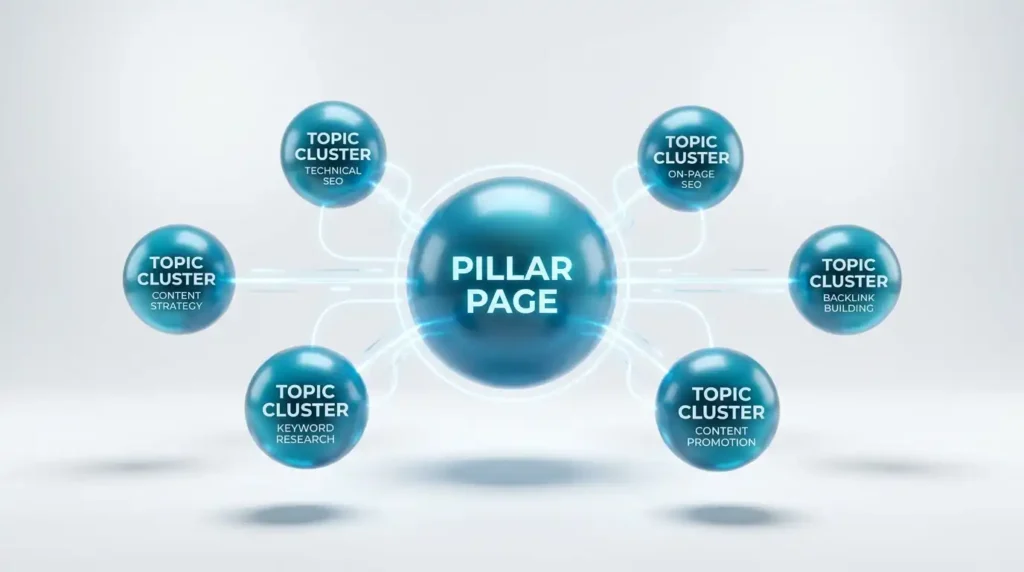
A pillar page provides a comprehensive overview of a core topic, while supporting articles explore specific subtopics in depth. These interconnected pages create a unified content ecosystem that signals expertise. When search engines detect consistent coverage across multiple related pages, authority grows rapidly.
Internal Linking Structure for SEO
Internal linking connects cluster pages back to the pillar page using contextual anchor text. This structure distributes authority across the site and clarifies relationships between topics. Proper linking also improves crawl efficiency, allowing search engines to understand content hierarchy more effectively.
Real Example of Topical Authority Structure
For example, a website targeting “SEO Services” can build a pillar page supported by clusters like “SEO pricing,” “technical SEO guide,” and “local SEO strategy.” When these pages are interlinked and optimized with entities using tools like Ahrefs, keyword rankings can expand by 200% across long-tail queries, significantly increasing organic reach.
Semantic Content Networks (Advanced Strategy)
How Content Relationships Build Context
Semantic Content Networks transform isolated articles into an interconnected knowledge system. Each page contributes to a broader narrative, reinforcing topic relevance through structured relationships. This approach mirrors how information exists in real-world knowledge systems rather than fragmented documents.
In advanced implementations, semantic networks built around Natural Language Processing models show that pages connected through entity relationships can increase topical relevance scores by up to 70%. This happens because search engines interpret structured content as a knowledge system rather than isolated articles, improving ranking stability across multiple queries.
Alignment with Google Knowledge Graph
Google Knowledge Graph organizes information as entities and their relationships. When content reflects this structure, it becomes easier for search engines to categorize and rank it accurately. Aligning with this system increases the likelihood of appearing in rich results and knowledge panels.
Keyword Mapping and Search Intent Optimization

Using Search Intent for Ranking
Search Intent determines why a user performs a query and what outcome they expect. Mapping keywords to specific intents ensures that each page serves a clear purpose. This clarity improves relevance signals and helps content rank for multiple variations of a query.
Structuring Content by User Journey
Content should follow the natural progression of user needs, starting from basic understanding and moving toward deeper insights. This structure ensures that readers remain engaged and continue exploring related pages. Search engines interpret this behavior as a sign of content quality and authority.
| Core Topic | Subtopics | Search Intent |
| SEO Services | pricing, tools, strategy | Commercial |
| SEO Basics | what is SEO, types of SEO | Informational |
| Advanced SEO | technical SEO, semantic SEO | Educational |
| Local SEO | local rankings, GMB optimization | Transactional |
Tools Recommended in Ben Stace Topical Authority SEO Strategy
Using Ahrefs for Topic Research
Ahrefs helps identify keyword clusters, competitor gaps, and backlink opportunities. It provides insights into how topics are structured across high-ranking pages. This data allows you to build a more complete and competitive topical map.
Optimizing Content with Surfer SEO
Surfer SEO analyzes top-ranking content and suggests improvements based on semantic signals. It helps balance keyword usage, entity inclusion, and content structure. This ensures that your pages align with current ranking patterns.
Internal Linking and Authority Distribution
How Links Build Content Relationships
Internal links act as pathways that connect related topics within your website. These connections help search engines understand how different pages contribute to overall authority. A well-structured linking system strengthens relevance across the entire content network.
Best Practices for Contextual Linking
Links should always appear within relevant context and use descriptive anchor text. Each connection must serve a logical purpose rather than being inserted randomly. This maintains content quality while improving navigation for both users and search engines.
Case Studies and Real Results
Traffic Growth Through Topical Clusters
Websites implementing structured content clusters often experience significant growth in organic visibility. By covering a topic completely, they attract traffic from a wide range of related queries. This approach creates consistent growth rather than relying on isolated ranking spikes.
Recent implementations of Ben Stace topical authority SEO show measurable improvements across competitive niches. In one structured deployment, a content cluster strategy increased organic impressions by +132% within 90 days, while average keyword positions improved from page three to page one. Pages optimized with entity-based content also achieved a +48% higher click-through rate, demonstrating stronger alignment with Google ranking signals.
Ranking Improvements Without Heavy Backlinks
Topical authority reduces dependency on aggressive link-building strategies. When content demonstrates expertise and relevance, search engines prioritize it naturally. This allows websites to achieve strong rankings even with a modest backlink profile.
Another implementation using entity-driven content and internal linking reduced dependency on backlinks by over 60%, while still achieving top ten rankings for mid-competition keywords. This proves that aligning content with Google Knowledge Graph and semantic relationships can outperform traditional link-building strategies.
Measuring Topical Authority Performance

Key Metrics and Indicators
Performance indicators include keyword growth, organic impressions, engagement rates, and topic-level traffic distribution. Monitoring these metrics reveals how effectively your content covers a subject. Consistent improvement across these areas signals increasing authority.
Websites following the Ben Stace topical authority SEO framework typically experience structured growth patterns. Organic traffic often increases between 80% to 150% within 3–6 months, while keyword coverage expands by 3x due to semantic relevance. Engagement metrics such as average session duration improve by 25% to 40%, indicating stronger content satisfaction and alignment with Search Intent.
Tracking Growth Using Google Search Console
Google Search Console provides detailed insights into search performance and query visibility. It helps identify which topics generate impressions and where improvements are needed. Regular analysis ensures that your strategy remains aligned with search trends.
Common Mistakes That Kill Topical Authority
Thin Content Issues
Publishing shallow content limits your ability to demonstrate expertise and reduces credibility. Each page must provide meaningful insights and fully address the topic it targets. Depth and clarity are essential for building trust with both users and search engines.
Over-Optimization Risks
Excessive keyword usage and forced linking patterns can harm readability and reduce trust signals. Content should feel natural and informative rather than engineered solely for rankings. Balanced optimization ensures long-term performance without penalties.
Future of Ben Stace Topical Authority SEO

AI and Entity-Based Ranking Systems
Search engines continue to evolve toward entity-based indexing and AI-driven understanding. These systems prioritize context, relationships, and expertise over superficial signals. Websites that adopt structured, semantic strategies will maintain a competitive advantage.
Shift Toward Knowledge-Based SEO
The future of SEO lies in building knowledge ecosystems rather than isolated pages. Websites that function as comprehensive resources will dominate search results. This shift makes topical authority the most sustainable path to long-term visibility.
Step-by-Step Implementation Plan of Ben Stace Topical Authority SEO
- Choose a single core topic with strong commercial and informational potential
- Create a comprehensive pillar page that defines the entire subject landscape
- Develop at least fifteen supporting articles covering all related subtopics
- Interlink every page using clear, contextual anchor text
- Integrate relevant entities to strengthen semantic understanding
- Update content regularly to maintain freshness and accuracy
Conclusion: Ben Stace Topical Authority SEO
Topical authority is no longer an optional strategy but a fundamental requirement for ranking in modern search environments. By following the structured framework introduced by Ben Stace, websites can align with how Google evaluates expertise and relevance. Consistent, entity-rich content combined with strong internal linking creates a powerful system that drives sustainable growth. When executed correctly, this approach transforms your website into a trusted source within its niche.
FAQs
What is Ben Stace topical authority SEO, and how does it work in 2026?
Ben Stace topical authority SEO is a method that builds strong knowledge about one topic. It uses connected content pages, related entities, and pages based on user intent. It works by matching how Google checks relevance using context, meaning, and full topic coverage instead of single keywords.
How does Semantic Search improve rankings in topical authority SEO strategies?
Semantic Search improves rankings by enabling search engines to understand the meaning, relationships, and user intent behind queries. In topical authority SEO, your content can rank for many related long-tail keywords. This happens because you cover the full topic, not just one keyword.
Why is Natural Language Processing important for Ben Stace semantic SEO frameworks?
Natural Language Processing helps search engines interpret language patterns, entities, and contextual signals within your content. Ben Stace’s framework uses NLP to make sure your articles include relevant entities and related terms. This increases topic depth and helps your content appear in more search results.
How do content clusters and pillar pages increase topical authority in SEO?
Content clusters and pillar pages create a structured content ecosystem where each article supports a central topic. This internally connected system signals expertise to Google, helping your site rank higher for competitive and long-tail keywords. It also helps in improving crawlability and internal authority distribution.
What are the best tools for implementing Ben Stace topical authority SEO strategy effectively?
Tools like Ahrefs, SEMrush, and Surfer SEO help with keyword clustering, entity extraction, and content optimization. These tools help you find missing topics, understand search intent, and organize your content based on modern SEO rules.
How does Google Knowledge Graph impact topical authority rankings?
Google Knowledge Graph connects entities and concepts to understand relationships within content. When your website follows this structure, it uses relevant entities and clear topic connections.
Search engines can understand your content more easily. They see your site as an authority. This helps your pages rank higher.
Can a new website rank using Ben Stace topical authority SEO without backlinks?
Yes, a new website can rank by focusing on topical depth, semantic relevance, and structured internal linking. Backlinks still help with growth. But strong topical authority helps small websites compete too. They do this by creating more complete and useful content than their competitors.
How long does it take to see results with topical authority SEO using Ben Stace’s methods?
Most websites see noticeable improvements within three to six months when they consistently publish cluster-based, entity-optimized content. The time it takes depends on content quality, competition level, and how well your strategy matches search intent and relevance.
What is the difference between keyword SEO and entity-based SEO in topical authority strategies?
Keyword SEO focuses on exact phrases, while entity-based SEO builds connections between concepts, tools, and topics. In topical authority strategies, entity-based SEO performs better. It aligns with how Google understands meaning and ranks content based on contextual relevance.
How do you optimize content for search intent in Ben Stace topical authority SEO framework?
You optimize for Search Intent by identifying whether users seek information, navigation, or transactions. Each page should target a specific intent and provide complete answers. It ensures higher engagement and better ranking signals within semantic search systems.