



Are AEO and GEO Different Things?
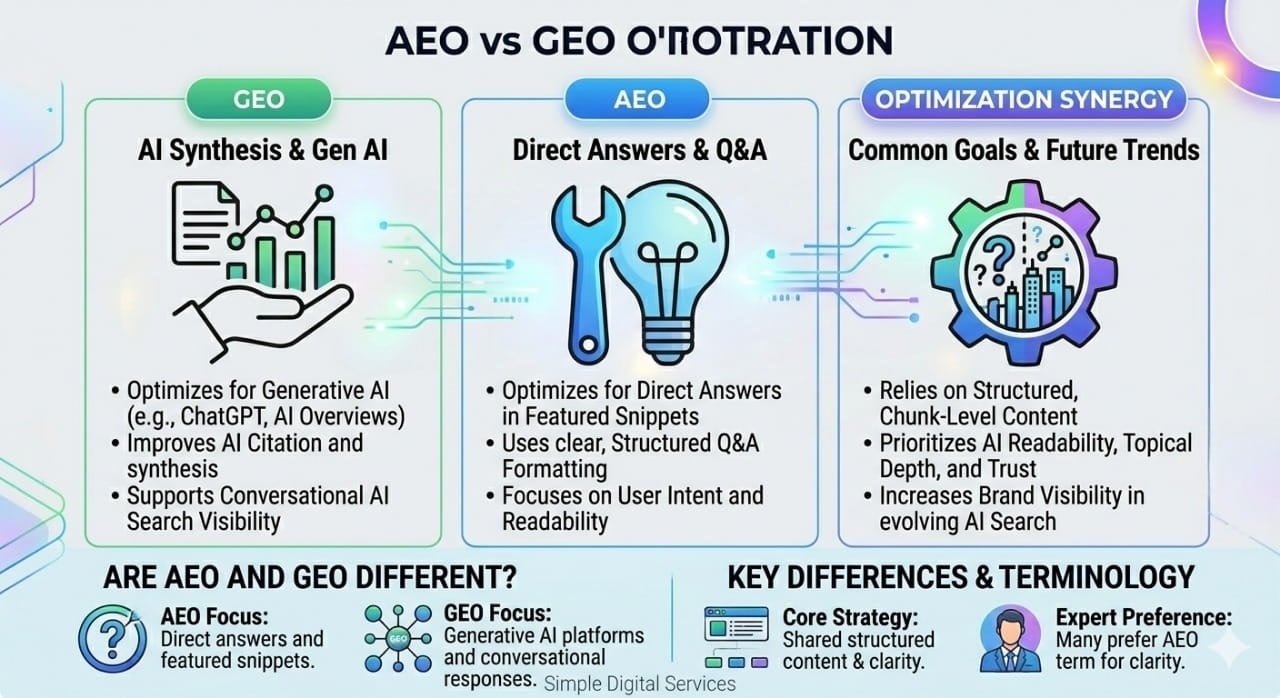
AEO (Answer Engine Optimization) and GEO (Generative Engine Optimization) are closely related AI search optimization strategies. Both focus on improving how content appears in AI-generated answers, search summaries, and conversational search platforms. AEO mainly focuses on direct answers, while GEO focuses on optimizing content for generative AI systems like ChatGPT and Google AI Overviews. In practical use, both strategies work toward the same goal: helping AI systems understand, extract, and present content more effectively.
What is AEO?
AEO (Answer Engine Optimization) is the process of optimizing content so it appears as direct answers in AI search systems, featured snippets, and answer boxes. It focuses on creating structured, question-based, and easy-to-understand content that AI engines can quickly retrieve and display. AEO became more important when search engines started providing direct answers instead of only showing webpage links. The strategy mainly improves content visibility, user engagement, and AI search performance through clear formatting and concise responses.
Key Features of AEO
AEO focuses on making content easy for AI systems and search engines to understand. It improves the chances of appearing in answer boxes and AI-generated summaries.
Points:
- Optimizes content for direct answers
- Uses clear and structured formatting
- Focuses on user intent and readability
What is GEO?
GEO (Generative Engine Optimization) is a modern optimization strategy designed for generative AI systems like ChatGPT, Google AI Overviews, and Bing Copilot. It focuses on helping AI models understand, synthesize, and reference website content in generated responses. GEO mainly improves how AI systems process and cite information across conversational search platforms. The strategy supports better AI visibility and answer generation in modern search environments.
Key Features of GEO
GEO helps businesses optimize content for AI-generated search experiences and conversational responses. It focuses on AI readability and citation-friendly content structure.
Points:
- Optimizes content for generative AI systems
- Improves AI citation and synthesis
- Supports conversational AI search visibility
Are AEO and GEO the Same?
AEO and GEO are very similar because both focus on optimizing content for AI-driven search systems and answer engines. Their main purpose is improving how content appears in AI-generated answers rather than only improving traditional search rankings. The difference between them is mostly based on terminology and platform focus. In practical digital marketing use, both strategies involve structured content, AI readability, and authoritative information.
Main Differences Between AEO and GEO
AEO focuses more on direct answers, while GEO focuses more on generative AI systems and AI-generated responses. However, both strategies use many of the same optimization methods.
Points:
- AEO focuses on answer-based search results
- GEO focuses on generative AI platforms
- Both improve AI search visibility and content extraction
Common Similarities Between AEO and GEO
Both AEO and GEO rely on structured content and question-based formatting to improve AI understanding. They also focus on authority, readability, and clear information hierarchy.
Points:
- Use structured and organized content
- Focus on AI readability and trust
- Improve visibility in AI-generated answers
Why Many Experts Prefer AEO
Many SEO professionals and digital marketers prefer the term AEO because it clearly explains the purpose of optimizing content for answer-based search systems. The phrase “Answer Engine Optimization” directly relates to providing accurate answers in AI search platforms and featured snippets. In comparison, the term GEO can create confusion because it is already linked with geography, geolocation, and geo-targeting concepts. Due to its clarity and direct meaning, AEO is considered more understandable and practical for AI search optimization.
Reasons Experts Prefer AEO
AEO is easier to recognize and better describes the actual goal of AI-focused optimization. It is also more closely connected to modern answer-based search experiences.
Points:
- Clear and easy-to-understand terminology
- Directly connected to answer-based search
- Less confusion compared to GEO terminology
Common Confusion Around GEO
The term GEO is widely used in multiple industries outside digital marketing. This makes it less unique and sometimes confusing for businesses and marketers.
| GEO Meaning | Industry |
| Geography | Education |
| Geolocation | Technology |
| Geo-targeting | Digital Advertising |
| Geological Terms | Science |
AEO vs GEO Comparison
AEO and GEO share many similarities because both focus on AI-driven search visibility and content optimization. However, they differ slightly in terminology and platform focus. AEO mainly focuses on direct answers, while GEO focuses on generative AI systems and AI-generated responses.
AEO vs GEO Short Comparison
| Feature | AEO | GEO |
| Full Form | Answer Engine Optimization | Generative Engine Optimization |
| Main Focus | Direct answers | AI-generated responses |
| Target Platforms | Search engines & AI answers | Generative AI systems |
| Content Goal | Clear answer extraction | AI synthesis and citations |
| Core Strategy | Structured answers | AI-readable content |
| Overall Purpose | Improve AI visibility | Improve AI visibility |
Main Difference Between AEO and GEO
The primary difference between AEO and GEO is the wording and platform emphasis rather than the actual optimization process. Both strategies use structured content, AI readability, and authority-focused optimization to improve visibility in AI search systems.
Points:
- AEO focuses more on answer engines
- GEO focuses more on generative AI tools
- Both support AI-driven search optimization
How AI Search Changed SEO
Traditional SEO mainly focused on improving webpage rankings through keywords, backlinks, technical SEO, and page authority. Search engines previously displayed lists of websites, and users had to visit pages to find answers. AI-powered search has changed this process by providing direct answers, summaries, and AI-generated responses instantly. This shift means businesses now need to optimize content not only for rankings but also for AI retrieval, answer extraction, and conversational search visibility.
Traditional SEO Focus
Traditional SEO strategies focused mainly on improving website visibility in search engine result pages through technical and content optimization.
| Traditional SEO Elements | Purpose |
| Keywords | Improve search relevance |
| Backlinks | Increase authority |
| Technical SEO | Improve indexing and performance |
| Page Authority | Strengthen rankings |
AEO Optimization Tactics
AEO optimization focuses on making content easier for AI systems to understand, extract, and display in answer-based search results. Modern AI search engines prioritize structured, clear, and authoritative information. Businesses now need AI-friendly formatting and highly readable content to improve visibility in AI-generated responses.
Optimize for Chunk-Level Retrieval
AI systems often divide webpages into smaller sections called “chunks” and retrieve only the most relevant parts instead of entire pages. Well-structured content improves the chances of AI systems selecting those sections.
| Best Practices | Purpose |
| Focused sections | Improve AI understanding |
| Clear headings | Better content organization |
| Concise answers | Faster answer extraction |
| Logical structure | Easier AI retrieval |
Optimize for Answer Synthesis
AI search systems combine information from multiple trusted sources to generate responses. Content should therefore be easy to merge with other authoritative information.
| Best Practices | Purpose |
| Simple sentence structure | Improve readability |
| Fact-based explanations | Increase trust |
| Clear formatting | Better AI extraction |
| Direct responses | Faster answer generation |
Optimize for Citation-Worthiness
AI systems prefer citing trustworthy, updated, and well-structured content. High-quality information increases the chance of appearing in AI-generated responses and answer boxes.
| Important Factors | Benefit |
| Accuracy | Improves trust |
| Credibility | Increases authority |
| Content depth | Better topic coverage |
| Expert information | Higher reliability |
| Fresh updates | Improved relevance |
Optimize for Topical Depth and Breadth
AI systems often break complex searches into multiple related subtopics. Websites that cover topics comprehensively have stronger AI visibility potential.
| Content Strategy | Purpose |
| Topic clusters | Improve topical authority |
| Related subtopic pages | Expand coverage |
| Comprehensive guides | Increase depth |
| Supporting articles | Strengthen relevance |
Optimize for Multi-Modal Content
Modern AI systems increasingly analyze multimedia content such as images, videos, charts, and infographics alongside text-based information.
| Multimedia Type | Benefit |
| Images | Better engagement |
| Videos | Improved explanation |
| Charts | Easy data understanding |
| Tables | Structured information |
| Infographics | Enhanced readability |
AEO and GEO Are Not Traditional SEO
Although AEO, GEO, and SEO are connected, they focus on different aspects of search optimization. Traditional SEO mainly improves webpage rankings and organic traffic, while AEO and GEO focus on AI answers, content extraction, and conversational search systems. Businesses now need both strategies together for stronger online visibility in modern AI-driven search environments.
SEO vs AEO/GEO Comparison
| Traditional SEO | AEO & GEO |
| Website rankings | AI-generated answers |
| Organic traffic | Answer extraction |
| Search engine indexing | AI citations |
| Keyword optimization | AI readability |
| SERP visibility | Conversational AI visibility |
Why AI Visibility Matters
AI-powered search systems are becoming one of the biggest sources of online discovery and information retrieval. Companies like OpenAI, Google, and Microsoft are rapidly integrating AI-generated answers into search experiences. This creates new opportunities for businesses to improve visibility, authority, and user trust in AI-driven platforms.
Benefits of AI Visibility
| Benefit | Impact |
| Better visibility | Increased brand exposure |
| Higher authority | Stronger credibility |
| Improved trust | Better user confidence |
| High-intent traffic | Better conversions |
Future of AEO and GEO
The future of search is becoming increasingly AI-driven as search engines continue integrating generative AI systems and conversational search experiences. Whether businesses use the term AEO or GEO, the core goal remains improving how content is understood and displayed by AI systems. Structured formatting, authority, and AI readability will become even more important in future search optimization strategies.
Future Trends of AI Search Optimization
| Future Trend | Expected Impact |
| Structured content | Better AI extraction |
| AI-readable formatting | Improved visibility |
| Authority-based content | Higher trust signals |
| Multi-format content | Stronger engagement |
| Conversational AI search | Expanded AI discovery |
Overall Experience
Our overall experience with AEO and GEO strategies was positive because both help improve visibility in modern AI-driven search systems. The most useful aspect was how structured and well-organized content increased the chances of appearing in AI-generated answers and featured snippets. We also found that clear formatting and authoritative information improved content trust and user engagement. Combining traditional SEO with AI-focused optimization created better long-term visibility and a stronger digital presence across search platforms.
Final Thoughts
AEO and GEO are closely related concepts, and both focus on optimizing content for AI-driven search and answer systems. Their main goal is to improve how content is understood and displayed in AI-generated responses and conversational search platforms. In practical use, both strategies follow similar methods, such as structured content, clarity, and authority. Most experts prefer the term AEO because it is simpler and more directly linked to answer-based search optimization.
FAQs About AEO vs GEO
What is the difference between AEO and GEO?
AEO focuses on optimizing content for direct answers in search engines and AI answer boxes, while GEO focuses on optimizing content for generative AI systems like ChatGPT and Google AI Overviews. Both aim to improve visibility in AI-driven search results. The main difference is mostly in terminology and emphasis, not the core strategy. In practice, both use similar optimization techniques.
Is GEO replacing AEO?
No, GEO is not replacing AEO. Both terms are used to describe similar AI search optimization strategies. Many experts still prefer AEO because it is clearer and easier to understand. GEO is a newer term used more in AI-focused discussions. Both can work together in modern SEO strategies.
Which is better, AEO or GEO?
Neither is strictly better because both serve the same purpose of improving AI search visibility. AEO is more commonly used in SEO communities, while GEO is used in AI research discussions. The effectiveness depends on how well the content is optimized, not the term used. Structured and high-quality content performs well in both cases.
Why do people use different terms for the same concept?
Different terms like AEO and GEO exist because AI search is a new and evolving field. Marketers and researchers use different names to describe similar optimization techniques. Some focus on “answers,” while others focus on “generative AI systems.” Over time, terminology may become more unified. However, the core concept remains the same.
Do AEO and GEO require different strategies?
No, both AEO and GEO use almost the same strategies, such as structured content, question-based writing, and AI-friendly formatting. The goal is to help AI systems understand and extract content easily. Whether you call it AEO or GEO, the optimization approach is very similar. The focus remains on improving AI visibility and content clarity.