



AI Governance Tools
Let’s be honest: deploying an AI model into production feels great until you realize you’ve essentially built a “black box” that handles sensitive customer data, makes automated decisions, and can drift into inaccuracy without warning.
Traditional software code is predictable; it stays where you put it. Machine learning systems, however, are dynamic. They inhale live data, adapt to messy user behaviors, and can decay in performance without dropping a single error log. If your automated pricing model suddenly discriminates against a demographic, or your customer service bot leaks internal data, saying “the model chose to do it” won’t save you from a multi-million-euro penalty under the EU AI Act.
This is exactly why AI governance tools have shifted from being a “good-to-have compliance checklist” to a core operational necessity. But how do you monitor these complex systems for risks like data drift and compliance gaps without slowing down your engineering team? Let’s break it down practically.
AI Governance Matrix
| Governance Dimension | Core Challenge | Tool Capability | Top Platform |
| Model Drift | Data patterns change over time, degrading accuracy. | Real-time statistical drift tracking & automated alerts. | Fiddler AI / DataRobot |
| Bias & Fairness | Algorithms amplifying demographic or historical bias. | Demographic parity tracking & disparate impact analysis. | IBM Watson OpenScale |
| Compliance | Keeping up with global acts (like the EU AI Act). | Automated audit trails and policy violation logging. | Microsoft Purview |
What Are AI Governance Tools?
AI governance tools are software platforms and management frameworks designed to monitor, control, and regulate artificial intelligence systems throughout their entire lifecycle. These tools help organizations ensure that AI models operate according to ethical standards, legal regulations, security policies, and business requirements. AI governance tools are widely used to manage model performance, detect bias, monitor automated decisions, improve transparency, and reduce operational risks in AI-powered systems. They also help businesses maintain accountability by tracking how AI models process data and generate outputs. As AI adoption continues to grow across industries, AI governance tools have become essential for ensuring responsible, secure, and compliant AI operations.
Importance of AI Governance Tools
AI governance tools are important because AI systems can create serious risks related to bias, privacy, security, compliance, and transparency if they are not monitored properly. Organizations use governance platforms to establish clear monitoring processes, control mechanisms, and risk management strategies for AI operations. These tools help businesses maintain compliance with evolving AI regulations while improving accountability in automated decision-making systems. AI governance solutions also protect customer data, improve trust in AI-generated outputs, and support ethical AI adoption across enterprise environments. By improving transparency and operational reliability, governance tools help organizations reduce legal, financial, and reputational risks associated with artificial intelligence technologies.
Core Functions of AI Governance Tools
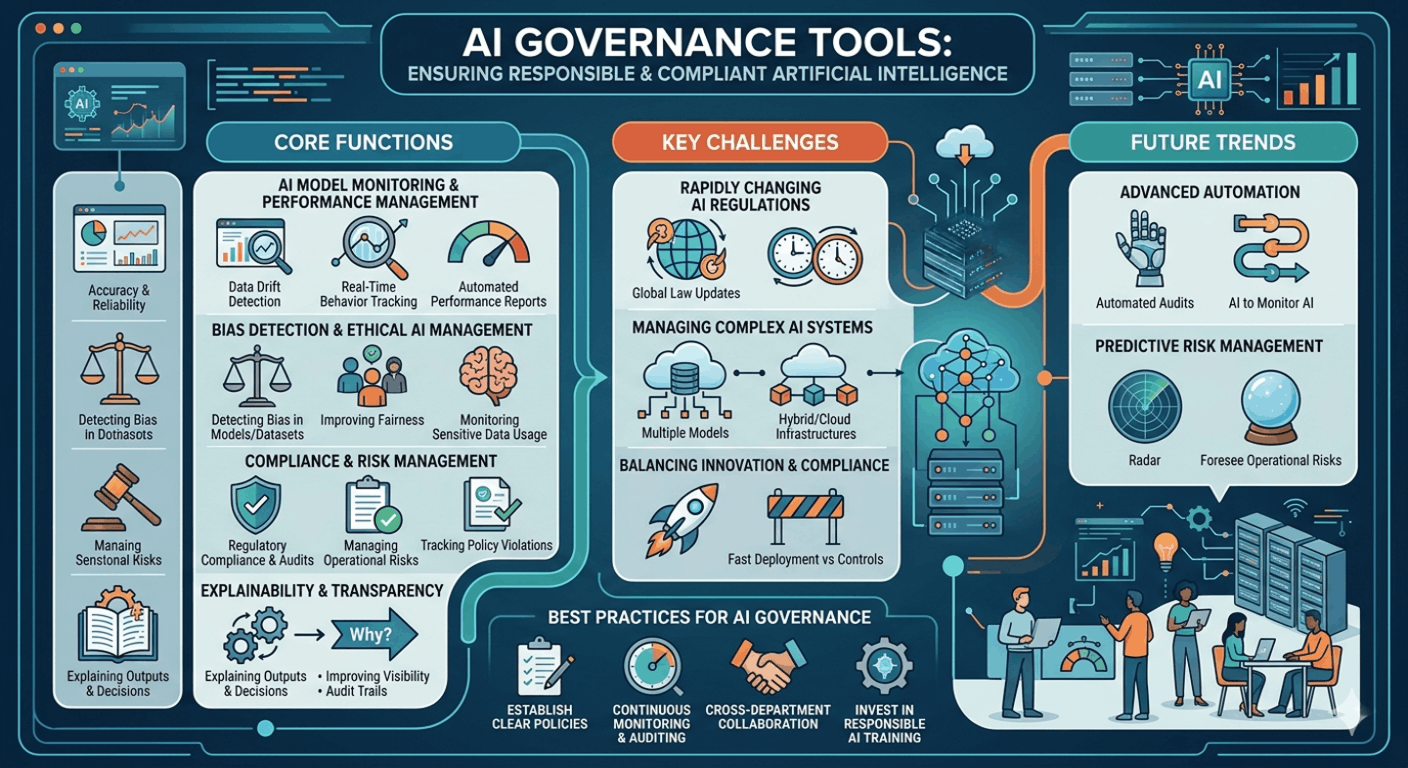
AI governance tools provide the controls needed to manage machine learning models throughout their lifecycle. They improve visibility, strengthen compliance, reduce operational risk, and support responsible AI adoption. These platforms help teams oversee model behavior, evaluate performance, maintain transparency, and enforce governance policies across production environments.
As AI becomes part of business-critical workflows, governance solutions ensure automated systems remain reliable, accountable, and aligned with organizational requirements.
1. AI Model Monitoring and Performance Management
Machine learning models are heavily dependent on their training environments. The moment a production model begins interacting with live, volatile user traffic, its prediction accuracy naturally begins to decay.
- Real-Time Accuracy Tracking: Production systems constantly evaluate live predictions against expected baseline results to catch operational anomalies before they ever reach an end-user.
- Intercepting Data and Concept Drift: Data drift occurs when the incoming info no longer reflects the historical patterns used during training. Concept drift happens when the real-world relationship between your variables changes entirely due to shifting market realities. Advanced tools track these shifts using metrics like the Population Stability Index (PSI), sending real-time alerts to trigger automated retraining loops before performance hits the floor.
- System Observability and Telemetry: Enterprise tools offer granular visibility into active workflows, API latencies, memory spikes, and edge-case errors. This allows infrastructure teams to patch vulnerabilities and maintain service continuity proactively.
- Automated Performance Summaries: Manual reporting cannot scale alongside continuous software updates. Governance platforms automatically compile audit-ready metrics, KPI baselines, and model health stats, removing the manual overhead from development teams.
2. Bias Detection and Ethical AI Management
Algorithms are only as fair as the data used to train them. If historical training sets contain human prejudices or uneven representation, the system will simply automate and scale that discrimination at an unmanageable pace.
- Algorithmic Bias Auditing: Governance tools continuously analyze live decisions and training matrices for unfair impacts across protected variables like age, gender, race, or location.
- Enforcing Fair Outcomes: Ethical management functions help cross-functional risk teams configure operational guardrails. If a model’s bias metric drops below an acceptable baseline, the platform can flag the issue instantly or route high-risk automated choices to a human reviewer for final validation.
- Sensitive Data Protection: With international privacy laws tightening, these platforms tightly monitor data access and lineage. They ensure that Personally Identifiable Information (PII) remains securely masked and isolated from unauthorized or unapproved training cycles.
3. Automated Compliance and Operational Risk Reduction
Navigating the legal landscape of artificial intelligence is no longer optional. Global frameworks demand transparent, auditable proof of system safety.
- Regulatory Audit Readiness: Instead of forcing engineers to compile old code notebooks, governance platforms capture automated logs of model states, parameters, and shifts to generate instant reports for external legal audits.
- Policy and Security Guardrails: If a model accesses restricted data pipelines or violates pre-set safety guidelines, the system logs the incident and alerts risk management to limit corporate liability.
- Minimizing Workflow Failures: Continuous infrastructure tracking ensures that third-party APIs and connected large language models remain resilient against external vulnerabilities and operational disruptions.
4. Explainability and Transparency
The era of the algorithmic “black box” is over. Regulators, executives, and customers now demand to know exactly why an AI made a specific decision.
- Demystifying Prediction Logic: If an individual is denied credit or a loan by an automated pipeline, explainability features isolate the exact feature weights that caused the rejection.
- Regulatory Translation: Advanced systems translate complex mathematical weights into plain-language visual charts that legal compliance teams and non-technical stakeholders can easily interpret.
- Preserving Accountability Records: By maintaining immutable historical version records, enterprises can definitively show which model variation made which specific choice at any exact point in time.
Compliance and Risk Management
Compliance and risk management are essential components of AI governance because organizations must ensure AI systems follow legal regulations, internal security policies, and industry standards. AI governance platforms help businesses identify operational risks, maintain compliance documentation, monitor policy violations, and improve security management across AI-powered environments. Effective governance reduces financial, legal, and reputational risks while improving accountability and operational transparency.
Supporting Regulatory Compliance and Audits
AI governance tools help organizations comply with regulations related to privacy, data protection, security, and ethical AI usage. These systems simplify auditing processes by maintaining detailed governance records and operational reports.
Automated compliance monitoring improves efficiency and helps businesses prepare for internal and external audits more effectively.
Key Functions
- Supporting compliance with AI regulations and standards
- Generating governance reports for audits
- Monitoring legal and operational compliance requirements
- Improving accountability in AI management
- Reducing regulatory and financial risks
Managing AI-Related Operational Risks
AI governance platforms continuously monitor AI systems to identify technical, operational, and security risks that may impact business performance or customer trust.
These tools help organizations reduce system failures, security vulnerabilities, and operational disruptions associated with AI-driven automation.
Key Functions
- Detecting operational anomalies and AI risks
- Monitoring AI system security and stability
- Reducing workflow disruptions and failures
- Supporting proactive risk management strategies
- Improving operational reliability of AI systems
Tracking Policy Violations and Security Concerns
Governance tools monitor AI operations to identify violations of internal policies, ethical guidelines, and security protocols. This helps organizations maintain secure and compliant AI environments.
Continuous tracking also improves incident response and reduces risks associated with unauthorized AI activities or security breaches.
Key Functions
- Identifying policy and security violations
- Monitoring AI system access and activity logs
- Improving incident response management
- Supporting enterprise security governance
- Enhancing AI operational transparency
Explainability and Transparency
Explainability and transparency are important functions of AI governance tools because many AI systems operate using highly complex algorithms that are difficult to interpret. Governance platforms provide explainability features that help organizations understand how AI models generate predictions, recommendations, and automated decisions. Improved transparency helps businesses maintain trust, simplify audits, and ensure accountability in AI operations.
Explaining AI-Generated Outputs and Decisions
AI governance tools provide detailed explanations about how machine learning models produce outputs and make automated decisions. These explanations help technical teams and business leaders understand AI behavior more clearly.
Explainability improves confidence in AI systems and supports responsible decision-making across organizations.
Key Functions
- Explaining prediction logic and AI behavior
- Improving understanding of automated decisions
- Supporting technical analysis of AI outputs
- Increasing transparency in AI workflows
- Helping teams identify decision-making patterns
Improving Transparency for Customers and Regulators
Transparency features help organizations demonstrate how AI systems operate and how decisions are generated. This is important for maintaining customer trust and meeting regulatory requirements.
Clear visibility into AI processes also improves communication between organizations, regulators, and customers.
Key Functions
- Providing visibility into AI operations
- Supporting regulatory reporting requirements
- Improving customer confidence in AI systems
- Enhancing trust through transparent AI practices
- Supporting ethical and compliant AI deployment
Supporting Audit and Accountability Processes
AI governance platforms maintain logs, reports, and monitoring records that support auditing and accountability processes. These features help organizations track AI decisions and operational activities effectively.
This improves governance management and simplifies compliance reviews across enterprise AI environments.
Key Functions
- Maintaining governance records and audit trails
- Supporting operational accountability processes
- Improving compliance documentation management
- Tracking AI system activities continuously
- Simplifying enterprise AI audits
Interactive Element: AI Risk & Compliance Calculator
| Risk Dimension | Assessment | Weight |
|---|---|---|
| Model Complexity | Generative/LLM | +50 |
| Regulatory Scope | Highly Regulated | x1.4 |
| Data Dynamics | Real-time | +20 |
| Current Mitigation | None | -0 |
| Strategic Recommendation | Critical risk profile. Immediate human-in-the-loop oversight and compliance documentation required. | — |
Popular AI Governance Tools
Several advanced AI governance platforms are widely used by organizations to manage AI systems, improve compliance, monitor performance, and maintain operational transparency across enterprise environments.
- IBM Watson OpenScale provides AI monitoring, explainability, bias detection, lifecycle management, and governance automation features
- Microsoft Purview supports compliance management, risk monitoring, security governance, and AI policy management across cloud environments
- DataRobot offers AI monitoring, model management, workflow automation, and governance optimization capabilities
- Fiddler AI focuses on explainability, model monitoring, performance analysis, and operational transparency for AI systems
AI Governance Functions Overview Table
| AI Governance Area | Main Purpose | Business Benefit |
| Bias Detection | Identify unfair AI behavior | Improved fairness and ethical compliance |
| Ethical AI Management | Support responsible AI operations | Better customer trust |
| Compliance Management | Meet legal and regulatory requirements | Reduced compliance risks |
| Risk Management | Monitor operational and security risks | Improved AI system reliability |
| Explainability | Understand AI-generated decisions | Increased transparency |
| Transparency | Improve visibility into AI operations | Stronger accountability |
| Automated Auditing | Track AI activities and governance records | Faster audit and reporting processes |
| Performance Monitoring | Monitor AI system behavior continuously | Better operational efficiency |
Challenges in AI Governance
Rapidly Changing AI Regulations
Keeping pace with global legal variations is a massive logistical hurdle. As frameworks like the EU AI Act adapt, compliance rules shift across different countries and industries. Organizations are forced to constantly overhaul their internal guidelines, pipeline controls, and documentation structures simply to avoid crushing legal penalties.
Managing Complex AI Systems
Modern corporate cloud environments do not run a single isolated model. They deploy hundreds of interconnected neural networks, data pipelines, external vendor APIs, and hybrid-cloud instances simultaneously. Maintaining unified operational visibility and enforcing security across these sprawling setups is incredibly resource-intensive.
Balancing Innovation and Compliance
Strict corporate policies can act as an accidental roadblock for software development. If your verification pipelines require endless manual reviews and complex documentation steps before deployment, your data science teams will slow down, causing your company to lose its competitive edge in the fast-moving tech market.
Best Practices for AI Governance
Successful AI governance requires structured policies, continuous monitoring, collaboration, and responsible AI management practices. Organizations that implement strong governance frameworks can improve compliance, reduce operational risks, and maintain long-term trust in AI systems. Following best practices helps businesses create secure, transparent, and scalable AI environments that support both innovation and accountability.
Establish Clear Governance Policies
Organizations should create detailed AI governance frameworks that define usage standards, ethical guidelines, security policies, and accountability procedures. Clear governance structures improve operational consistency and reduce compliance risks.
Well-defined policies also help employees understand how AI systems should be developed, monitored, and managed responsibly.
Best Practices
- Defining AI security and compliance standards
- Creating ethical AI usage guidelines
- Establishing accountability and governance procedures
- Standardizing AI monitoring and reporting processes
- Improving transparency across AI operations
Continuous Monitoring and Auditing
Continuous monitoring allows organizations to detect AI-related risks, operational anomalies, and compliance violations early. Regular audits improve accountability and maintain long-term AI reliability.
Automated governance monitoring also helps businesses respond faster to technical issues and regulatory concerns.
Best Practices
- Monitoring AI performance and operational behavior continuously
- Conducting regular compliance and security audits
- Detecting risks and anomalies proactively
- Maintaining audit trails and governance reports
- Improving long-term system reliability and transparency
Cross-Department Collaboration
AI governance requires coordination between technical and non-technical departments, including engineering, legal, compliance, security, and business operations teams. Collaboration improves governance efficiency and decision-making quality.
Strong communication between departments helps organizations manage AI risks more effectively and maintain consistent governance practices.
Best Practices
- Encouraging collaboration across technical and business teams
- Improving communication between compliance and engineering departments
- Sharing governance responsibilities across organizations
- Aligning operational and legal objectives effectively
- Supporting faster issue resolution and policy implementation
Invest in Responsible AI Training
Employee education and training are important for maintaining responsible AI practices within organizations. Training programs help teams understand AI ethics, compliance requirements, security standards, and governance procedures.
Well-trained employees improve operational awareness and reduce risks associated with improper AI usage or governance failures.
Best Practices
- Providing AI ethics and compliance training programs
- Educating teams on governance standards and policies
- Improving awareness of data privacy and security risks
- Supporting responsible AI development practices
- Strengthening organizational governance readiness
AI Governance Challenges and Best Practices Table
| AI Governance Area | Main Challenge | Best Practice Solution |
| AI Regulations | Rapidly changing compliance standards | Regular governance policy updates |
| Complex AI Systems | Managing large-scale AI infrastructures | Continuous monitoring and automation |
| Innovation vs Compliance | Balancing growth with governance controls | Flexible and scalable governance policies |
| Security and Risk Management | Operational and compliance risks | Proactive auditing and risk monitoring |
| Cross-Team Coordination | Departmental communication gaps | Strong cross-functional collaboration |
| Responsible AI Usage | Lack of governance awareness | Employee training and education programs |
Future of AI Governance Tools
AI governance platforms are rapidly shifting from basic reporting dashboard apps to autonomous risk systems. Instead of catching a compliance violation or data leak after it happens, next-generation tools use predictive analytics to stress-test workflows before they ever interact with live customer data.
As decentralized agentic workflows become standard practice across enterprise cloud architectures, deploying these automated control layers is the single best strategy to protect your brand reputation, scale your automation safely, and build long-term trust with global regulators.
Conclusion
AI governance tools play a critical role in helping organizations manage artificial intelligence systems responsibly and efficiently. These tools support compliance, transparency, risk management, bias detection, and operational monitoring across AI environments. As AI technologies continue to expand across industries, strong governance frameworks and monitoring platforms will become essential for maintaining trust, security, and long-term business success.
FAQs
What are AI governance tools?
AI governance tools are software platforms used to monitor, manage, and regulate artificial intelligence systems. They help organizations maintain compliance, improve transparency, detect bias, and reduce operational risks in AI-powered environments. These tools also support ethical AI development and responsible decision-making.
Why are AI governance tools important?
AI governance tools are important because AI systems can create risks related to bias, privacy, security, and compliance if not monitored properly. These tools help businesses maintain accountability, protect customer data, and ensure AI models operate according to legal and ethical standards.
How do AI governance tools detect bias?
AI governance platforms analyze datasets, machine learning models, and AI-generated outputs to identify unfair or discriminatory patterns. They continuously monitor automated decisions and help organizations improve fairness, transparency, and ethical AI operations across business systems.
What industries use AI governance tools?
AI governance tools are widely used in industries such as healthcare, finance, banking, retail, insurance, cybersecurity, and technology. These industries rely on governance platforms to manage compliance, monitor AI systems, and reduce operational and regulatory risks.
What are the main features of AI governance tools?
Common features include AI model monitoring, compliance management, explainability, risk analysis, bias detection, security monitoring, and automated auditing. These functions help organizations maintain reliable, transparent, and secure AI operations.
What is the future of AI governance tools?
The future of AI governance tools will focus on automation, predictive risk analysis, and real-time compliance monitoring. Advanced governance platforms will use machine learning to improve transparency, automate audits, and support responsible AI deployment at scale.