



How Do I Track AEO? Introduction
Search behavior is changing rapidly as users now ask direct questions to AI tools, voice assistants, and chatbots instead of relying only on traditional search engines. This shift has increased the importance of Answer Engine Optimization (AEO), which focuses on making content clear, accurate, and easy for AI systems to understand and display as direct answers. Unlike traditional SEO, AEO tracks metrics such as featured snippets, voice search visibility, AI-generated answers, and user intent satisfaction. Businesses and website owners use AEO tracking to measure how often their content appears in answer-based search results and conversational AI platforms.
What Is AEO?
Answer Engine Optimization (AEO) is the process of improving content so search engines, AI tools, and voice assistants can directly use that information to answer user questions. Unlike traditional SEO, which mainly focuses on page rankings and website traffic, AEO focuses on delivering accurate and structured answers that AI systems can easily understand. Modern search platforms now prefer content that clearly explains topics, matches user intent, and provides quick factual responses. Because of this shift, businesses are increasingly optimizing their websites for AI-generated answers, featured snippets, and conversational search experiences.
Direct Answer Optimization
AEO helps websites create content that directly answers user questions instead of only targeting rankings. Search engines and AI systems prefer concise and informative responses that solve user queries quickly. This increases the chances of appearing in answer boxes and AI-generated summaries.
Structured Content Formatting
Content structure plays a major role in AEO because AI systems read information more effectively when headings, sections, and schema markup are properly organized. Well-structured pages improve machine readability and increase visibility in modern search environments.
Conversational Search Targeting
Modern users search using natural language and complete questions rather than short keywords. AEO focuses on conversational queries so that content matches how people speak to AI chatbots and voice assistants.
Featured Snippets And Voice Search
AEO also improves the chances of appearing in featured snippets, voice search responses, and zero-click search results. Search engines often select highly relevant and trustworthy content for these direct answer positions.
Why Tracking AEO Matters
Tracking AEO is important because it helps website owners understand whether AI systems are actually using their content as direct answers. Traditional SEO metrics, such as rankings and clicks, cannot fully measure answer visibility in AI-powered search environments. Modern search behavior now includes voice assistants, conversational AI tools, and zero-click searches where users receive information instantly without visiting websites. By monitoring AEO performance, businesses can measure visibility, authority, and answer accuracy more effectively.
Measuring AI Answer Visibility
AEO tracking helps identify which pages appear in AI-generated summaries, featured snippets, and answer engines. This allows businesses to understand how search systems interpret and present their content.
Understanding User Interaction
Tracking engagement metrics helps analyze how users interact with answer-focused content. Metrics such as time on page, engagement rate, and user behavior provide insights into content quality and usefulness.
Monitoring Conversational Queries
AEO tracking also reveals which conversational and question-based searches generate visibility. This helps content creators improve future content according to real user intent and AI search behavior.
Evaluating Authority And Trust
AI systems prioritize trustworthy and authoritative content. Tracking AEO performance helps determine whether search engines and AI tools recognize a website as a reliable information source.
How AEO Tracking Is Different From SEO Tracking
Traditional SEO tracking mainly focuses on rankings, clicks, and keyword positions, while AEO tracking measures how effectively content performs as a direct answer within AI-driven search environments. Although both strategies aim to improve online visibility, AEO focuses more on user intent, conversational relevance, and answer accuracy. As AI search evolves, websites may gain significant visibility even without receiving direct clicks because users often get answers immediately within search interfaces.
Ranking Versus Answer Visibility
SEO measures page rankings in search results, while AEO measures whether content appears directly in AI-generated answers, snippets, and voice responses. The focus shifts from position to answer usefulness.
Click-Based Versus Zero-Click Performance
SEO often prioritizes website traffic and click-through rates, but AEO focuses on visibility even when users do not visit the website directly. Zero-click searches are becoming increasingly common in AI search environments.
Keywords Versus User Intent
SEO relies heavily on keyword optimization, whereas AEO prioritizes conversational intent and natural language questions. AI systems analyze meaning and context more deeply than traditional search engines.
Link Signals Versus Entity Authority
Traditional SEO emphasizes backlinks and link performance, while AEO also considers entity authority, topical expertise, and factual trustworthiness when selecting answers.
Short Comparison Table
| SEO Tracking | AEO Tracking |
| Focuses on rankings | Focuses on direct answers |
| Measures clicks and traffic | Measures visibility and answer usage |
| Keyword-focused optimization | Intent-focused optimization |
| Prioritizes SERP positions | Prioritizes the AI answer’s appearance |
| Depends heavily on backlinks | Depends on authority and accuracy |
Core Metrics Used To Track AEO
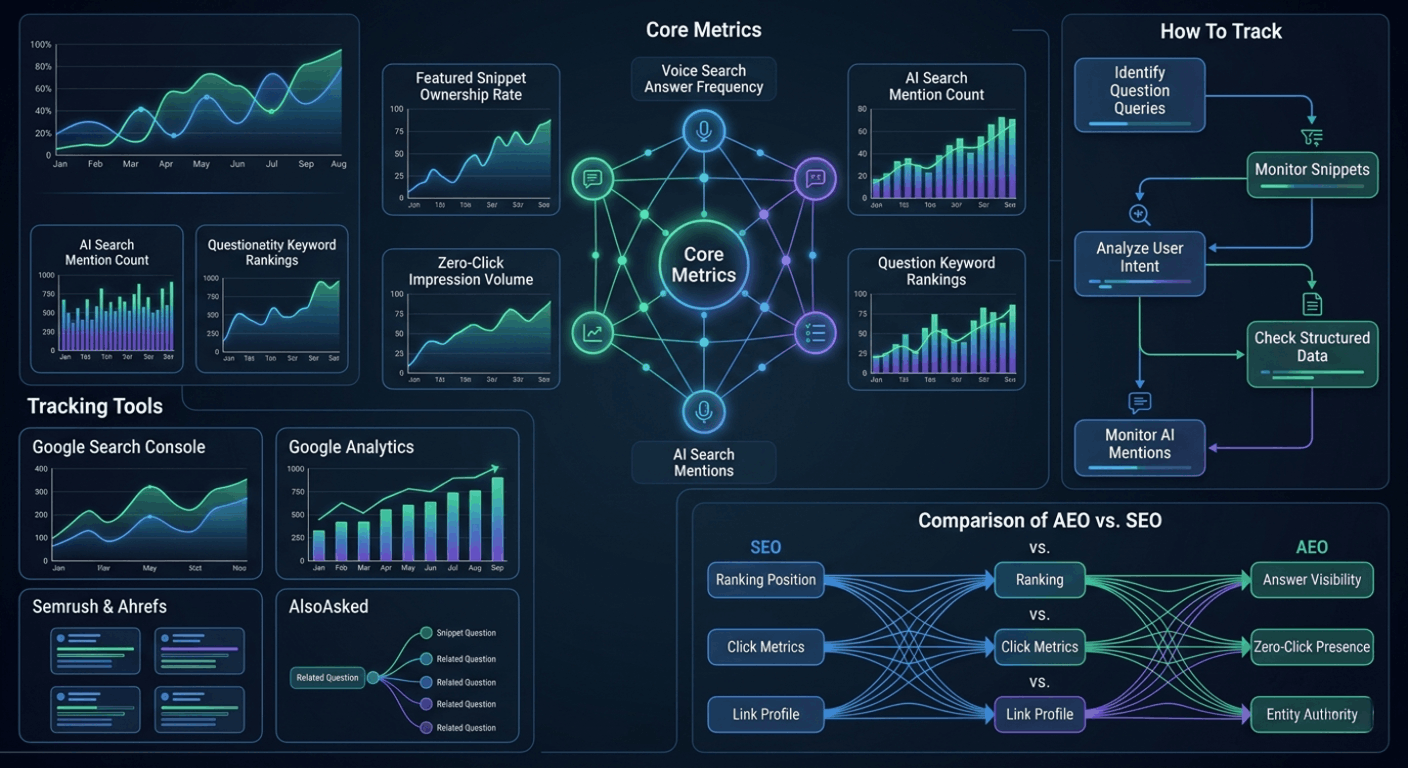
Tracking AEO requires monitoring specific metrics that show how search engines and AI systems use your content as direct answers. Unlike traditional SEO metrics that mainly focus on rankings and traffic, AEO metrics measure visibility in AI-generated results, featured snippets, and conversational search platforms. These performance indicators help businesses understand whether their content is properly optimized for answer engines and voice-based searches.
Featured Snippet Visibility
Featured snippets are one of the strongest indicators of successful AEO because search engines use them to provide direct answers above normal search results. When your content appears in snippets, it improves authority, visibility, and answer relevance in AI-driven search environments.
- Track how many featured snippets your website owns
- Monitor which search queries trigger snippets
- Measure snippet impressions and click-through rates
Voice Search Performance
Voice search performance measures how effectively your content responds to spoken and conversational queries. Voice assistants prefer concise, accurate, and trustworthy answers that directly satisfy user intent.
- Analyze voice-friendly and question-based keywords
- Monitor conversational mobile search behavior
- Track natural language search visibility
AI Search Mentions
AI search mentions show whether conversational AI systems recognize and reference your content as a trusted information source. This metric is becoming increasingly important as AI-generated search experiences continue to grow.
- Monitor whether AI systems mention your brand
- Identify which pages receive AI references
- Track citation frequency and entity association
Zero-Click Search Visibility
Zero-click visibility measures how often users see your content directly in search results without visiting your website. Strong zero-click presence can still improve brand awareness and online authority.
- Track search impression growth over time
- Monitor answer appearances in SERP features
- Analyze FAQ and knowledge panel visibility
Question-Based Keyword Tracking
AEO relies heavily on question-focused queries because users increasingly search using conversational language. Tracking these keywords helps identify opportunities to appear in direct answers and AI summaries.
- Monitor “What is” and “How do I” queries
- Analyze conversational and long-tail searches
- Identify high-intent answer opportunities
Best Tools To Track AEO
Several professional SEO and analytics tools help monitor AEO performance across search engines and AI-powered platforms. These tools provide insights into featured snippets, conversational keywords, answer visibility, and user engagement. Using the right combination of tools allows businesses to measure how effectively their content performs in answer-driven search environments.
Google Search Console
Google Search Console is one of the most effective free tools for monitoring AEO-related search performance. It provides valuable insights into question-based queries, impressions, and rich search features.
- Monitor query impressions and search visibility
- Track question-focused keyword performance
- Analyze rich results and CTR data
Google Analytics
Google Analytics helps measure how users interact with answer-focused content after landing on a website. Engagement signals often indicate whether users find the information useful and relevant.
- Track bounce rate and engagement time
- Analyze scroll depth and user interaction
- Measure user intent satisfaction signals
Semrush
Semrush offers advanced SEO monitoring features that support AEO tracking and competitive analysis. It is widely used for analyzing featured snippets and answer-focused keyword opportunities.
- Monitor featured snippet ownership
- Analyze question keyword performance
- Track SERP feature visibility trends
Ahrefs
Ahrefs helps identify conversational keyword opportunities and competitor visibility within answer-focused search results. It is also useful for monitoring organic visibility growth over time.
- Track question-based keyword rankings
- Monitor competitor answer visibility
- Analyze organic visibility performance
AlsoAsked
AlsoAsked is designed to reveal related questions users commonly search online. This helps create content that aligns closely with conversational search intent and AI-generated query patterns.
- Discover related user questions
- Build conversational topic structures
- Create FAQ-focused content strategies
How To Properly Track AEO Step By Step
Tracking Answer Engine Optimization requires a structured process that measures how AI systems, search engines, and voice assistants use your content as direct answers. Proper AEO tracking focuses on conversational visibility, answer relevance, structured content, and user intent satisfaction. By following the right tracking process, businesses can improve their chances of appearing in featured snippets, AI summaries, and zero-click search results.
Step 1: Identify Question-Based Queries
The first step in AEO tracking is identifying the types of questions users search online. Modern search behavior is highly conversational, which means people often search using complete phrases and natural language questions instead of short keywords. Understanding these patterns helps create content that directly matches user intent and AI search expectations.
| Query Type | Purpose |
| Long-tail questions | Target detailed user searches |
| Conversational phrases | Match natural language queries |
| User intent keywords | Understand search behavior |
| Voice-search patterns | Optimize for spoken searches |
Step 2: Monitor Featured Snippets
Featured snippets are one of the clearest indicators of strong AEO performance because search engines use them to provide direct answers at the top of search results. Monitoring snippet performance helps identify whether your content is being selected as an authoritative answer source.
| Snippet Metric | Importance |
| Snippet wins | Shows answer visibility growth |
| Snippet losses | Identifies optimization gaps |
| Competitor snippets | Tracks competitor performance |
| Answer box visibility | Measures direct answer exposure |
Step 3: Analyze User Intent Signals
User engagement signals help search engines and AI systems understand whether content satisfies search intent effectively. Strong engagement usually indicates that users find the information relevant, accurate, and useful.
| Engagement Signal | Why It Matters |
| Time on page | Reflects content usefulness |
| Engagement rate | Measures user interaction |
| Return visits | Indicates trust and value |
| Scroll behavior | Shows reading activity |
Step 4: Check Structured Data Performance
Structured data helps AI systems interpret website content more efficiently. Schema markup improves machine readability and increases the likelihood of appearing in rich results, FAQs, and featured answer sections.
| Schema Type | Function |
| FAQ schema | Supports direct answers |
| How-to schema | Improves instructional visibility |
| Article schema | Defines content structure |
| Organization schema | Strengthens brand identity |
Step 5: Monitor Brand Mentions In AI Systems
AI search systems increasingly reference trusted brands and authoritative sources in generated responses. Monitoring brand mentions helps measure how often AI platforms recognize and use your content as a reliable source.
| AI Mention Signal | Purpose |
| Brand mentions in AI chats | Measures AI recognition |
| Citations in summaries | Tracks authority signals |
| Content references | Identifies AI usage |
| Entity recognition | Strengthens topical trust |
Important AEO KPIs
AEO KPIs help measure how effectively content performs in AI-driven search environments. These metrics focus on direct answer visibility, conversational search performance, and AI trust signals rather than only traditional rankings and traffic.
Featured Snippet Count
Featured snippet count measures how often your content appears as a direct answer in search results. A higher snippet count usually indicates stronger answer optimization and authority.
| KPI | Importance |
| Featured snippet count | Shows direct answer visibility |
| Snippet impressions | Measures search exposure |
| Snippet CTR | Tracks engagement performance |
AI Mentions
AI mentions indicate whether conversational AI systems recognize and reference your content. This KPI is becoming increasingly important as AI-powered search experiences continue to expand.
| KPI | Importance |
| AI mentions | Measures AI trust |
| Citation frequency | Indicates authority strength |
| Brand references | Shows AI recognition |
Question Keyword Rankings
Question keyword rankings measure how effectively your content targets conversational and intent-based searches. These rankings are critical for appearing in AI-generated answers and voice search results.
| KPI | Importance |
| Question rankings | Measures conversational reach |
| Long-tail visibility | Targets detailed searches |
| Intent-based queries | Matches user behavior |
Zero-Click Impressions
Zero-click impressions track how often users see your content directly within search results without visiting your website. Strong visibility still improves authority and brand awareness.
| KPI | Importance |
| Zero-click impressions | Shows answer exposure |
| SERP visibility | Measures search presence |
| FAQ appearances | Improves direct visibility |
Engagement Metrics
Engagement metrics help evaluate whether users find your content useful and relevant. Search engines often consider strong engagement as a positive quality signal.
| KPI | Importance |
| Engagement rate | Measures interaction quality |
| Scroll depth | Tracks reading activity |
| Return visits | Indicates content value |
Voice Search Visibility
Voice search visibility measures how well content performs in spoken and conversational search environments. AI assistants usually prioritize short, accurate, and trustworthy answers.
| KPI | Importance |
| Voice search visibility | Measures conversational reach |
| Spoken query matching | Supports voice optimization |
| Natural language performance | Improves AI understanding |
FAQ Visibility
FAQ visibility measures how effectively structured FAQ content appears in search results and AI answer systems. Well-optimized FAQs improve answer extraction and conversational relevance.
| KPI | Importance |
| FAQ visibility | Improves answer extraction |
| Rich result appearance | Enhances SERP visibility |
| Conversational answers | Supports AI responses |
Common Mistakes While Tracking AEO
Many websites optimize content for Answer Engine Optimization but fail to track the right performance signals. AEO tracking requires a different approach compared to traditional SEO because AI systems focus more on answer quality, authority, conversational relevance, and structured information. Ignoring important AEO factors can reduce visibility in AI-generated answers, featured snippets, and voice search results. Understanding these common mistakes helps businesses build a stronger and more accurate AEO strategy.
Ignoring Zero-Click Visibility
Many marketers focus only on website traffic and assume that searches without clicks have no value. However, in AEO, appearing directly in search answers, snippets, and AI summaries still improves authority and brand visibility even if users do not visit the website.
Tracking Only Rankings
Traditional keyword rankings alone cannot accurately measure AEO performance because answer engines prioritize direct responses instead of simple search positions. A website may have lower rankings but still appear frequently in AI-generated answers.
Forgetting Conversational Queries
AEO depends heavily on natural language and conversational search behavior. Ignoring question-based queries reduces the chances of appearing in voice search results and AI-powered answer systems.
Not Using Structured Data
Without schema markup and structured content, AI systems may struggle to properly understand and categorize website information. Structured data improves machine readability and increases visibility in rich search features.
Ignoring Authority Signals
AI systems prioritize trustworthy and authoritative sources when selecting answers. Websites with strong expertise, factual accuracy, and topical authority usually perform better in AI-generated search environments.
Future Of AEO Tracking
AEO tracking is expected to become more advanced as AI-powered search systems continue evolving. Search engines and conversational AI tools are increasingly focusing on user intent, answer quality, and trusted information sources instead of relying only on traditional ranking signals. Future AEO tracking will likely include more detailed AI visibility metrics, conversational engagement analysis, and entity-based authority measurement. Businesses that adapt early to these changes can gain stronger visibility across modern search platforms.
AI Citation Scoring
Future AEO systems may track how often AI platforms cite and reference content as a trusted source. Citation scoring could become an important authority signal for measuring content reliability.
Conversational Engagement Metrics
AI-driven search environments may increasingly measure how users interact with conversational answers. Metrics related to user satisfaction and engagement could play a larger role in future optimization strategies.
Multi-Platform Answer Visibility
Future tracking systems may monitor answer visibility across multiple AI platforms, voice assistants, smart devices, and conversational search engines instead of focusing on one search engine only.
AI Trust And Entity Authority
Search systems are likely to rely more heavily on entity authority, factual trust, and expertise signals. Brands with strong topical relevance may gain better AI visibility and recognition.
Real-Time Answer Monitoring
Advanced AEO tools may eventually provide real-time monitoring of AI-generated answers, citations, and search visibility changes across conversational platforms.
Short Summary Table
| AEO Factor | Importance |
| Zero-click visibility | Improves answer exposure |
| Conversational queries | Supports natural language search |
| Structured data | Helps AI understand content |
| Authority signals | Builds trust and credibility |
| AI citation tracking | Measures AI recognition |
| Real-time monitoring | Tracks answer visibility changes |
Final Thoughts
Tracking AEO has become essential because modern search engines and AI systems now prioritize direct answers instead of only traditional rankings. Businesses that monitor featured snippets, conversational queries, AI mentions, and zero-click visibility can better understand how their content performs in answer-driven search environments. A strong AEO strategy focuses on accuracy, authority, structured content, and user intent so AI platforms can recognize and trust the information. Proper AEO tracking helps websites improve visibility, strengthen topical authority, and stay competitive as AI-powered search continues to grow.
FAQs
What is AEO, and why is it important?
Answer Engine Optimization (AEO) is the process of optimizing content so AI systems, search engines, and voice assistants can use it as direct answers for users. It is important because modern users increasingly rely on conversational search and AI-generated responses instead of traditional search results. AEO improves visibility in featured snippets, voice searches, and zero-click searches. Businesses using AEO effectively can increase authority and online recognition.
How do I track AEO performance?
AEO performance can be tracked by monitoring featured snippets, AI mentions, conversational keyword rankings, voice search visibility, and zero-click impressions. Tools like Google Search Console, Google Analytics, Semrush, and Ahrefs help measure these metrics. Tracking user engagement and structured data performance is also important. Proper monitoring helps identify whether AI systems trust and display your content.
What is the difference between SEO and AEO?
SEO mainly focuses on improving website rankings and increasing traffic from search engines, while AEO focuses on providing direct answers for users through AI systems and conversational search platforms. AEO prioritizes answer accuracy, natural language queries, and structured content. SEO is ranking-oriented, whereas AEO is answer-oriented. Both strategies work together but target different search behaviors.
Why are featured snippets important for AEO?
Featured snippets are important because they allow search engines to display content directly as answers above normal search results. These snippets improve visibility, authority, and trustworthiness in AI-driven search environments. Websites appearing in snippets often receive better recognition from search engines and voice assistants. Featured snippets are considered one of the strongest signals of successful AEO optimization.
How does voice search affect AEO?
Voice search affects AEO because voice assistants usually provide short, direct, and conversational answers to users. Content optimized for natural language queries and question-based searches has a higher chance of appearing in voice search results. AI systems prefer concise and well-structured responses for spoken searches. Optimizing for voice search improves conversational visibility and user engagement.
Which tools are best for tracking AEO?
Some of the best tools for tracking AEO include Google Search Console, Google Analytics, Semrush, Ahrefs, and AlsoAsked. These tools help monitor question-based keywords, featured snippets, conversational queries, and user engagement metrics. They also provide insights into AI visibility and answer-focused search performance. Using multiple tools together gives a more complete understanding of AEO success.
What are zero-click searches in AEO?
Zero-click searches occur when users receive answers directly on the search results page without visiting a website. In AEO, these searches are important because visibility itself can improve authority and brand recognition. AI-generated summaries, featured snippets, and knowledge panels often create zero-click experiences. Tracking these impressions helps measure answer visibility across modern search environments.