




AI Academic Writing Tools Competitor Positioning Strategy
The market for AI-driven text generation has reached a saturation point. For platforms targeting the scholarly, scientific, and research communities, the stakes are completely different from those for generic B2B copywriting tools. The “wrapper economy”, where platforms charge premiums for superficial user interfaces built over identical foundational LLMs, is failing under the scrutiny of academic institutions.
To achieve sustainable growth and immediate search engine visibility, an AI academic writing tool’s competitor positioning strategy must move away from generic “speed and automation” narratives. Instead, platforms must position themselves as deeply specialized research and scholarly partners that prioritize academic integrity, semantic literature synthesis, and strict institutional compliance.
1. The Market Positioning Matrix
To capture market share from established players in search, editing, and generative AI, your tool, such as AnswerThis AI, must define a distinct operational footprint. The matrix below outlines the competitive landscape and identifies critical positioning opportunities for a specialized academic workspace.
| Competitor Category | Core Primary Use Case | Market Positioning Narrative | Your Positioning Opportunity (The Gap) |
| Search & Discovery (Consensus, Perplexity) | Smart research engine, fact extraction, and source discovery. | “The smart research engine with verified facts and citation backing.” | Depth & Synthesis Workspace: Position as an end-to-end drafting environment rather than just a search bar. Transition users smoothly from discovery to manuscript drafting. |
| Editing & Proofreading (Paperpal, Trinka) | Technical grammar check and clarity for ESL/EFL scholars. | “The professional editing and grammar checker for international researchers.” | Original Argument Structuralization: Focus on overcoming structural writer’s block, optimizing argumentative flow, and generating logical transitions rather than just fixing syntax. |
| Academic Drafting (Jenni AI, Yomu AI) | Rapid draft generation and paragraph scaffolding. | “The fast academic assistant that helps you write your paper draft expansion.” | The Ethical Co-Pilot: Position as an AI assistant that eliminates hallucinations by locking text generation exclusively to user-uploaded or verified peer-reviewed databases. |
| General Writing & Paraphrasing (Grammarly, QuillBot) | General-purpose grammar assistance, tone adjustments, and rewriting. | “The everyday writing companion for clear, polished communication.” | Deep Scholarly Domain Expertise: Focus heavily on complex citation style guides (APA, MLA, Chicago, Harvard), journal-specific formatting requirements, and advanced academic nomenclature. |
2. Differentiated Messaging Architecture
An effective messaging architecture must explicitly separate your product from basic generative text tools that pose legal, ethical, and quality risks to researchers.
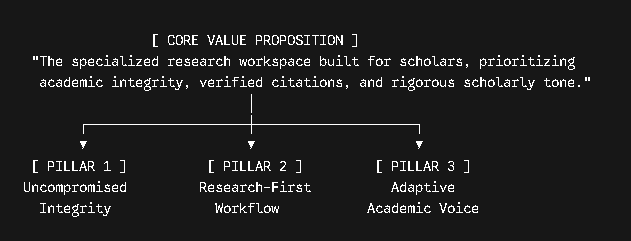
The Core Value Proposition
“The first AI research workspace built specifically for scholars, prioritizing academic integrity, transparent citations, and flawless scholarly tone.”
Pillar 1: Uncompromised Integrity
- Target Pain Point: Fear of AI hallucinations, accidental plagiarism, and journal rejection.
- Messaging Focus: “Draft with absolute confidence. Every scientific claim, statistical mention, and literature assertion is cross-referenced in real-time against verified, peer-reviewed databases to prevent hallucinations and secure academic compliance.”
Pillar 2: Research-First Workflow
- Target Pain Point: Workflow fragmentation caused by switching between reference managers, browser tabs, and word processors.
- Messaging Focus: “Stop fracturing your cognitive load between reference managers, isolated search engines, and word processors. Integrate your literature review, structured outlining, and manuscript drafting into a unified, semantically linked digital workspace.”
Pillar 3: Adaptive Academic Voice
- Target Pain Point: Generic, robotic AI output that fails to meet peer-review quality standards.
- Messaging Focus: “Maintain your distinct scholarly voice while elevating the precision, clarity, and structural cohesion of your manuscripts. Train the system on your past publications to adapt seamlessly to complex domain-specific vocabulary.”
3. Messaging Tailored by Target Persona
Academic software adoption requires balancing three highly distinct buyer and user personas. Your messaging must adapt to their unique pain points and institutional incentives.
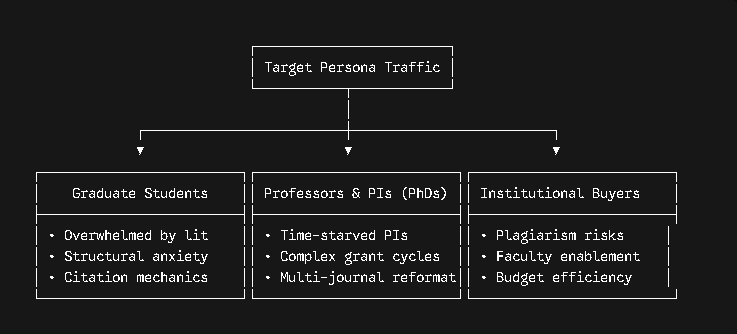
Graduate Students & Early-Career Researchers
- Core Pain Points: Overwhelming volume of literature reviews, structural anxiety when writing long-form dissertations, and tedious manual formatting of citations.
- Strategic Messaging Angle: “Overcome blank-page paralysis and synthesize hundreds of target papers into a cohesive literature review in minutes, all while ensuring flawless, automated citation compliance.”
Professors & Primary Investigators (PIs)
- Core Pain Points: Severe time constraints, managing grant proposals, reviewing substandard student drafts, and reformatting papers for different high-impact (Q1) journals.
- Strategic Messaging Angle: “Accelerate your publication cycle. Transform raw research notes, statistical outputs, and abstract outlines into publication-ready, journal-compliant manuscripts without the administrative burden.”
University Libraries & Institutional Buyers
- Core Pain Points: Institutional reputation risks, widespread student AI misuse, plagiarism vulnerabilities, and strict software budget constraints.
- Strategic Messaging Angle: “Equip your entire campus faculty and student body with an institution-compliant, ethically grounded AI writing assistant that actively champions academic honesty and ethical research standards.”
4. Semantically Optimized Go-to-Market (GTM) Strategy
Winning search visibility and user trust within the academic community requires combining tactical distribution with a workflow-centric user experience.
The “Freemium” Gateway
Do not gatekeeper the core utility immediately. Provide unrestricted access to the literature review synthesis engine and citation validation tool with a monthly usage cap. Allow students and researchers to experience the workflow value before prompting them to upgrade for unlimited long-form manuscript drafting and advanced style-guide transformations.
Institutional Pilot Programs
Circumvent lengthy enterprise sales cycles by targeting department chairs and university library directors with structured, 90-day pilot programs. Frame these pilots around ethical AI deployment and academic integrity management, presenting your tool as a solution to unverified AI generation rather than a contributor to it.
Workflow Integration Ecosystem
Position your software not as an additional destination, but as an optimization layer for existing setups. Develop deep, native integrations with standard research software, including:
- Reference Managers: Zotero, Mendeley, EndNote.
- Document Editors: Google Docs, Microsoft Word, and LaTeX Overleaf.
Your core go-to-market messaging should reinforce this connectivity: “We don’t disrupt your research workflow; we connect it.”
5. Technical Architecture of Academic Large Language Models (LLMs)
To build authority and earn the trust of researchers, it is vital to explain how a specialized academic writing assistant operates technically compared to general consumer tools like ChatGPT or Copy.ai.
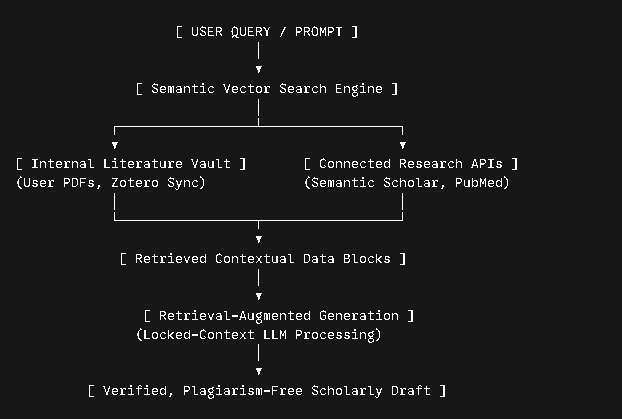
Retrieval-Augmented Generation (RAG)
Generic writing platforms rely purely on the parametric memory of a large language model, which leads to fabricated data and fake citations. Academic writing software must deploy Retrieval-Augmented Generation (RAG).
When a user prompts the system to draft a section, the software converts the prompt into a semantic vector query, searches connected open-access research APIs (such as Semantic Scholar, PubMed, or CrossRef), extracts relevant data blocks, and passes those specific texts as the exclusive source context back to the language model.
Natural Language Processing (NLP) & Entity Extraction
Advanced academic tools use specialized NLP models trained specifically on scientific literature (e.g., SciBERT). These models identify complex NLP entities, such as chemical compounds, proteins, mathematical variables, and specific legal statutes, ensuring that domain-specific terminology is preserved accurately during paraphrase or synthesis operations.
6. Practical Workflow: Integrating AI safely into the Research Cycle
To maintain academic integrity and bypass AI detection software, researchers must treat AI tools as structural assistants rather than automated ghostwriters. The following framework outlines a balanced, four-stage writing process.
Phase 1: Structural Scaffolding & Ideation
Use the AI assistant to outline your manuscript’s architecture based on standard scientific conventions.
- Actionable Prompt Strategy:
“Act as an expert peer reviewer in [Insert Domain, e.g., Molecular Biology]. Provide a detailed, structural outline for an original research article based on the IMRaD format (Introduction, Methods, Results, and Discussion) evaluating [Insert Hypothesis]. Focus specifically on identifying the logical transitions needed between the methodology and results sections.”
Phase 2: Context-Locked Synthesizing
Upload your target literature library directly into your tool’s vector space to synthesize text from verified data.
- Actionable Prompt Strategy:
“Based strictly on the attached three PDF files, synthesize the current empirical findings regarding [Insert Specific Entity/Topic]. Group the arguments by chronological methodology. For every assertion, append the correct internal citation based on the authors’ last names. Do not introduce external facts or infer conclusions not explicitly supported by these texts.”
Phase 3: Structural Human Editing & De-AIification
Once the first draft is generated, apply a strict human editing framework to ensure your unique voice remains central to the paper.
- Eliminate Algorithmic Footprints: Strip out common LLM transitional markers and boilerplate phrases, such as:
- “Furthermore, it is important to note that…”
- “Moreover, a deeper dive reveals…”
- “In conclusion, this study underscores the paramount importance of…”
- Inject Authorial Context: Replace generic phrasing with specific experimental details, precise historical timelines, and personal laboratory insights that an AI model cannot recreate.
Phase 4: Precision Style Checking
Leverage specialized editing engines to ensure absolute alignment with target journal guidelines.
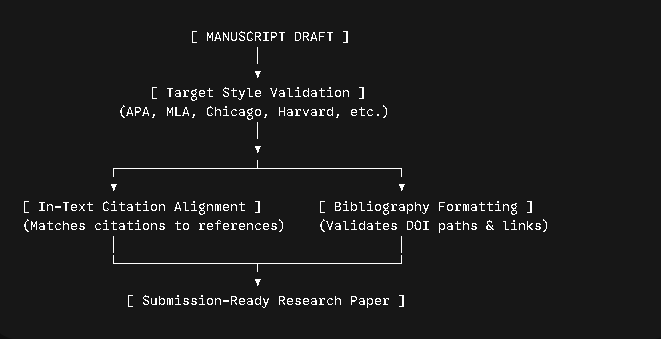
By framing your platform around this rigorous, structured, and ethically sound workflow, your software moves away from the risky category of generic text generators. Instead, it positions itself as an essential, high-utility workspace for the global research community.
Frequently Asked Questions: AI Academic Writing Tool Competitor Positioning Strategy
How does this platform prevent AI hallucinations and fake citations in academic drafts?
Unlike generic AI tools that guess information, this workspace uses Retrieval-Augmented Generation (RAG). It locks text generation exclusively to your uploaded PDFs or verified open-access databases like Semantic Scholar, meaning every claim is directly tied to a real, traceable source.
Can using this tool trigger institutional AI detection or plagiarism flags?
No, because it acts as a structural co-pilot rather than an automated ghostwriter. By synthesizing your specific research notes and stripping out robotic AI transitional phrases, the platform helps you maintain a distinct, compliance-safe human authorial voice.
How does the platform handle complex citation styles and journal-specific formatting?
The system features deep scholarly domain expertise that automates formatting for APA, MLA, Chicago, Harvard, and Overleaf (LaTeX). It adapts your manuscript’s in-text citations, bibliographies, and structure to meet the exact submission guidelines of high-impact Q1 journals.
Can I integrate my existing research workflow and reference managers into this workspace?
Yes, the platform acts as an optimization layer rather than a replacement for your current setup. It features native, two-way sync integrations with reference managers like Zotero, Mendeley, and EndNote, as well as document editors like Google Docs and Microsoft Word.
What makes this tool different from generic AI writing assistants like ChatGPT or QuillBot?
Generic tools rely on general internet data, leading to superficial phrasing and structural writer’s block. This platform utilizes specialized NLP models (like SciBERT) that understand advanced scientific nomenclature, mathematical variables, and the rigorous argumentative flow required for peer-reviewed publishing.