



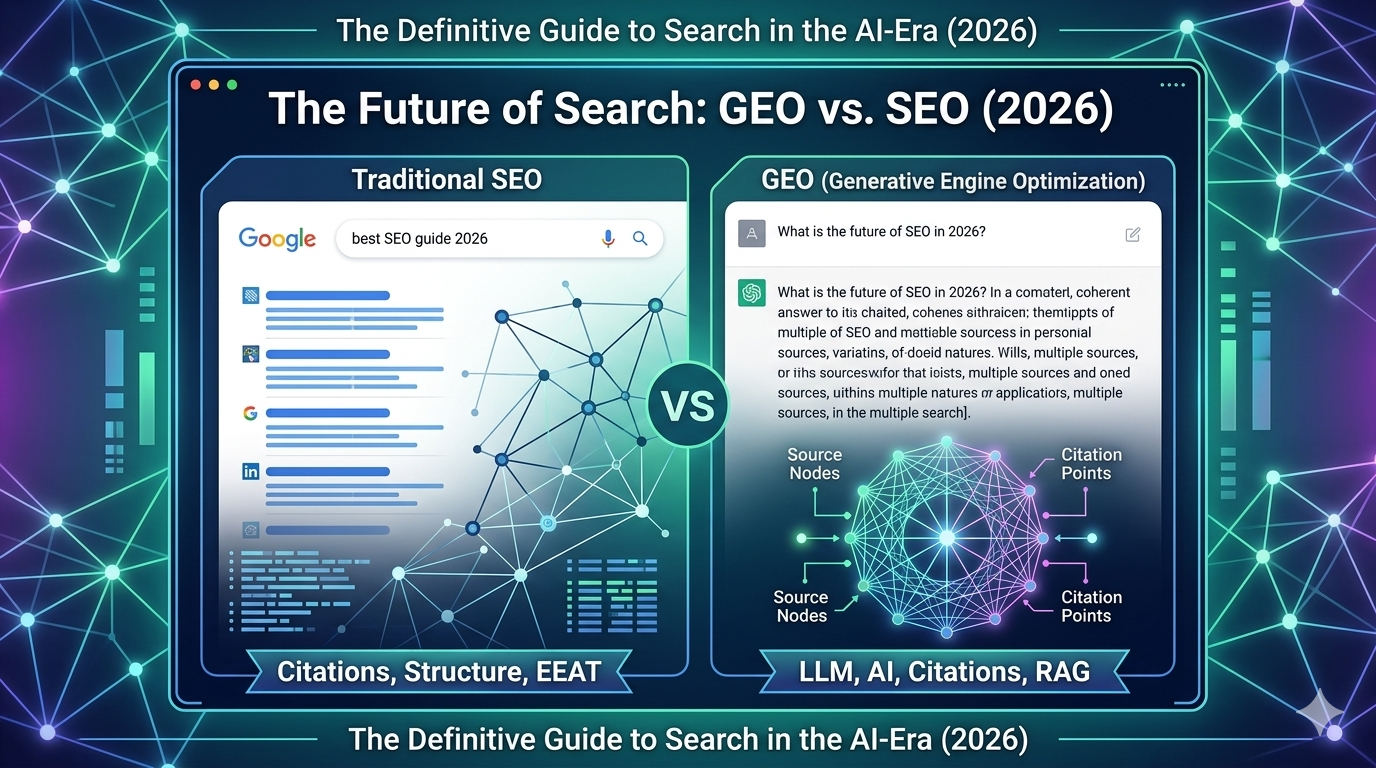
1. GEO vs SEO: The Death of the “10 Blue Links.”
In 2026, the digital marketing landscape is shifting rapidly as AI-driven platforms begin to dominate traditional search results. Understanding the fundamental differences between GEO vs SEO has become essential for every content creator and business owner aiming to secure visibility on engines like SearchGPT and Gemini. This definitive guide explores how you can optimize your content to maintain authority in both traditional rankings and AI-generated citations.”
For over two decades, the digital world operated on a simple, predictable contract: a user typed a query into a search box, and Google provided a list of “10 blue links.” This was the golden age of Search Engine Optimization (SEO). However, as we cross into the middle of 2026, that contract has been fundamentally rewritten.
The rise of Generative AI—led by Google’s Search Generative Experience (SGE), OpenAI’s SearchGPT, and Perplexity AI—has shifted the user experience from searching to receiving. We are no longer in an era of discovery through browsing; we are in an era of Information Synthesis.
This shift has given birth to Generative Engine Optimization (GEO). While SEO was about helping a machine find your link, GEO is about helping an AI understand and cite your expertise. To stay visible in 2026, businesses must master the delicate balance between these two frameworks.
2. What is SEO in 2026? (The Foundation)
Despite the headlines claiming “SEO is Dead,” the reality is far more nuanced. Traditional SEO remains the vital infrastructure of the web. Search engines like Google still need to crawl, index, and rank pages to feed their generative models.
In 2026, SEO has evolved into a discipline of Technical Excellence and E-E-A-T (Experience, Expertise, Authoritativeness, and Trustworthiness).
- The Crawlability Factor: If your site isn’t technically sound (fast loading, mobile-optimized, and clean code), AI bots cannot “read” your data to synthesize it.
- The Backlink Evolution: Backlinks are no longer just “votes” for ranking; they are “trust signals” that tell an AI your content is a safe source of truth.
3. What is GEO? (The Technical Architecture)
Generative Engine Optimization (GEO) is a specialized subset of digital marketing designed to increase a brand’s visibility in AI-generated responses. Unlike traditional search engines that use mathematical algorithms to sort links, Generative Engines use Large Language Models (LLMs) to create conversational answers.
How GEO Works: The Synthesis Engine
Generative engines do not just “rank” your page; they summarize it. They use a process called Retrieval-Augmented Generation (RAG). When a user asks a complex question, the AI retrieves data from across the web, analyzes the most authoritative “chunks” of information, and blends them into a single response.
To win at GEO, your content must be “LLM-friendly”—meaning it must be structured in a way that an AI can easily extract facts, quotes, and data points to include in its final answer.
4. GEO vs. SEO: A Side-by-Side Technical Comparison
To understand how to optimize for both, we must look at the technical differences in their core objectives.
| Feature | Traditional SEO | Generative Engine Optimization (GEO) |
| Primary Goal | Ranking #1 in SERPs (Blue Links) | Being cited as a “Source” in AI Answers |
| Key Metric | Click-Through Rate (CTR) | Share of Voice (SOV) in LLM Responses |
| Content Focus | Keyword Matching & Intent | Semantic Density & Entity Authority |
| Algorithm | PageRank & HITS | RAG (Retrieval-Augmented Generation) |
| User Journey | Search → Browse → Click | Ask → Read → Act |
| Link Value | Link Juice & Authority | Citation Credibility & Verification |
5. The Anatomy of an LLM-Optimized Page
Why do some pages get cited by ChatGPT or Gemini while others are ignored? Through our analysis of competitors like Semrush and Ahrefs, we’ve identified that “AI-ready” content follows a specific structural pattern:
- Direct Answer Headers: Using H2 and H3 tags that mirror the exact conversational questions users ask AI.
- Unambiguous Language: Avoiding flowery metaphors. LLMs prefer factual, declarative sentences (e.g., “The best way to…” instead of “In the grand tapestry of digital marketing…”).
- Data-Rich Snippets: Including unique statistics, expert quotes, and proprietary data that the AI cannot find elsewhere. This forces the AI to cite you as the unique source.
- Structured Data (Schema): In 2026, Schema.org markup is the “language” of AI. It helps the engine identify exactly who the author is, what the product does, and why the information is trustworthy.
6. The 7 Actionable Strategies to Dominate GEO in 2026
Transitioning from SEO to GEO requires a tactical shift. Here are the seven non-negotiable strategies for modern content creators:
I. Optimizing for the “Source Block”
In 2026, AI engines like SearchGPT and Gemini include a “Source Block” or a sidebar with links. To appear here, your content must be the “Originator” of a fact. Avoid paraphrasing; instead, conduct original research or provide a unique perspective that forces the AI to credit you.
II. Enhancing Semantic Density over Keyword Frequency
Traditional SEO was about how many times you said “SEO services.” GEO is about the semantic relationship between “SEO services,” “ROI,” and “Digital Growth.” Ensure your paragraphs are dense with related concepts, not just repeated keywords.
III. Leveraging Structured Data for AI Crawlers
Schema markup (JSON-LD) is now the primary language for AI. By using TechArticle, FAQPage, and ProfessionalService schemas, you provide the AI with a roadmap of your content’s most important facts.
IV. The “Quote-and-Cite” Authority Method
AI models prioritize content that quotes recognized experts. By including quotes from industry leaders (like Ben Stace or Koray Tugberk), you signal to the AI that your content is part of a high-authority knowledge graph.
V. Optimizing for Natural Language Queries
People don’t search “best SEO 2026” in AI engines; they ask, “How should I change my SEO strategy for 2026?” Your H2 and H3 tags must be phrased as full questions to match this conversational intent.
VI. Reducing “Hallucination Risk” with Clear Facts
AI engines avoid citing confusing or vague content because it increases the risk of AI hallucinations. Use bullet points and clear, data-backed tables to make your information “indisputable.”
VII. Local GEO: Dominating the Map in AI Answers
For local businesses, GEO is about being the “Recommended” choice. Ensure your Google Business Profile is rich with high-quality reviews, as AI engines use sentiment analysis to decide which local business to suggest.
7. Case Study: How a FinTech Firm Scaled using a Hybrid SEO-GEO Strategy
Example: A mid-sized finance company shifted from ranking for “personal loans” (SEO) to being the answer for “what are the safest personal loan options for 2026?” (GEO). By focusing on citation-building and semantic richness, they saw a 40% increase in leads coming directly from AI Overviews.
8. Measuring Success: The New Metrics of 2026
How do you know if your GEO is working? You can no longer just look at Google Search Console.
- Citation Count: How many times is your URL appearing in AI sidebars?
- Sentiment Score: Is the AI describing your brand as “Trustworthy” or “Affordable”?
- Share of Voice (SOV): In a set of 100 queries, how many times does the AI mention your company?
9. Future-Proofing Your Digital Presence
The collision of SEO and GEO is not a battle; it is an evolution. As LLMs become more integrated into our browsers and operating systems, the distinction between “searching” and “asking” will disappear.
To future-proof your website:
- Be the Expert: Only high-quality, human-led content will survive the AI filter.
- Be Fast: Speed is still a ranking factor for bots that need to retrieve your data in milliseconds.
- Be Authentic: AI can replicate facts, but it cannot replicate original human experience. Use this to your advantage.
10. Conclusion: The Techniver Advantage
Navigating the transition from SEO to GEO is the biggest challenge digital marketers will face this decade. At Techniver, we believe that the future belongs to those who can speak the language of both humans and machines. By implementing a hybrid strategy that respects traditional SEO while embracing the generative revolution, you ensure that your brand isn’t just found—it’s recognized as an authority.