


Introduction to VhatGPT
Artificial Intelligence (AI) continues to revolutionize the way humans interact with technology, and VhatGPT stands out as one of the most advanced conversational AI platforms of 2026. Designed to assist both individuals and institutions, it leverages the power of large language models (LLMs) to provide intelligent responses, content generation, and even personalized guidance. Its unique ability to understand context and deliver coherent, human-like answers has made it increasingly popular in schools, businesses, and personal projects.
VhatGPT, unlike conventional chatbots, integrates robust AI research and user-friendly design, ensuring seamless interaction across devices and platforms.
What is VhatGPT?
It is an AI-powered conversational platform that provides advanced, context-aware responses for a variety of tasks. It is built on principles similar to other leading LLMs, such as OpenAI’s GPT and Google Bard. Still, it distinguishes itself through education-focused features, enhanced privacy controls, and a user-friendly interface suitable for both students and professionals.
Definition and Core Functionality
At its core, VhatGPT functions as an intelligent assistant capable of understanding natural language prompts and generating meaningful responses. Users can ask questions, request content creation, or even seek help with coding, mathematics, and research. Its architecture relies on deep learning models trained on extensive datasets, ensuring accurate predictions and adaptive responses.
The AI continuously refines its answers through fine-tuning and reinforcement learning, allowing it to handle complex queries with increasing efficiency. For those following AI trends, VhatGPT exemplifies the rapid evolution of LLMs in delivering practical, everyday applications while maintaining safety and reliability standards.
Key Features of VhatGPT
- Advanced Conversational Abilities: VhatGPT can engage in detailed discussions, summarize information, and provide step-by-step instructions for problem-solving.
- Educational Integration: Features designed specifically for classroom and remote learning scenarios, including homework guidance and learning assistance.
- Multi-Platform Access: Available on web, desktop, and mobile, ensuring users can interact seamlessly from any device.
- Customizable Outputs: Users can adjust the tone, style, and length of responses, making it ideal for professional, creative, and personal use.
How It Differs from Other LLMs
While OpenAI’s GPT and Google Bard are widely recognized, VhatGPT offers several advantages:
- Education-Friendly Filters: Prevents inappropriate outputs in school environments.
- Enhanced Privacy Controls: Provides clear policies on data usage and reporting, which is especially crucial for students and educators.
- Simplified Interface: Unlike some LLMs that require technical expertise, VhatGPT’s intuitive design makes it accessible for all age groups.
By combining robust AI capabilities with practical features, it positions itself as a leading tool for both casual and professional users.
How to Use VhatGPT
Using VhatGPT effectively requires understanding its interface, available features, and best practices. Whether for school, business, or personal projects, following the correct steps ensures maximum productivity.
Creating an Account and Setting Up
- Sign-Up: Visit the official VhatGPT website (also known as Xchat) and create an account using an email or social login.
- Device Compatibility: It supports Windows, macOS, Android, and iOS devices.
- Initial Configuration: Set your preferred language, default output style, and privacy settings to match your intended use.
Navigating the Interface
The user interface is designed for simplicity:
- Chat Window: Enter prompts and receive real-time responses.
- History Panel: Track previous conversations and revisit useful answers.
- Settings Menu: Adjust model behavior, output length, and tone preferences.
Best Practices for Effective Use
- Clear Prompts: Specific and concise questions yield better answers.
- Iterative Queries: Use follow-up questions to refine responses.
- Safe Usage: Avoid sharing sensitive personal information to maintain privacy.
- Educational Use: Integrate responsibly for research and homework, citing sources properly.
By mastering these basics, users can harness the full potential of VhatGPT in a wide range of applications.
VhatGPT in Education
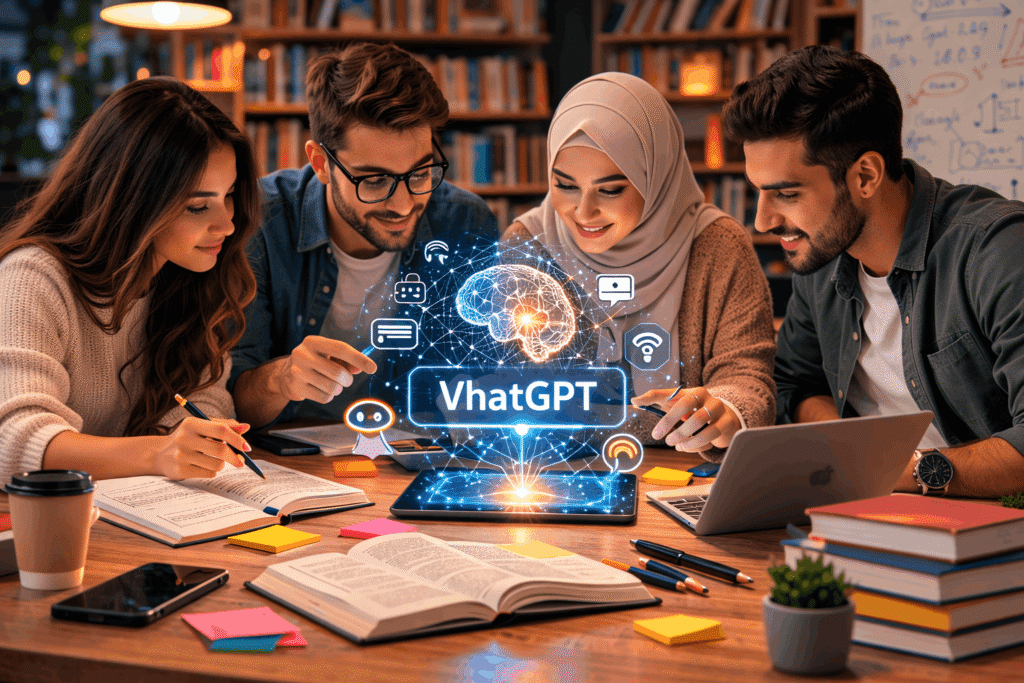
It has gained substantial traction in educational environments, providing unique opportunities for both teachers and students. However, concerns about privacy and academic integrity remain central to discussions around its use.
Does VhatGPT Report Its Chats to Schools?
A common question among students and educators is whether VhatGPT shares conversation data with institutions. Official policies indicate that it does not automatically report individual chats to schools. The platform uses data primarily for improving AI performance, adhering to strict privacy guidelines. In some managed educational deployments, administrators may have access to usage summaries, but content-specific reporting is not the default behavior.
This approach contrasts with certain school-oriented platforms, which monitor student activity more closely. It balances usability with privacy, ensuring students can safely explore its capabilities.
Benefits for Students and Teachers
- Homework Assistance: Explains concepts clearly and provides step-by-step problem-solving guidance.
- Learning Enhancement: Supports multiple subjects and languages, helping bridge knowledge gaps.
- Teacher Support: Enables educators to generate lesson plans, quiz questions, and educational resources efficiently.
Potential Risks and Misuse
While VhatGPT is powerful, it can be misused for academic dishonesty if not monitored properly. Teachers and institutions are encouraged to provide guidelines for responsible use, integrating AI as a supplementary tool rather than a replacement for learning.
Technical Insights of VhatGPT
It is not just another chatbot; it represents the convergence of state-of-the-art AI research, LLM innovations, and practical usability. Understanding its technical foundations can clarify why it delivers accurate, context-aware responses consistently.
How VhatGPT Works Behind the Scenes
It is built on large language models (LLMs), which are neural networks trained to predict text sequences. This involves:
- Pretraining: The model is exposed to billions of text sequences from diverse sources, including books, websites, and academic papers.
- Fine-Tuning: Developers optimize the model for specific tasks like educational assistance, conversational flow, and content generation.
- Reinforcement Learning with Human Feedback (RLHF): Human reviewers guide the AI to produce safe, accurate, and contextually relevant outputs.
These layers ensure that VhatGPT can understand nuances in language, handle complex queries, and generate content comparable to professional writing. For AI enthusiasts, its architecture reflects trends seen in GPT-4, ChatGPT, and other advanced LLMs, combining deep learning with practical deployment considerations.
Integration with APIs and External Tools
VhatGPT supports integration via APIs, enabling developers and businesses to embed AI capabilities into applications. Some notable features include:
- Content Generation Tools: Automate writing, summaries, and reports.
- Educational Apps: Enhance interactive learning with AI-powered tutoring.
- Productivity Integration: Connect with office software to draft emails, generate data analysis, or create code snippets.
Such integration ensures that it is not just a standalone chatbot but part of a larger AI ecosystem, reinforcing its relevance for students, educators, and professionals.
Updates and Maintenance
VhatGPT is regularly updated to improve accuracy, add features, and ensure compliance with safety standards. Downtime can occur during maintenance or server upgrades, but the platform maintains high uptime compared to other LLMs. By monitoring AI news and research, users can stay informed about major updates, algorithm improvements, and reliability statistics.
Common Issues with VhatGPT
Even advanced AI platforms can encounter technical and user-related issues. Understanding these challenges helps users troubleshoot effectively.
Is VhatGPT Down?
Temporary service disruptions may happen due to:
- High server load during peak usage
- Scheduled maintenance or updates
- Network or connectivity issues
Users can check official status pages or social media updates from the VhatGPT team. Monitoring AI news portals can also provide real-time alerts on outages or feature updates.
Troubleshooting Tips
Common fixes include:
- Refreshing the browser or app
- Checking internet connectivity
- Logging out and back in
- Clearing the cache or updating the app to the latest version
Persistent issues can be reported to support for resolution, ensuring smooth interaction without compromising productivity.
Ownership and Development
Understanding who owns and develops VhatGPT provides context about its reliability, roadmap, and trustworthiness.
Who Owns VhatGPT?
It is developed and maintained by a team of AI researchers and engineers backed by prominent AI-focused companies and investors. While the exact company details may vary depending on regional deployments, the platform adheres to global AI ethical standards and emphasizes safe, responsible AI usage.
Corporate Vision and Roadmap
The developers aim to:
- Expand multi-language support and educational tools
- Enhance privacy and compliance, particularly for school deployments
- Integrate more advanced AI capabilities, including multimodal inputs
These strategic goals align with AI news coverage and industry trends, showcasing VhatGPT as a forward-looking AI platform.
Advanced Applications of VhatGPT
VhatGPT’s capabilities extend beyond casual conversation, enabling diverse professional, creative, and research applications.
Professional Use Cases
- Business Automation: Drafting reports, emails, and client communications.
- Data Analysis: Summarizing research findings or generating insights from datasets.
- Content Creation: Blogging, social media posts, and creative writing.
Integration in AI News and Research
Many AI news platforms cite VhatGPT in discussions about AI advancements, benchmarks, and real-world applications. Its inclusion in studies and reports reflects recognition from top AI research communities, highlighting its relevance in modern AI ecosystems.
Creative and Personal Uses
- Storytelling, writing exercises, and journaling
- Interactive learning tools for students
- Personal productivity hacks and planning assistance
This versatility allows users from all backgrounds to leverage AI without requiring technical expertise.
Comparison with Other AI Chatbots
For those deciding among AI tools, comparing VhatGPT with other LLMs highlights its strengths.
GPT-4 vs. VhatGPT
- Response Quality: Both are highly capable, but VhatGPT emphasizes educational filters.
- Speed: VhatGPT offers faster response times in certain regions due to optimized infrastructure.
- Customization: VhatGPT allows output style adjustments more easily for specific applications.
Google Bard vs. VhatGPT
- Accuracy: It often delivers context-aware replies with fewer generic responses.
- Accessibility: Simplified interface for students and teachers.
- Integration: API access for productivity apps and educational software.
Other Emerging LLMs
Several LLMs like Anthropic’s Claude and Meta’s LLaMA are gaining traction. AI news frequently reports on benchmarking studies where VhatGPT demonstrates competitive performance in language understanding, text generation, and educational applications.
Is VhatGPT a Real AI Tool or Just a Trend?
With the rapid rise of AI chatbots, many users wonder whether VhatGPT is a genuine AI platform or simply another short-term trend circulating online. Discussions across developer forums, tech communities, and AI enthusiasts suggest that VhatGPT is part of the broader wave of conversational AI tools built using large language model (LLM) technology. Similar to systems developed by companies such as OpenAI, Google, and Anthropic, platforms like VhatGPT rely on advanced neural networks to generate human-like responses and assist with tasks such as research, writing, and problem-solving.
Discussion in AI Communities
Across online AI forums, developers and technology analysts often discuss whether emerging tools like VhatGPT represent independent AI projects or alternative interfaces built around existing language models. Communities frequently compare their responses, usability, and features with well-known conversational AI platforms such as ChatGPT and Claude. These discussions help users evaluate the tool’s reliability, accuracy, and real-world usefulness.
Confusion with Other Chatbots
One reason VhatGPT sometimes confuses is the similarity in naming and functionality to other AI chatbots. Many users assume it is directly related to ChatGPT or other well-known models, but in most cases, platforms like VhatGPT operate as separate tools or interfaces that may use different AI infrastructures. This naming similarity can lead to misconceptions about ownership, capabilities, and official affiliations.
Comparison with Major LLM Platforms
When compared with leading AI systems, VhatGPT generally focuses on simplicity, accessibility, and education-friendly usage. While major AI companies such as Meta and Google develop large-scale foundational models, tools like VhatGPT often aim to provide a simplified environment for students, educators, and casual users.
| Feature | VhatGPT | ChatGPT | Claude | Google Bard |
|---|---|---|---|---|
| Primary Focus | Education support and easy AI interaction | General-purpose AI assistant | Long-context reasoning and analysis | Search-integrated AI responses |
| Developer | Independent / emerging AI platform | OpenAI | Anthropic | |
| Typical Users | Students, educators, beginners | Professionals, developers, businesses | Researchers and advanced users | General internet users |
| Interface | Simple and beginner-friendly | Advanced features and integrations | Focused on long conversations | Integrated with Google ecosystem |
| Core Technology | Large Language Models (LLMs) | GPT-based models | Claude LLM architecture | Gemini-based models |
Overall, rather than being a temporary trend, VhatGPT reflects the growing expansion of AI chatbot ecosystems, where multiple tools coexist to serve different audiences and use cases.
Future of VhatGPT
Upcoming Features
- Multimodal AI: Ability to process text, audio, and image inputs seamlessly
- Enhanced Personalization: AI adapts more effectively to individual user needs
- Collaboration Tools: AI-assisted teamwork and research support
AI Trends and Predictions
It is positioned at the intersection of AI in education, business, and research. With increasing AI adoption, platforms like VhatGPT will become central to learning ecosystems, productivity workflows, and even creative industries, reinforcing the relevance of staying updated through AI news portals.
Frequently Asked Questions
What is VhatGPT?
It is an advanced AI conversational platform powered by large language models (LLMs). It provides context-aware responses, content generation, educational support, and professional tools, making it suitable for students, teachers, businesses, and creative applications.
Who owns VhatGPT?
It is developed by a team of AI researchers and engineers, supported by AI-focused companies and investors. Its ownership emphasizes ethical AI use, ongoing development, and safe integration into educational, professional, and personal environments.
How to use VhatGPT effectively?
Users can maximize it by entering clear, specific prompts, adjusting response length and tone, iterating follow-up questions, and responsibly citing outputs for school, work, or creative projects. Proper usage ensures accurate and helpful AI assistance.
Does it report its chats to schools?
It does not automatically share individual conversations with schools. Data is primarily used to improve AI performance. Some managed school versions may provide usage summaries, but private content remains secure and confidential.
Is it free to use?
It offers both free and premium subscription plans. Free access provides essential features, while paid tiers unlock faster responses, advanced tools, extended conversation history, and priority support for professional and educational users.
Is it down right now?
Temporary downtime may occur due to maintenance, server updates, or high traffic. Users can check official status pages, app notifications, or AI news portals for real-time updates and troubleshooting guidance.
Can VhatGPT help with homework?
Yes, it assists with homework by explaining concepts, providing step-by-step solutions, summarizing topics, and generating study notes. Students should use it responsibly and cite outputs while integrating AI insights into their learning.
Does it support multiple languages?
It supports numerous languages, allowing global users to interact seamlessly. It can generate text, provide explanations, and translate content while maintaining context and accuracy across different linguistic environments.
How safe is it for children?
It incorporates filters and moderation to prevent inappropriate content, making it suitable for students. Schools can manage access, and parents should supervise younger users to ensure safe, responsible AI interaction.
What makes it different from other AI chatbots?
It stands out due to its education-friendly features, privacy safeguards, fast and accurate responses, customizable outputs, and seamless integration with apps. Unlike many LLMs, it combines professional, creative, and student-focused functionalities.