



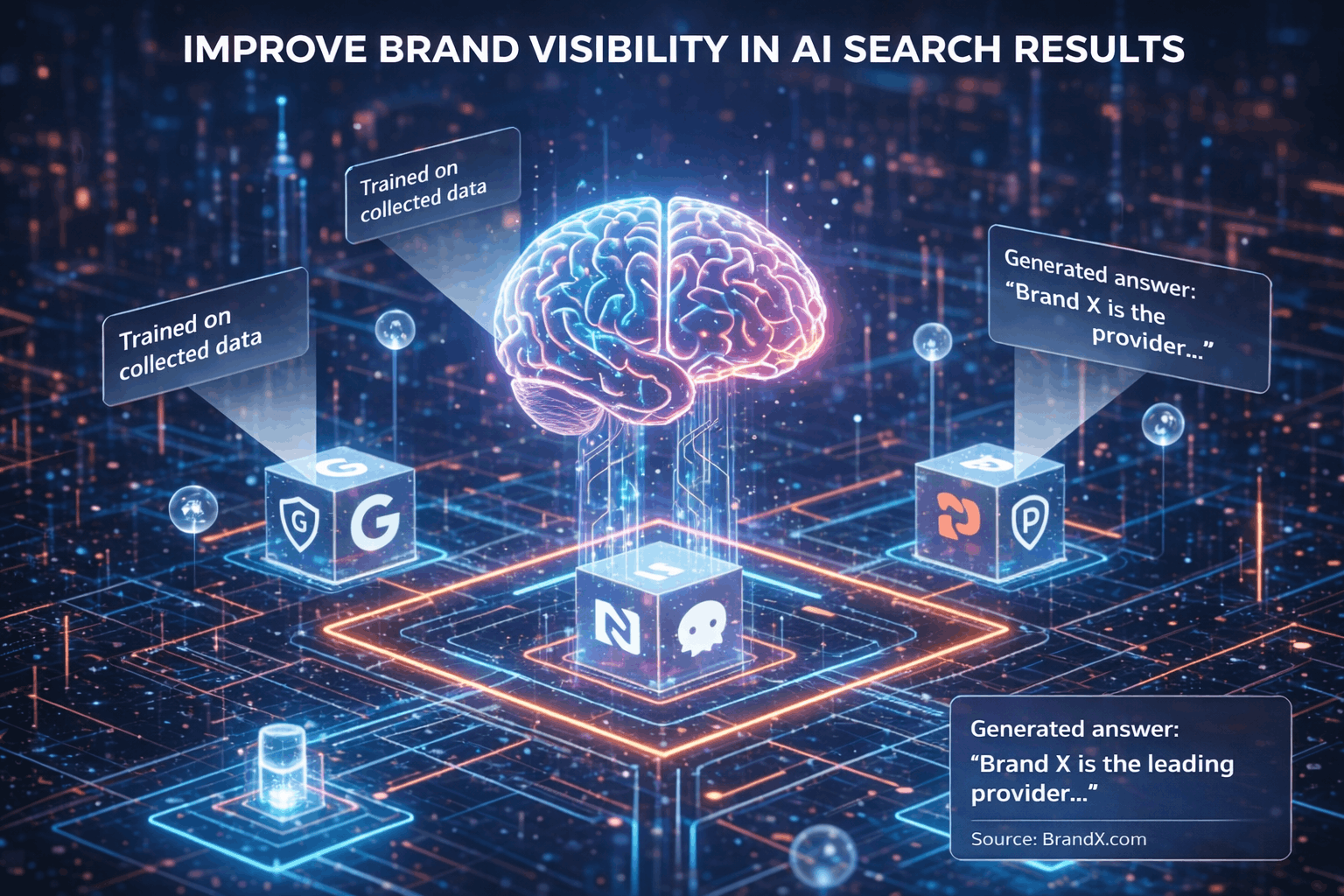
Introduction: Best Ways to Improve Brand Visibility in AI Search Results
The best ways to improve brand visibility in AI search results are implementing structured data (schema markup), strengthening entity authority, earning high-quality brand citations, and publishing clear, answer-focused content. AI platforms like Google AI Overview, ChatGPT, and Perplexity AI generate responses by synthesizing trusted sources rather than ranking keyword-optimized pages. Brands that provide machine-readable information, consistent third-party validation, and concise structured answers are more likely to be cited and recommended in AI-generated results.
1. Shift from Keyword Targeting to Entity Authority
AI search systems such as Google AI Overview, ChatGPT, and Perplexity AI use entity recognition and knowledge graph relationships instead of keyword density to generate answers. These systems identify brands, products, services, and people as structured entities and evaluate how they connect across the web.
How AI Identifies and Evaluates Entities
AI models determine whether a brand is a clearly defined Organization entity. They analyze how that entity connects to products, services, categories, and industries. They compare brand information across multiple indexed sources to confirm consistency. They also evaluate trust signals such as reviews, backlinks, credentials, and third-party mentions before deciding whether to cite the brand.
When a brand appears consistently across authoritative sources with structured relationships, AI systems assign higher entity confidence.
How to Build Entity Authority
Entity authority improves when a brand maintains identical business information across directories, social platforms, and official websites. Implementing the Organization schema with sameAs attributes connects the brand to verified external profiles. Earning contextual mentions from authoritative domains strengthens co-occurrence signals. Listing the brand in recognized industry associations further validates entity credibility.
When AI systems can clearly map a brand inside knowledge graphs, citation probability increases significantly.
2. Implement Schema Markup for Machine Readability
Schema markup improves machine interpretation by labeling content using structured vocabulary from Schema.org. AI systems rely on structured data to reduce ambiguity and confirm factual accuracy.
Core Schema Types That Influence AI Visibility
The organization schema defines the legal brand identity and ownership. Product schema specifies product name, SKU, availability, and price. Service schema clarifies service scope and service area. The FAQPage schema structures questions and answers for direct extraction. Review schema provides ratings and sentiment signals. Person schema validates author identity and expertise.
Why Structured Data Impacts AI Results
Structured data allows AI to verify brand ownership of products and services without inference. It enables clean extraction of summaries, improves attribution accuracy, and reduces confusion between similarly named brands. When the schema is missing, AI relies more heavily on third-party descriptions, which reduces control over brand representation.
Proper schema implementation increases factual clarity and improves machine-level trust signals.
3. Create Structured and Extractable Content
AI models extract information in modular segments rather than reading entire pages like humans. Content must be formatted for parsing efficiency.
Structural Requirements for AI-Friendly Pages
Each page should use one clear H1 heading followed by logical H2 and H3 subheadings. Paragraphs should remain concise and focus on one idea. Definitions should clearly answer a question in approximately 40 to 60 words. Tables should present comparisons in structured columns. Technical details should be stated declaratively without marketing language.
How AI Extracts Information
AI systems prioritize factual, direct statements that define what something is, how it works, or why it matters. They extract quantifiable data more reliably than descriptive storytelling. Structured comparisons and definition-style summaries are more likely to be cited inside generated responses.
Clear formatting increases extraction accuracy and citation likelihood.
4. Build High-Authority Brand Citations
AI models compare multiple sources before generating answers. Citation frequency increases when a brand appears consistently in authoritative publications.
Sources That Strengthen Entity Validation
Authoritative news websites provide strong trust signals. Industry research platforms reinforce subject relevance. Professional associations confirm industry participation. Academic publications increase credibility. High-authority niche blogs contribute contextual relevance.
Why Multi-Source Validation Matters
AI systems cross-reference data from different domains to verify consistency. When a brand is mentioned repeatedly in reputable contexts, entity confidence increases. Repeated validation across multiple independent sources significantly improves the chance of being cited in AI summaries.
Third-party credibility outweighs self-published promotional claims.
5. Strengthen E-E-A-T Signals
AI systems assess signals aligned with Experience, Expertise, Authority, and Trust.
Measurable Authority Indicators
Publishing content written by credentialed professionals increases expertise perception. Implementing the Person schema for authors validates identity. Displaying certifications and partnerships provides verifiable trust markers. Including measurable case studies demonstrates practical experience. Updating outdated statistics ensures accuracy.
Clear authorship and transparent organizational information increase institutional credibility and AI trust weighting.
6. Develop AI-Optimized FAQ Sections
FAQ sections align directly with AI answer-generation logic because they mirror question-and-answer structures used in conversational search.
Structural Standards for FAQ Optimization
Each FAQ answer should provide a concise factual explanation without promotional language. Questions should reflect real user search intent. Implementing the FAQPage schema allows AI systems to extract answers without reinterpretation.
When FAQs clearly answer high-intent queries, AI systems frequently use them in generated summaries.
7. Optimize Technical SEO for AI Crawling
AI systems require crawlable and semantically structured HTML to interpret content accurately.
Technical Factors That Affect AI Visibility
Page speed influences crawl efficiency, with the recommended Largest Contentful Paint under 2.5 seconds. Mobile responsiveness ensures accessibility across device types. Clean semantic HTML improves parsing clarity. Valid JSON-LD structured data prevents schema errors. Updated XML sitemaps assist indexing. Proper canonicalization prevents duplication conflicts.
Technical errors reduce parsing reliability and weaken entity recognition.
8. Maintain Cross-Platform Brand Consistency
AI systems validate brand data by comparing multiple sources.
Data Points That Must Remain Identical
The legal business name must remain consistent. Physical address and contact numbers must match across listings. Brand descriptions should align semantically. Logos should remain standardized. Social media handles must correspond to the official entity.
Inconsistent information fragments entity identity and lowers confidence scoring in AI systems.
9. Monitor AI Mentions Across Platforms
AI visibility requires continuous evaluation across generative platforms.
How to Conduct Monitoring
Test informational and commercial queries inside ChatGPT. Search brand-related queries in Google AI Overview. Verify citation sources in Perplexity AI. Analyze whether the brand is cited, how it is described, and whether competitor entities are preferred.
Monitoring identifies content gaps, misinformation, and opportunities to improve entity clarity.
10. Publish Comparative and Educational Assets
AI frequently generates responses that compare products, services, or brands.
Content Types That Increase Citation Probability
Comparative feature matrices allow AI to extract structured differences. Industry research reports provide authoritative data. Performance benchmarks offer quantifiable evidence. Cost comparisons help AI answer commercial queries.
Original, data-backed content increases extraction reliability and citation strength.
11. Use Structured Tables and Quantified Data
AI systems process numerical information with higher precision than narrative descriptions.
Recommended Data Formats
Pricing tables clarify cost structures. Specification charts detail technical attributes. Performance metrics provide measurable validation. Industry statistics with cited sources reinforce authority.
Structured numerical content improves summarization accuracy and comparison generation.
12. Correct Misinformation Proactively
AI outputs evolve based on repeated web signals.
Correction Strategy
Publish official clarification content when errors appear. Update structured data to reflect accurate details. Remove outdated or conflicting content. Strengthen authoritative citations to reinforce corrected information.
Consistent factual reinforcement gradually influences AI-generated responses.
Master Table: Factors That Improve Brand Visibility in AI Search Results
| Category | Optimization Area | Technical Implementation | Measurable Benchmark | Why AI Systems Prioritize It | Impact Level |
| Entity Authority | Organization Definition | Organization schema with name, logo, URL, sameAs | Valid JSON-LD, no schema errors | Confirms legal entity ownership | High |
| Entity Authority | sameAs Linking | Link official social profiles, Wikipedia, and LinkedIn | All major profiles connected | Cross-verifies entity identity | High |
| Entity Authority | NAP Consistency | Identical Name, Address, Phone across the web | 100% consistency in directories | Prevents entity fragmentation | High |
| Entity Authority | Knowledge Graph Inclusion | Structured entity references | Appears in brand knowledge panels | Enables AI entity mapping | High |
| Entity Authority | Industry Association Links | Listed on official association sites | Active membership listing | Adds third-party validation | Medium-High |
| Structured Data | Product Schema | SKU, price, availability, brand | Valid structured markup | Enables product comparison extraction | High |
| Structured Data | Service Schema | Service type, provider, areaServed | Schema validation passes | Clarifies service context | High |
| Structured Data | FAQPage Schema | Question–Answer structured pairs | 40–60 word answers | Direct answer extraction | High |
| Structured Data | Review Schema | ratingValue, reviewCount | Real user reviews present | Provides sentiment signals | High |
| Structured Data | Person Schema | Author name, credentials | Linked author entity | Validates expertise | Medium-High |
| Content Structure | Heading Hierarchy | Single H1, logical H2–H3 | No heading duplication | Improves content parsing | High |
| Content Structure | Paragraph Length | < 80 words | Consistent across the page | Improves extractability | Medium |
| Content Structure | Definition Blocks | 40–60 word summaries | Concise declarative answers | Higher citation likelihood | High |
| Content Structure | Comparison Tables | Feature matrix format | Clear column structure | Supports AI comparative answers | High |
| Content Structure | Declarative Language | Factual statements | No marketing exaggeration | Improves summarization clarity | High |
| Authority Signals | High-DA Backlinks | Contextual links from DA 60+ | Domain authority verified | Multi-source validation | High |
| Authority Signals | News Mentions | Coverage in trusted media | Indexed publication pages | Strengthens trust signals | High |
| Authority Signals | Research Citations | Cited in whitepapers/studies | External reference inclusion | Adds credibility weight | Medium-High |
| Authority Signals | Case Studies | Measurable performance data | Numerical results provided | Demonstrates real-world expertise | Medium |
| Technical SEO | Page Speed | LCP under 2.5 seconds | Core Web Vitals pass | Improves crawl efficiency | High |
| Technical SEO | Mobile Optimization | Responsive design | Mobile-friendly test pass | AI systems use mobile-first indexing | High |
| Technical SEO | XML Sitemap | Updated sitemap.xml | Submitted in Search Console | Ensures crawl discovery | Medium |
| Technical SEO | Canonical Tags | Proper canonicalization | No duplicate indexing | Prevents entity dilution | High |
| Technical SEO | Clean HTML | Semantic structure | No validation errors | Improves AI parsing accuracy | High |
| Brand Consistency | Logo Standardization | Same logo across platforms | Visual consistency | Supports brand recognition | Medium |
| Brand Consistency | Product Naming | Consistent SKU & naming | No variation across pages | Prevents entity mismatch | High |
| Brand Consistency | Description Alignment | Same brand description tone | Consistent metadata | Improves entity confidence | Medium |
| Monitoring | AI Query Testing | Brand queries in AI tools | Manual testing weekly | Measures citation presence | High |
| Monitoring | Citation Tracking | Source link analysis | Identify which domain is cited | Improves optimization targeting | High |
| Monitoring | Sentiment Review | Analyze AI tone | Neutral/positive representation | Protects reputation accuracy | Medium |
| Comparative Content | Best-of Lists | Structured rankings | Transparent criteria | Frequently used by AI summaries | High |
| Comparative Content | Feature Breakdown | Side-by-side attributes | Clear differentiation | Supports AI decision answers | High |
| Comparative Content | Pricing Comparisons | Transparent pricing table | Up-to-date values | Extractable commercial data | High |
| Data Authority | Industry Statistics | Referenced numerical data | Source citation included | Strengthens answer credibility | High |
| Data Authority | Benchmarks | Performance metrics | Quantified comparisons | Enables data-driven AI summaries | High |
| Misinformation Control | Official Correction Pages | Publish updated clarification | Indexed correction content | Influences AI retraining signals | Medium-High |
| Misinformation Control | Directory Updates | Update external listings | All directories aligned | Reduces conflicting signals | High |
| Content Depth | Topical Coverage | Covers “what, why, how, best” | Complete intent coverage | Improves semantic relevance | High |
| Content Depth | Internal Linking | Contextual anchor linking | Logical topic clusters | Reinforces entity relationships | High |
| Content Depth | Topical Clusters | Pillar + supporting pages | Clear content architecture | Improves knowledge mapping | High |
Measuring and Maximizing AI Visibility
AI visibility is measured by citation presence, contextual accuracy, and recommendation frequency within generated answers. It depends on entity clarity, structured data accuracy, multi-source validation, crawlable infrastructure, and verifiable authority signals.
Unlike traditional SEO rankings, AI visibility reflects how reliably your brand is interpreted and cited inside synthesized responses rather than where it appears in search listings.
Brands that prioritize structured entity authority, factual clarity, and third-party validation consistently achieve higher representation in AI-generated search results.
Conclusion: Best Ways to Improve Brand Visibility in AI Search
Improving brand visibility in AI search results depends on structured data accuracy, strong entity authority, and consistent third-party validation. AI platforms prioritize machine-readable information, verified brand signals, and concise extractable content over traditional keyword density. Implementing schema markup, maintaining cross-platform consistency, and earning authoritative mentions directly increase citation probability. Continuous monitoring across AI platforms ensures accurate representation and identifies optimization gaps. Brands that focus on factual clarity, technical precision, and entity mapping achieve stronger visibility inside AI-generated answers rather than just search rankings.
Our Experience
In our experience, improving brand visibility in AI search results required shifting completely from keyword-focused SEO to structured entity optimization. We implemented Organization, Product, and FAQ schema across key pages and strengthened third-party mentions on authoritative industry sites. After standardizing brand data and publishing concise, answer-focused content blocks, we noticed improved citation frequency in AI-generated responses. The most impactful change was combining structured data with consistent external validation rather than relying on on-page optimization alone.
FAQs
What is AI search?
AI search uses large language models to generate direct answers by combining information from multiple sources instead of showing only ranked web pages. Platforms like Google AI Overview, ChatGPT, and Perplexity AI summarize and cite content based on authority and clarity.
What is AI visibility?
AI visibility refers to how often and accurately a brand is mentioned, cited, or recommended inside AI-generated answers. It focuses on inclusion within responses rather than traditional search rankings.
How is AI search different from traditional SEO?
Traditional SEO prioritizes keyword rankings and backlinks, while AI search prioritizes entity clarity, structured data, and authoritative validation. AI systems extract and synthesize information instead of listing blue links.
What is entity authority in AI search?
Entity authority means a brand is clearly defined and consistently recognized across the web. AI systems map brands within knowledge graphs and evaluate relationships between products, services, and industries.
Does schema markup improve AI visibility?
Yes. Structured data, such as Organization, Product, FAQPage, and Review schema, improves machine readability and reduces ambiguity. Proper schema increases citation accuracy and extractability.
How do I get my brand cited in AI-generated answers?
Publish concise factual summaries, implement structured data, and secure authoritative third-party mentions. AI models prioritize brands that are consistently validated across multiple trusted sources.
Do backlinks still matter for AI search?
Yes, but quality matters more than quantity. Contextual backlinks from authoritative domains strengthen trust signals and improve entity validation in AI systems.
What type of content does AI prefer?
AI prefers clear, structured, and factual content with definition-style summaries, comparison tables, and quantifiable data. Concise answers that directly address user intent are more likely to be cited.
How can I track my AI visibility?
Manually test brand-related queries across AI platforms and analyze whether your brand appears, how it is described, and whether citations are included. Monitoring helps identify content gaps and inaccuracies.
Is AI optimization a one-time process?
No. AI visibility requires continuous updates, structured data maintenance, and ongoing authority building. Regular monitoring and refinement improve long-term citation consistency.