



Introduction
Search engines have changed completely. They do not just look for basic words anymore. Today, generative engines try to understand the real meaning behind your question. They use Natural Language Processing (NLP) to do this quickly.
If your website relies on old keyword stuffing, you will lose traffic. You are missing out on the zero-click search revolution. At Techniver, we help brands fix their data. We help them dominate modern AI search results.

What is Answer Engine Optimization (AEO)?
Answer Engine Optimization (AEO) is a highly technical science. It means structuring your content specifically for Large Language Models (LLMs). It goes beyond basic keyword matching. It focuses entirely on semantic extraction and entity resolution instead.
When a user asks a complex question, generative engines need fast answers. They rely on pre-indexed, highly structured data chunks to build responses. By optimizing for AEO, you ensure your text is the exact chunk the AI selects.
Why AEO Matters More Than Clicks
AEO is not about getting a user to click your link right away. It is about forcing the AI to use your brand as its main source. You want the AI to cite you as the ultimate truth. This builds massive trust with your target audience.
To win at AEO, you must know what AI engines want to see. They want direct answers in the very first sentence. They hate promotional fluff and annoying sales talk. They rely heavily on structured data to understand your page context.
The Techniver Approach to Semantic SEO
To outrank your rivals, you must stop writing for old web crawlers. Modern AI systems break your content down into specific entities. An entity is a person, place, concept, or organization that Google already knows.
When you write a technical guide, the AI looks for strong connections. You must map your content strategy to a broader topic. Building a comprehensive AI search glossary helps pass link equity back to core resource pages. This proves your entire domain is an expert on specific terminology.
Building Technical E-E-A-T for AI
Google uses E-E-A-T as a highly technical ranking signal. E-E-A-T stands for Experience, Expertise, Authoritativeness, and Trustworthiness. AI engines measure your trust score using pure math. They calculate the distance between your brand and proven facts.
You cannot just say you are an expert on a topic. You must prove it to the machine using backend code. Adding advanced Person and Organization schema builds algorithmic trust signals. These technical signals directly back up your core about us credentials and author expertise.
SEO vs AEO: The Core Strategic Differences

Traditional SEO and AEO have very different end goals. SEO focuses on driving clicks through basic blue links. AEO focuses on dominating the AI answer box directly. You want your exact text at the absolute top of the screen.
You need to adjust how you track your performance completely. Here is exactly how traditional SEO and AEO differ in everyday practice:
- Main Algorithm: Traditional SEO uses PageRank and backlinks. AEO uses NLP extraction and entity matching instead.
- Content Format: SEO relies on long articles with high keyword density. AEO needs short, modular data chunks and hard facts.
- Success Metric: SEO tracks high click-through rates (CTR). AEO tracks brand citations and AI Overview hits.
- Backend Code: SEO uses basic meta tags and XML sitemaps. AEO requires valid JSON-LD FAQPage and Article schema.
Why FAQ Schema is the Ultimate Tool
Large Language Models are incredibly smart, but they still read in chunks. Massive blocks of text confuse them easily. This makes it hard for them to pull exact answers. When you use FAQ Schema, you pre-chunk your data.
This allows the algorithm to easily digest your facts. Google removed visual FAQ snippets from normal search in 2023. However, the backend JSON-LD code is still incredibly powerful. It remains the strongest extraction signal today.
How FAQ Schema Boosts AI Overviews
Backend schema is vital for AI Overviews, ChatGPT, and Perplexity. Structuring your data cleanly, much like organizing AI search FAQs, acts as a direct map for search bots. It removes all the guesswork for the algorithm and ensures accurate extraction every time.
The code acts like a direct map for search bots. It removes all the guesswork for the algorithm. It guarantees that the AI finds your specific question. It ensures the bot reads your exact factual answer every time.
Platform-Specific AEO Strategies
Not all generative engines work the same way. You cannot use one trick for all of them. ChatGPT likes academic data, while Perplexity likes community advice. Google likes fast, high-ranking websites with clean technical code.
You need a multi-layered approach to win citations everywhere. If you only write for one platform, you lose traffic on the others. Let us break down how to master the big three platforms effectively.
Dominating ChatGPT Citations
ChatGPT chooses its sources based on cold, hard facts. It wants to see a strong consensus across the web. To get mentions here, your answers must read like an encyclopedia. Pack your sentences with hard data and exact percentages.
Keep your tone entirely neutral and objective. Avoid using promotional words or aggressive sales pitches. Add direct links to established industry studies. This proves your data is completely real and verified.
Securing Perplexity AI Mentions
Perplexity works like a smart research assistant for users. It prefers real-world applications over basic dictionary definitions. To rank here, you must show active experience. Share highly specific use cases to prove your actual skills.
Provide step-by-step troubleshooting methods for common problems. Talk about potential mistakes users might make. Write like you are explaining a complex topic to a coworker. Include practical, hands-on examples for every theory.
Winning Google AI Overviews (SGE)
Google’s AI ties deeply into its normal ranking signals. Your basic technical SEO must be flawless first. Your page speed must be very fast. Your mobile design must be perfect for all screen sizes.
You need a clean internal linking structure to pass equity. Update your published dates and statistics at least once a quarter. Ensure your author profiles have verified credentials. Never let your core pillar pages suffer from content decay.
The Techniver 40-60 Word Extraction Rule
Word count is a major technical factor in AI search. It decides if an AI model will extract your text or skip it. Our data at Techniver shows a clear winning pattern. The best length for an extraction block is between 40 and 60 words.
This size gives the AI enough context to understand the point. It is also small enough to fit inside the model’s output limits. Your very first sentence is the most important part. It must deliver the exact answer immediately.
Writing the Perfect AI Answer Chunk
The next two sentences should support your first claim. Use a technical reason or a hard data point here. Do not use introductory padding in your answers. Never use filler phrases like “that is a great question.”
Get straight to the point without wasting any words. Every chunk of text must make sense on its own. The AI might pull one paragraph and ignore the rest completely. It must survive without the surrounding context.
How to Structure Comparison Content for AI
Comparison content is huge for Answer Engine Optimization. When users are confused, they ask AI to compare products. AI models heavily prefer content that offers an objective view. They hate biased sales pitches and promotional rants.
Articles with clear criteria and fair pros-and-cons lists win. If you provide a fair comparison, you win the citation. The AI is much more likely to quote your data. It looks trustworthy, factual, and totally unbiased.
Using Structured Lists for AI Extraction
AI models absolutely love structured data formats. Clean lists organize data into readable rows and concepts. This makes it incredibly easy for the AI to parse facts. Always use bullet points when comparing two or more entities.
Do not use images of text on your website. The AI cannot read an image easily. Use actual HTML bullet points instead. Keep the text inside each point very short and strictly factual.
Advanced JSON-LD Implementation for AEO

Deploying FAQ schema requires strict attention to detail. JSON-LD syntax rules are highly unforgiving. A single missing comma will break your code entirely. It will make your markup invisible to all search bots.
The text inside your schema script must be exact. It must be a verbatim match to your visible frontend text. Never hide schema data from the actual user. Google considers this cloaking and issues severe manual penalties.
Validating Your Backend Schema Code
You must validate your code before going live. Use the Google Rich Results Test to check your syntax. Fix any errors before you hit the publish button. Below is a technically valid JSON-LD code template.
At Techniver, we use this exact layout for high-end client sites:
{
"@context": "https://schema.org",
"@type": "FAQPage",
"mainEntity": [
{
"@type": "Question",
"name": "How does Semantic SEO impact Answer Engine Optimization?",
"acceptedAnswer": {
"@type": "Answer",
"text": "Semantic SEO impacts AEO by structuring content around specific NLP entities instead of basic keywords. This exact mapping allows Large Language Models to accurately process context, extract facts, and confidently cite your website."
}
},
{
"@type": "Question",
"name": "What are the core technical requirements for FAQ Schema?",
"acceptedAnswer": {
"@type": "Answer",
"text": "The core technical requirements include using valid JSON-LD syntax and ensuring the schema matches your visible content. You must also validate the code through the Google Rich Results Test to prevent cloaking penalties."
}
}
]
}Monitoring AEO Metrics and Citation Velocity
Tracking your AEO success is a bit tricky today. You must look beyond traditional Google Search Console clicks. You need to establish a brand new tracking matrix. Track your brand citation velocity across the web carefully.
This metric measures how often AI chatbots actively quote your brand name. You will likely see a sharp increase in zero-click impressions. These will mostly appear for long-tail, conversational questions.
| Tracking Goal | Traditional SEO Metric | Modern AEO Metric |
| Brand Visibility | Keyword ranking positions. | AI chatbot citations. |
| User Engagement | Website clicks and sessions. | Zero-click impressions. |
| Market Authority | Domain Authority (DA) score. | Knowledge Graph presence. |
Understanding the Zero-Click Traffic Shift

This shift is a massive win for your website. It proves your content is populating AI Overviews perfectly. Direct traffic might not spike on day one. However, your branded search queries will definitely surge soon.
Users will read your AI answer and search for your brand. This shows that your topical authority is working exactly as planned. It builds massive trust and recognition within your target market.
How NLP Vectors Replace Traditional Keywords
Search algorithms no longer read pages like human readers do. They convert your sentences into mathematical vectors. A vector is a string of numbers that represents a core concept. This is how the AI measures semantic relevance.
If your vectors align with trusted knowledge bases, you rank higher. You cannot trick vectors by stuffing keywords into your headers. You must provide deep, factual explanations of the core topic. This builds real semantic density on your page.
The Role of the Google Knowledge Graph
The Google Knowledge Graph is a massive database of verified facts. It connects people, places, and concepts together logically. To win at AEO, your brand must exist inside this graph. You must become a recognized entity in your niche.
Using schema markup helps Google add you to this graph. Connecting your content to a detailed about us page strengthens this connection significantly. The AI learns to trust your domain over time. This makes your website the default answer for future queries.
Avoiding Common Cloaking Penalties
Many marketers try to cheat the AI systems today. They place valid JSON-LD code in the backend of their site. However, they hide the actual text from the user using CSS. They think this will give them an easy ranking boost.
Google considers this deceptive behavior and calls it cloaking. If you do this, your site will receive a manual penalty. Always ensure your schema text is 100 percent visible to humans. Never sacrifice your long-term trust for a quick technical trick.
Handling Content Decay in the AI Era
Content decay is the silent killer of AEO traffic. AI engines constantly look for the freshest, most accurate data. If your page has statistics from three years ago, the AI will ignore it. It will find a newer article to cite instead.
You must schedule regular content audits for your pillar pages. Update the published date, refresh the numbers, and add new examples. This simple habit keeps your content at the top of the AI citation list. It proves your website is still an active, reliable entity.
Conclusion
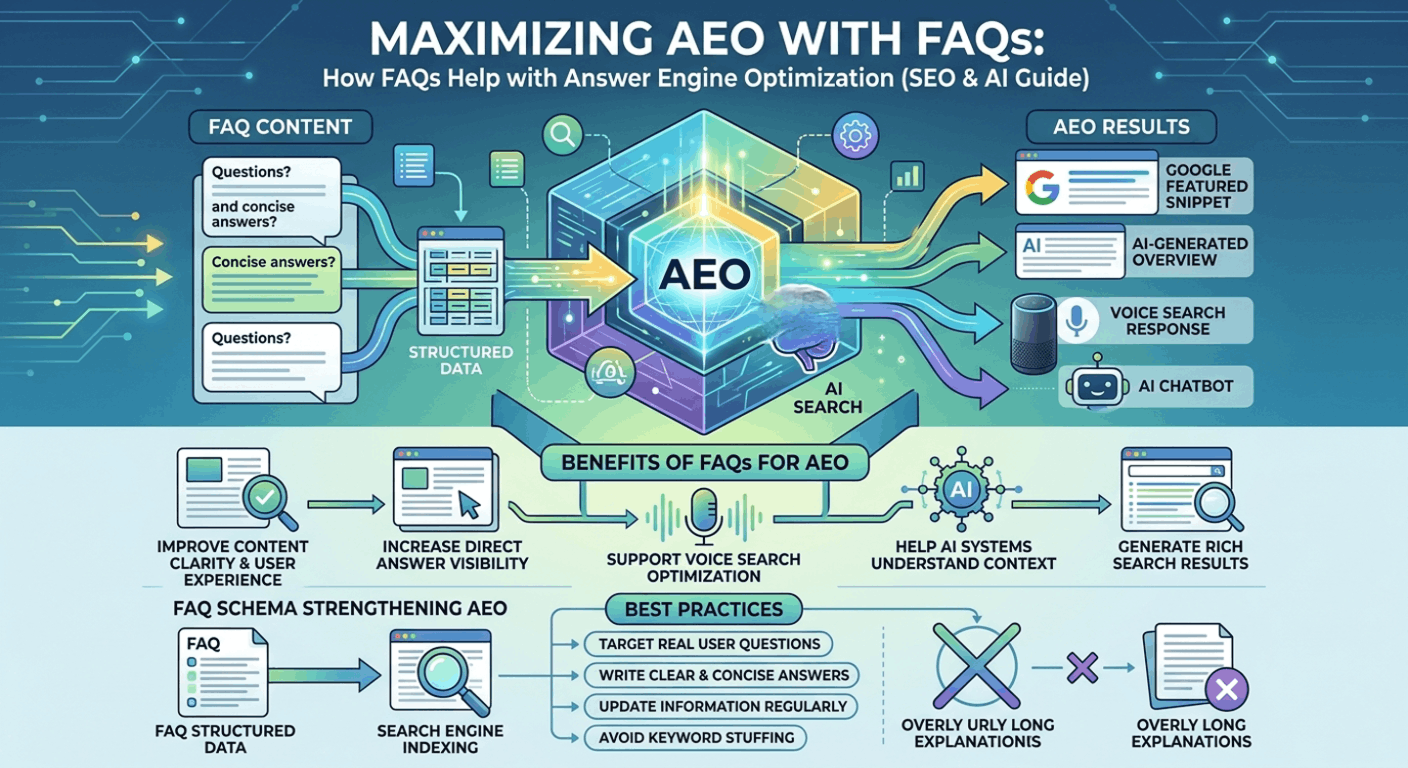
FAQs play a critical role in Answer Engine Optimization. They present information in the exact format that AI systems prefer. This structure helps search engines understand your content instantly. It also improves voice search visibility and supports AI-generated answers.
By creating accurate and well-structured FAQ sections, you gain a massive advantage. You significantly improve your chances of appearing in answer-focused search results. This simple step secures your website’s success in future AI-driven search environments.
Frequently Asked Questions on AEO Mechanics
How does TF-IDF relate to modern NLP extraction?
TF-IDF was an old metric for tracking keyword frequency. Modern NLP models do not care about it at all. They use vector embeddings to understand words and concepts. Focus on deep entity coverage instead of just repeating words.
Can I deploy FAQ schema across programmatic SEO pages?
Yes, you can use dynamic FAQ schema for programmatic pages. The answers must remain highly relevant and strictly factual. Using spun or low-quality automated answers will destroy your technical E-E-A-T score instantly.
Why did Google restrict visual FAQ snippets in traditional SERPs?
Google wanted to clean up the user search interface completely. They wanted to stop marketers from spamming the screen with promotional text. However, the backend structured data is still a vital extraction signal for their AI.
How do I measure the semantic relevance of my AEO content?
You can test your text using the Google Natural Language API. Run your content directly through their testing tool. If the API accurately identifies your main topics as primary entities, your content is perfectly optimized.
Does Techniver offer custom AEO audits for enterprise websites?
To stay ahead, marketers need to map current NLP entities and monitor generative search trends continuously. Utilizing dedicated AI search trackers allows businesses to measure their brand citation velocity. You can also deploy free AI trackers to monitor your specific zero-click impressions and adjust your strategies in real-time.
What are the Best practices for writing AEO-friendly FAQs?
Best practices include writing clear and concise answers that directly address user questions. FAQs should be updated regularly to keep information accurate and relevant. Avoid keyword stuffing and focus on natural language. Using real user questions ensures better alignment with search intent and improves AEO performance.