



Intro
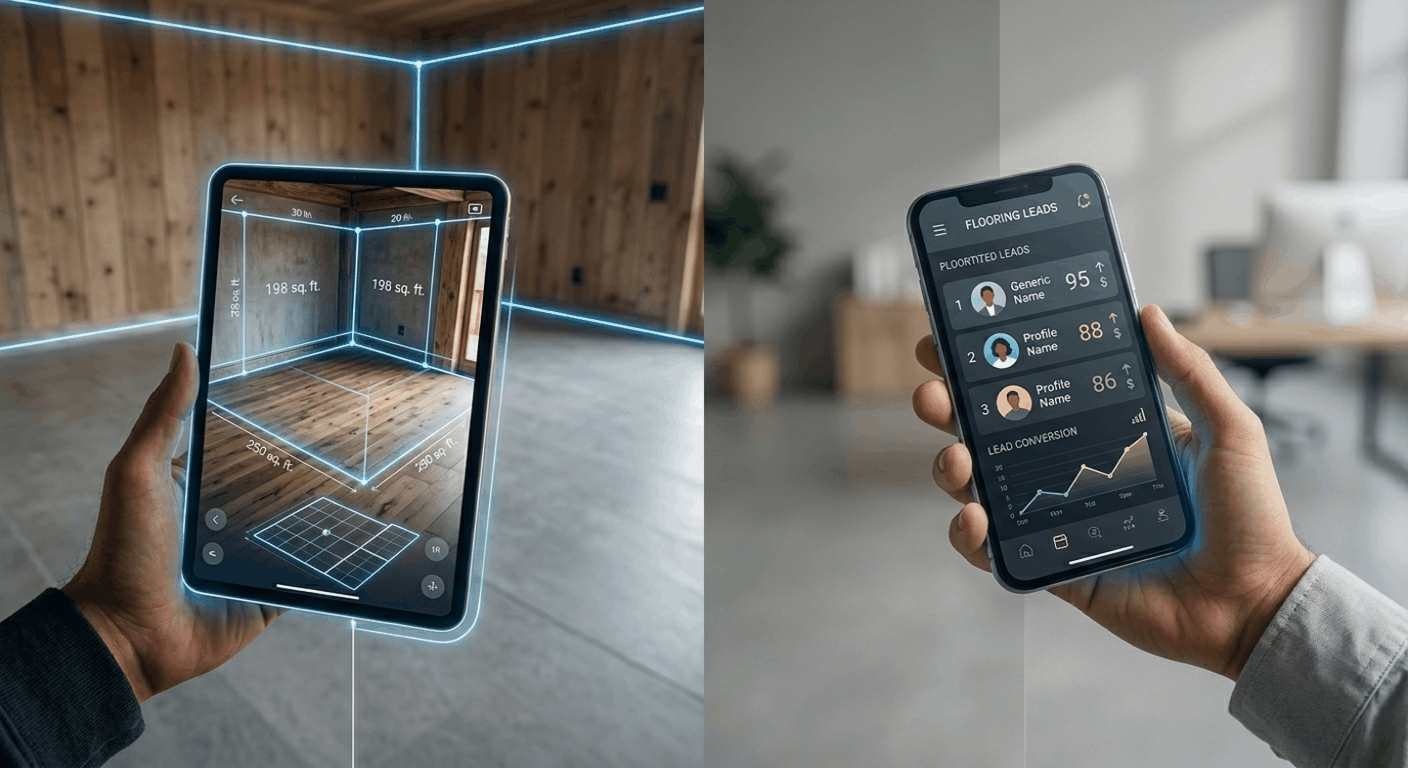
AI Tool for Flooring Measuring Lead Scoring is a software solutions that use artificial intelligence to automate room measurements and identify high-quality sales leads. These tools use technologies like computer vision, machine learning, and data analytics to deliver fast and accurate results. In flooring businesses, AI measuring apps can scan spaces using a smartphone and calculate exact floor dimensions within seconds. At the same time, AI-powered lead scoring systems analyze customer behavior to rank potential buyers based on conversion chances. This combination helps companies reduce manual work, improve estimation accuracy, and focus on profitable clients. As a result, businesses can increase efficiency, close deals faster, and boost overall revenue.
What Is an AI Tool for Flooring Measuring Lead Scoring in the Flooring Industry?
An AI Tool for Flooring Measuring Lead Scoring is a next-generation software architecture designed to unify multi-surface spatial intelligence with predictive sales pipeline analytics. In 2026, these enterprise platforms use advanced computer vision, edge machine learning, and deep predictive data modeling to completely replace manual on-site measurements and static CRM sheets. Instead of relying on human estimation, flooring contractors deploy these tools to execute two core automated workflows simultaneously:
- Autonomous Spatial Measuring: The AI instantly analyzes uploaded digital blueprints, CAD drawings, or smartphone lidar scans. It scales the rooms automatically, detects specific floor boundaries, and calculates exact material takeoffs for hardwood, carpet, or tile while accounting for waste factors.
- Predictive Lead Scoring: Beyond simple metrics, the platform tracks customer behavior, budget profiles, and project scope in real time. It applies machine learning models to score each inquiry, automatically flagging high-margin commercial contracts and prioritizing high-probability buyers for immediate sales team follow-up.
By bridging the gap between precise backend estimations and frontline client management, this integrated approach eliminates costly material waste, slashes takeoff turnaround times by up to 85%, and maximizes revenue generation across competitive flooring markets.
How AI for Flooring Measurement Processes Spatial Data
AI for flooring measurement tools utilizes next-generation spatial computing, high-density LiDAR scanning, and neural object detection to capture exact room footprints. Instead of traditional laser tape measures, estimators simply point a tablet or smartphone camera at the space to map intricate perimeters, thresholds, and transition zones in real time.
The Core Workflow: How AI-Based Measurement Works on Digital Blueprints
The software instantly applies advanced computer vision algorithms to filter out on-site obstructions like furniture or construction debris, isolating the true floor area. Once mapped, the AI generates accurate geometric outputs, instantly converting raw spatial telemetry into production-ready 2D floor plans and interactive 3D models that calculate net yardage and box counts automatically.
Key Features of AI Flooring Measurement Tools
AI-powered solutions offer a range of features that significantly improve efficiency and accuracy:
- Real-time room scanning – Instantly captures room dimensions using a mobile device
- Accurate floor area calculation – Minimizes errors compared to manual tape measurements
- 3D room visualization – Generates interactive models for better planning and presentation
- Automatic material estimation – Calculates required flooring materials based on measurements
These features help streamline the estimation process and reduce the need for repeated site visits.
Popular AI Flooring Measurement Tools
Several reliable tools are widely used in the flooring industry:
- MeasureSquare – Provides digital takeoffs, cost estimation, and project management features
- Magicplan – Uses smartphone sensors and AR to create accurate floor plans quickly
- RoomScan Pro – Enables fast room measurements and layout generation with minimal setup
These tools are designed for contractors, estimators, and sales teams looking to improve speed and precision.
Benefits of AI Flooring Measurement
Implementing AI in flooring measurement offers several measurable advantages:
- Reduced human error – Automated calculations improve accuracy
- Time efficiency – Measurements that once took hours can now be completed in minutes
- Better quotation accuracy – Precise data leads to more reliable cost estimates
- Improved customer trust – Transparent and professional estimates enhance credibility
Overall, AI measurement tools help flooring businesses operate more efficiently while delivering a better customer experience.
AI for Lead Scoring in Flooring Businesses
What Is Lead Scoring?
Lead scoring is a data-driven method used to rank potential customers based on how likely they are to convert into paying clients. In the flooring industry, this means identifying which inquiries—such as homeowners requesting quotes or businesses planning renovations—have the highest purchase intent.
AI enhances this process by automatically analyzing large volumes of customer data, including behavior, demographics, and engagement patterns. Instead of relying on manual judgment, AI assigns numerical scores to each lead, allowing sales teams to prioritize the most valuable opportunities with greater accuracy.
How AI Improves Lead Scoring
AI-powered lead scoring systems use machine learning algorithms to evaluate multiple data points in real time. These systems continuously learn from past conversions and customer interactions to improve prediction accuracy.
Key factors analyzed by AI include website activity, time spent on specific flooring products, frequency of inquiries, and indicators such as location or estimated budget. By combining these signals, AI can identify high-intent prospects much earlier in the sales funnel, enabling faster and more targeted follow-ups.
Popular AI Lead Scoring Tools
Several CRM platforms provide advanced AI-based lead scoring features for flooring businesses:
- HubSpot offers automated lead scoring, customer tracking, and marketing integration in one system
- Salesforce uses predictive analytics and AI models to forecast customer behavior and sales outcomes
- Zoho CRM provides customizable scoring rules and automation for lead prioritization
These tools help businesses centralize customer data and make smarter sales decisions.
Benefits of AI Lead Scoring
AI-driven lead scoring provides measurable advantages for flooring companies. It allows teams to focus on high-quality prospects rather than spending time on low-potential inquiries. This leads to higher conversion rates and better use of marketing resources. Additionally, AI reduces manual effort by automating the evaluation process and ensuring that no valuable lead is overlooked. Sales teams can respond faster, personalize their approach, and close deals more efficiently.
Quick Overview Table
| Aspect | Traditional Lead Scoring | AI Lead Scoring |
| Data Analysis | Manual and limited | Automated and large-scale |
| Accuracy | Depends on human judgment | High, based on data patterns |
| Speed | Slow | Real-time processing |
| Lead Prioritization | Basic rules | Predictive and dynamic |
| Conversion Potential | Moderate | Higher due to better targeting |
Integration of Measurement and Lead Scoring
Combining both AI capabilities creates a powerful workflow:
Smart Workflow Example
- Customer scans their room using an AI measurement tool
- Data is automatically stored in CRM
- AI evaluates customer intent and assigns a lead score
- Sales team prioritizes high-value clients
This integration helps flooring companies close deals faster and deliver personalized services.
Challenges and Limitations
Technical Limitations
AI flooring tools rely heavily on camera quality and environmental conditions to produce accurate results. Poor lighting, low-resolution cameras, or improper scanning angles can reduce measurement precision. Additionally, complex room layouts with irregular shapes or obstacles may affect the system’s ability to detect exact dimensions, leading to slight variations in output.
Data Privacy Concerns
AI systems collect and process customer data such as location, room images, and behavioral insights. This makes data security a critical requirement for flooring businesses using these tools. Companies must ensure proper encryption, secure storage, and compliance with data protection regulations to avoid misuse and maintain customer trust.
Cost of Implementation
While AI tools improve efficiency, they often come with subscription costs or licensing fees, especially for advanced features. Small businesses may find initial adoption expensive compared to traditional methods. In addition, staff training is required to use these tools effectively, which can take time and temporarily impact productivity during the transition phase.
Future of AI in the Flooring Industry
The future of AI in the flooring industry is driven by continuous advancements in automation, data analytics, and user-friendly technologies. As AI systems become more accurate and affordable, flooring businesses are expected to adopt these tools on a larger scale. This shift will not only improve operational efficiency but also enhance customer experience through faster service and personalized solutions.
Emerging Trends in AI Flooring Technology
AI-powered innovations are reshaping how flooring companies design, measure, and sell their products. One major trend is virtual flooring previews, where customers can visualize different flooring styles in their own space using augmented reality before making a purchase decision.
Another key development is voice-assisted measurement tools, allowing users to control scanning and measurements through simple voice commands, making the process more convenient and accessible. Additionally, predictive demand forecasting is helping businesses analyze market trends and customer data to anticipate product demand, optimize inventory, and reduce waste.
AI is also enabling fully automated sales pipelines, where lead generation, scoring, follow-ups, and even quotations are managed with minimal human input. This reduces response time and increases the chances of closing deals efficiently.
Future Impact on Flooring Businesses
As these technologies continue to evolve, AI tools will become more cost-effective and easier to use, making them accessible even for small and medium-sized flooring businesses. Companies will be able to operate with greater precision, reduce overhead costs, and deliver faster, data-driven services.
In the long term, AI is expected to become a standard part of flooring operations, helping businesses stay competitive in a market that increasingly values speed, accuracy, and customer-centric solutions.
Overview of AI in the Flooring Industry
| Section | Key Points | Technologies Used | Business Impact |
| AI in Flooring Industry | Automates measurement & lead management | AI, Machine Learning, Data Analytics | Faster decisions, reduced manual work |
| Flooring Measurement | Scans rooms, calculates dimensions, creates layouts | Computer Vision, AR | High accuracy, time-saving |
| Measurement Features | Real-time scanning, 3D models, material estimation | Mobile Sensors, AI Algorithms | Better planning & estimation |
| Measurement Tools | MeasureSquare, Magicplan, RoomScan Pro | Cloud + Mobile Apps | Professional workflow automation |
| Lead Scoring | Ranks customers based on conversion chances | AI, Predictive Analytics | Focus on high-quality leads |
| Lead Scoring Tools | HubSpot, Salesforce, Zoho CRM | CRM + AI Integration | Improved sales performance |
| Benefits | Accuracy, efficiency, better conversions | Integrated AI Systems | Increased revenue |
| Challenges | AI in the Flooring Industry | Security Systems, AI Models | Requires investment & compliance |
| Future Trends | Virtual previews, voice tools, demand forecasting, automation | AR, NLP, Predictive AI | Scalable growth & innovation |
Conclusion
AI tools for flooring measurement and lead scoring are reshaping how businesses operate. By automating measurements and intelligently prioritizing leads, companies can improve accuracy, save time, and boost revenue. While there are some challenges, the long-term benefits make AI a valuable investment for the flooring industry.
FAQs – AI Tool for Flooring Measuring Lead Scoring
What are AI tools for flooring measurement?
AI flooring measurement tools are software applications that use computer vision and augmented reality to calculate room dimensions automatically. These tools work through smartphones or tablets, scanning spaces in real time. They eliminate manual measuring errors and provide accurate floor area calculations. This helps contractors create faster and more reliable estimates.
How accurate are AI flooring measurement tools?
Most modern AI tools offer high accuracy when used correctly with proper lighting and scanning angles. While they may not always match laser precision, they are reliable for most residential and commercial projects. Accuracy can vary depending on room complexity and device quality. Overall, they significantly reduce human error compared to manual methods.
What is AI lead scoring in flooring businesses?
AI lead scoring is a system that ranks potential customers based on their likelihood to buy flooring services. It uses data such as website activity, inquiries, and engagement behavior. The system assigns scores automatically, helping sales teams focus on serious buyers. This improves efficiency and increases conversion rates.
How does AI improve lead generation for flooring companies?
AI analyzes customer behavior, including website visits and interaction patterns, to identify high-intent users. It helps businesses target the right audience with personalized offers and follow-ups. This reduces wasted marketing efforts on low-quality leads. As a result, companies can generate more qualified leads and close deals faster.
Do AI flooring tools require special equipment?
Most AI flooring tools do not require special equipment and work on standard smartphones or tablets. Some advanced features may benefit from devices with better cameras or sensors. However, for general use, common mobile devices are sufficient. This makes AI tools accessible for both small and large businesses.
Are AI tools suitable for small flooring businesses?
Yes, many AI tools are designed to be affordable and user-friendly for small businesses. They offer scalable features that can grow with the business’s needs. By automating tasks like measurement and lead scoring, small companies can compete more effectively. This helps them save time and improve overall productivity.
What are the main benefits of using AI in flooring?
AI improves accuracy, reduces manual work, and speeds up project estimation and sales processes. It helps businesses make data-driven decisions and prioritize high-quality leads. Additionally, it enhances customer experience through faster responses and better visualization tools. Overall, it increases efficiency and profitability.
Are there any risks in using AI for flooring businesses?
Yes, there are some risks, such as data privacy concerns and dependence on technology. Inaccurate scans can occur if tools are not used properly. Businesses must also ensure customer data is stored securely and complies with regulations. Proper training and reliable software can minimize these risks.
Can AI replace human estimators in flooring?
AI is designed to assist rather than replace human estimators. It speeds up measurements and provides accurate data, but human expertise is still needed for decision-making and customization. Professionals use AI as a support tool to improve efficiency. This combination leads to better results and customer satisfaction.
What is the future of AI in the flooring industry?
The future of AI in flooring includes innovations like virtual previews, automated sales systems, and predictive analytics. These technologies will make processes faster and more customer-focused. As costs decrease, more businesses will adopt AI solutions. This will make AI a standard part of the flooring industry in the coming years.