



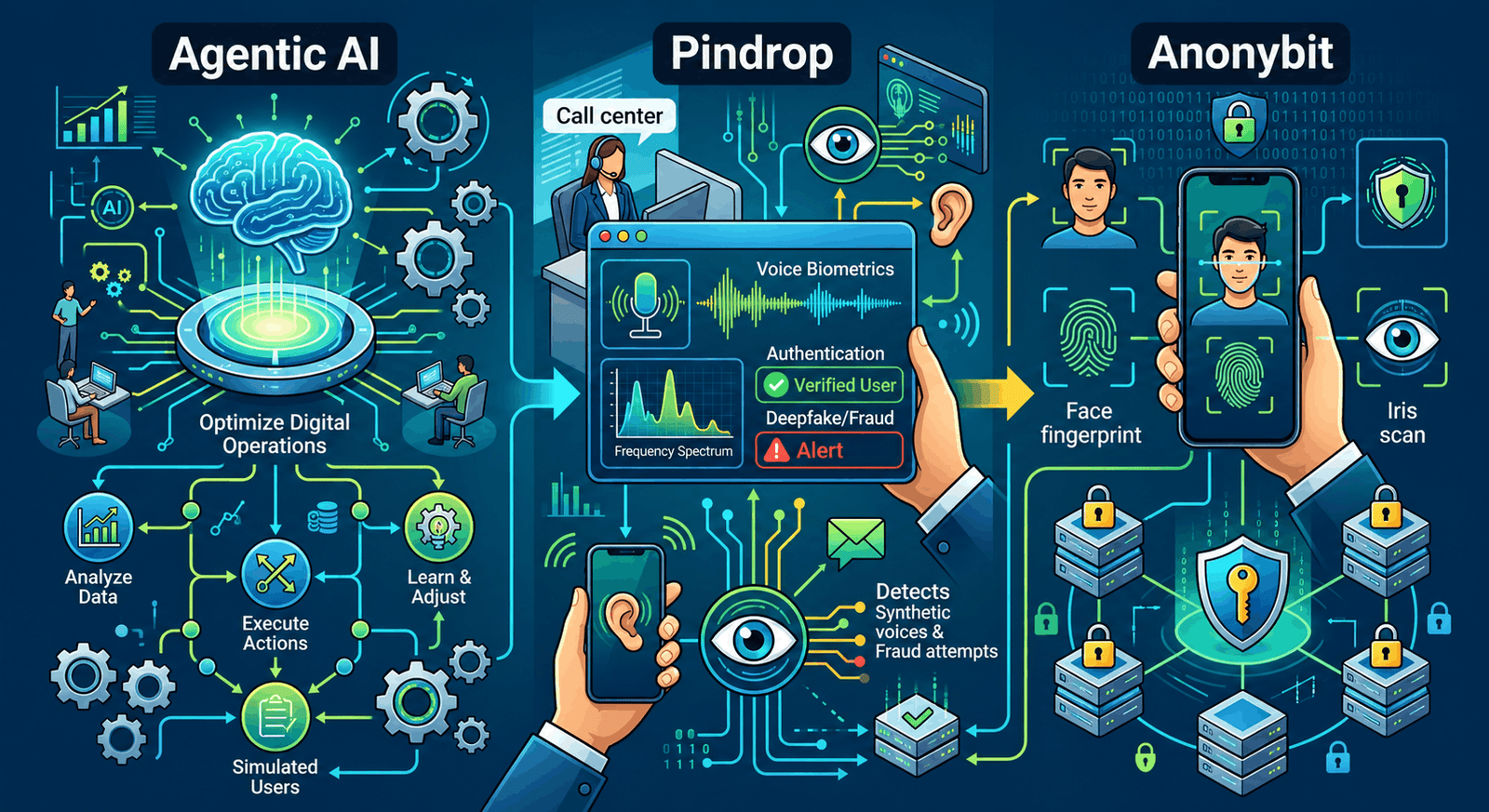
Agentic AI Pindrop Anonybit
Artificial Intelligence (AI) is rapidly evolving from basic automation to advanced systems like Agentic AI, which can independently plan, decide, and execute tasks with minimal human input. This shift is driving innovation in areas such as cybersecurity, identity verification, and fraud detection. Companies like Pindrop and Anonybit are leveraging Agentic AI to enhance digital security through voice authentication and decentralized biometric systems. In this article, we explore Agentic AI, along with platforms like Pindrop and Anonybit, and how they are transforming modern security and identity solutions.
What is Agentic AI?
Agentic AI is an advanced form of artificial intelligence that can operate autonomously to achieve specific goals with minimal human intervention. Unlike traditional AI systems that simply respond to prompts, Agentic AI can plan tasks, make decisions, and execute multi-step actions in a structured and goal-oriented way. This makes it more powerful and practical for real-world applications where continuous decision-making and automation are required.
How Agentic AI Works
Agentic AI follows a goal-driven workflow where it first understands the objective, then breaks it into smaller steps, and finally executes those steps automatically. It can also adjust its actions based on feedback or changing conditions, making it more adaptive than traditional AI tools like ChatGPT.
Key Features of Agentic AI
Autonomous Decision-Making
Agentic AI can make independent decisions based on data and predefined goals without requiring constant user input.
Multi-Step Task Execution
It can handle complex tasks by dividing them into smaller steps and completing them in sequence.
Goal-Oriented Behavior
Instead of just generating responses, it focuses on achieving outcomes and completing assigned objectives.
Adaptive Learning
The system improves over time by learning from results and optimizing its actions.
Common Use Cases of Agentic AI
Automation Workflows
- Streamlining repetitive business processes
- Managing data and reporting tasks automatically
Customer Service Bots
- Handling customer queries without human involvement
- Providing instant and consistent support
Cybersecurity Monitoring
- Detecting threats in real time
- Responding to suspicious activities automatically
Smart Assistants
- Managing schedules and tasks
- Performing actions like booking, searching, and organizing data
Why Agentic AI is Important
Agentic AI represents the next phase of AI development because it shifts from “assistive AI” to “action-oriented AI.” Traditional systems focus on helping users, while Agentic AI actively completes tasks and solves problems independently. This evolution improves efficiency, reduces manual workload, and enables smarter automation across industries.
How Agentic AI Works
Agentic AI operates through a structured, goal-driven process that allows it to complete tasks independently rather than just respond to prompts. These systems are designed to simulate decision-making and execution similar to a human workflow, making them highly effective for automation and complex problem-solving.
Core Functionality
Goal Understanding
Agentic AI begins by receiving a clear objective or task from the user. This goal acts as the foundation for all further actions and decisions.
Task Decomposition
The system breaks the main goal into smaller, manageable steps. This allows it to handle complex workflows in a logical and organized manner.
Autonomous Execution
Once the steps are defined, the AI executes actions automatically without requiring continuous human input. This may include retrieving data, generating outputs, or interacting with other systems.
Continuous Adjustment
Agentic AI monitors results and adjusts its actions based on feedback or new data. This adaptive behavior improves accuracy and efficiency over time.
This multi-step and self-adjusting capability makes Agentic AI more advanced than traditional tools like ChatGPT, which primarily focus on generating responses rather than completing end-to-end tasks.
What is Pindrop?
Pindrop is a cybersecurity company specializing in voice authentication and fraud detection. It uses artificial intelligence and machine learning to analyze voice signals, detect anomalies, and verify the identity of callers in real time. This technology is widely used in industries where secure communication is critical, such as banking and customer support.
Key Features
Voice Biometric Authentication
Analyzes unique voice characteristics to verify user identity accurately.
Fraud Detection in Call Centers
Identifies suspicious behavior and prevents unauthorized access during customer interactions.
Deepfake Voice Detection
Detects synthetic or AI-generated voices that may be used in fraud attempts.
Real-Time Risk Analysis
Evaluates calls instantly and flags potential threats during live interactions.
Use Cases
Banking Security
Helps financial institutions prevent fraud and secure customer accounts.
Call Center Verification
Ensures that only authorized users can access sensitive information.
Preventing Voice Scams
Detects and blocks fraudulent calls, including impersonation attempts.
What is Anonybit?
Anonybit is a decentralized biometric identity platform that focuses on secure and privacy-first authentication. It uses AI to verify identities through biometric data such as face recognition, voice patterns, and fingerprints, without storing sensitive information in a central database.
Key Features
Decentralized Identity Storage
User data is distributed rather than stored in a single location, reducing the risk of large-scale data breaches.
Privacy-Focused Authentication
Ensures that biometric data remains protected and is not exposed during verification processes.
Biometric Verification
Supports multiple authentication methods, including face, voice, and fingerprint recognition.
No Centralized Data Storage
Eliminates single points of failure, improving overall system security.
Use Cases
Secure Logins
Provides safe and password-less access to digital platforms.
Identity Verification Systems
Used in applications requiring strong user authentication, such as fintech and e-governance.
Financial Services Security
Enhances fraud prevention and identity protection in banking and financial transactions.
Overall, Agentic AI, Pindrop, and Anonybit represent a powerful combination of automation, security, and privacy-focused technology, shaping the future of digital identity and cybersecurity.
Benefits of These Technologies
Enhanced Security
These technologies significantly improve security by using AI to detect fraud, anomalies, and suspicious activities in real time. Systems like Pindrop can identify voice-based fraud attempts, while Agentic AI can respond instantly to potential threats, reducing the risk of unauthorized access.
Automation
Agentic AI enables full automation of processes such as identity verification, monitoring, and threat detection. This reduces the need for manual intervention and allows organizations to handle large volumes of data and interactions efficiently.
Privacy Protection
Platforms like Anonybit focus on decentralized identity storage, ensuring that sensitive biometric data is not stored in a single location. This approach minimizes the risk of data breaches and provides stronger privacy protection for users.
Efficiency and Scalability
By combining automation with intelligent decision-making, these technologies reduce operational costs and improve efficiency. Organizations can scale their security systems without significantly increasing resources or manpower.
Quick Comparison Table
| Technology | Core Function | Key Benefit |
| Agentic AI | Decision-making & automation | Handles tasks independently |
| Pindrop | Voice authentication & fraud detection | Prevents voice-based fraud |
| Anonybit | Decentralized biometric identity | Enhances privacy & security |
Limitations and Challenges of Agentic AI and Security Platforms
While Agentic AI and platforms like Pindrop and Anonybit offer advanced capabilities, they also come with practical limitations that organizations must address before implementation.
High Implementation Cost
- Requires advanced infrastructure and integration with existing systems
- Initial setup and maintenance can be expensive for small businesses
Privacy Concerns with Biometrics
- Use of biometric data (voice, face, fingerprint) raises data protection issues
- Users may have concerns about how their identity data is stored and used
Dependence on Data Accuracy
- AI systems rely heavily on high-quality data for accurate results
- Poor or biased data can lead to incorrect decisions or false positives
Risk of AI Misuse
- Technologies like deepfake voice cloning can be exploited for fraud
- Unauthorized use of AI can increase cybersecurity threats
Future of Agentic AI and Security Platforms
The future of AI is moving toward fully autonomous systems that can manage tasks, make decisions, and respond to threats without human intervention. Companies like Pindrop and Anonybit are leading innovation in secure, intelligent, and privacy-focused technologies.
Key Future Trends
More Advanced Fraud Detection
- AI systems will detect complex fraud patterns in real time
- Improved accuracy in identifying threats and anomalies
Fully Automated Identity Systems
- Password-less authentication using biometrics
- Seamless and secure user verification processes
Better Privacy Protection Technologies
- Increased use of decentralized identity systems
- Stronger encryption and data protection methods
Summary Table
| Aspect | Challenge | Future Improvement |
| Cost | High setup and maintenance cost | More affordable solutions over time |
| Privacy | Concerns with biometric data | Decentralized and secure storage |
| Accuracy | Depends on data quality | Improved AI models and datasets |
| Security Risks | AI misuse (deepfakes, fraud) | Advanced detection and prevention tools |
Final Thoughts
Agentic AI represents a significant advancement in artificial intelligence by enabling systems to act independently and complete complex tasks. Platforms like Pindrop and Anonybit demonstrate real-world applications in cybersecurity and identity verification. These technologies improve automation, enhance security, and protect user data through advanced AI methods. Overall, they are playing a key role in building more secure, efficient, and reliable digital systems for the future.
FAQs – Agentic AI, Pindrop & Anonybit
What is Agentic AI?
Agentic AI is an advanced form of artificial intelligence that can act independently to complete tasks. It can plan, decide, and execute actions without constant human input.
How is Agentic AI different from traditional AI?
Traditional AI responds to commands, while Agentic AI can take actions and complete multi-step tasks. It focuses on achieving goals rather than just generating responses.
What is Pindrop used for?
Pindrop is used for voice authentication and fraud detection. It helps identify whether a caller is genuine or a potential fraudster using AI analysis.
What does Anonybit do?
Anonybit provides decentralized biometric identity verification. It secures user data using face, voice, and fingerprint authentication without central storage.
Is Agentic AI safe to use?
Agentic AI is generally safe but depends on proper implementation and data quality. Users should ensure monitoring and verification to avoid risks.
Can Agentic AI be used in cybersecurity?
Yes, it is widely used in cybersecurity for threat detection and automated response. It helps identify risks and act in real time.
How does Pindrop detect fraud?
Pindrop analyzes voice patterns and detects anomalies during calls. It can identify deepfake voices and suspicious behavior instantly.
Why is Anonybit considered secure?
Anonybit uses decentralized storage, which reduces the risk of data breaches. It ensures that biometric data is not stored in one central location.
What are the benefits of Agentic AI?
It improves automation, enhances decision-making, and reduces manual workload. It also increases efficiency across different industries.
What is the future of Agentic AI?
The future includes fully automated systems, better fraud detection, and stronger privacy technologies. It will play a major role in digital security and automation.