



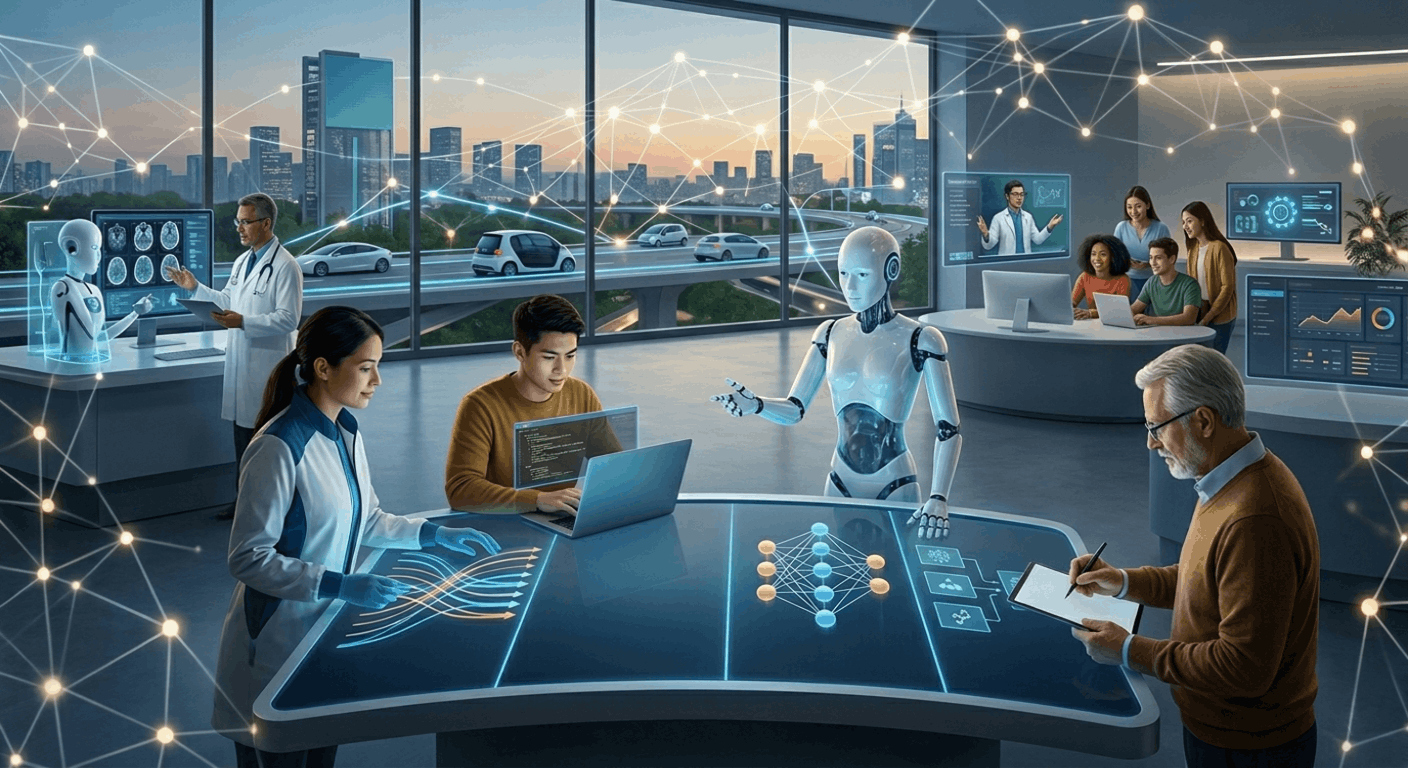
Introduction to Intelligent AI
Intelligent AI refers to advanced artificial intelligence systems that can think, learn, and make decisions based on data and context. Unlike traditional rule-based systems, intelligent AI adapts over time and improves its performance through learning. In 2026, intelligent AI is widely used in automation, search engines, healthcare, business, and content creation. It plays a major role in making machines more human-like in understanding and response.
What Is Intelligent AI?
Intelligent AI is an advanced branch of artificial intelligence that focuses on building systems capable of learning from data, understanding context, and making decisions in complex situations. It combines core technologies such as machine learning, deep learning, and Natural Language Processing (NLP) to simulate human-like understanding. Unlike basic AI systems that only follow fixed instructions, intelligent AI can analyze patterns, adapt to new information, and improve performance over time. In modern applications, it is widely used in automation, analytics, and decision-making systems across industries like healthcare, business, and technology.
How Intelligent AI Works
Intelligent AI operates through a structured process that involves data input, learning models, and predictive output. It processes large amounts of data, identifies meaningful patterns, and uses that information to generate accurate results. This allows systems to respond intelligently instead of relying on static programming.
Core Working Process
Data Collection and Training
AI systems are trained using large and diverse datasets to understand patterns, relationships, and real-world scenarios. The quality and scale of data directly impact AI performance and accuracy.
Machine Learning Models
Machine learning enables AI to improve automatically as new data is introduced. These models adjust their predictions based on experience, making the system more accurate over time.
Deep Learning Networks
Deep learning uses neural networks that mimic the human brain to process complex data such as images, speech, and text. This allows AI to handle advanced tasks like image recognition and language understanding.
Decision Making
After processing data, AI uses learned patterns to make predictions or decisions. This step allows it to solve problems, generate insights, and provide intelligent responses based on context.
Table: Intelligent AI Process Overview
| Stage | Function |
| Data Collection | Gathers large datasets for training |
| Machine Learning | Improves performance through experience |
| Deep Learning | Processes complex data like images and text |
| Decision Making | Generates predictions and solutions |
Key Features of Intelligent AI
Learning Ability
Intelligent AI continuously improves its performance by learning from new data and past experiences. It adapts its outputs based on patterns, which makes it more accurate over time.
Context Understanding
It can understand meaning, intent, and relationships between different data points. This helps AI generate more relevant and human-like responses instead of basic keyword-based outputs.
Automation
Intelligent AI can perform repetitive and time-consuming tasks without human intervention. This improves efficiency in industries like business, customer service, and data processing.
Adaptability
AI systems can adjust their behavior based on new inputs and environments. This flexibility allows them to work effectively in changing conditions.
Types of Intelligent AI
Narrow AI
- Designed for specific tasks like chatbots and recommendation systems
- Works within limited functions
- Most AI systems today fall into this category
General AI (Future Concept)
- Can perform any intellectual task like a human
- Not yet fully developed in real-world systems
- Focus of ongoing AI research
Super AI (Future Concept)
- Surpasses human intelligence in all areas
- Theoretical stage at present
- Expected to be highly advanced and autonomous
Applications of Intelligent AI
Business and Automation
- Used in customer support systems
- Helps in data analysis and reporting
- Automates business workflows
Healthcare
- Assists in disease detection and diagnosis
- Supports medical research
- Improves treatment planning
Education
- Provides personalized learning systems
- Acts as a virtual tutor
- Helps students understand complex topics
Finance
- Detects fraud in transactions
- Manages risk analysis
- Supports trading and investment decisions
Content Creation
- Generates articles and blogs
- Creates marketing content
- Assists in creative writing tasks
Benefits of Intelligent AI
Faster Decision Making
- Processes large amounts of data quickly
- Provides real-time results
- Supports instant decision-making
Improved Accuracy
- Reduces human errors in analysis
- Increases the reliability of predictions
- Improves data-driven decisions
Cost Efficiency
- Reduces manual labor costs
- Automates repetitive processes
- Improves operational efficiency
Scalability
- Handles large-scale operations easily
- Works across multiple systems
- Supports business growth without a major cost increase
Automation through AI may reduce the need for certain manual or repetitive jobs. While it creates new opportunities in tech fields, it can also replace traditional roles. This shift requires workforce adaptation and skill development.
Table: Limitations of Intelligent AI
| Limitation | Explanation |
| Data Dependency | Performance depends on training data quality |
| Lack of Emotion | Cannot understand real human feelings |
| Privacy Risks | Risk of data misuse or security issues |
| Job Impact | Automation may reduce some job opportunities |
Future of Intelligent AI
Human-Like Reasoning Development
The future of intelligent AI is focused on improving reasoning capabilities to make systems more human-like in thinking. Advanced models will better understand context, logic, and complex situations. This will allow AI to provide more natural and accurate responses in real-world applications.
Key Points:
- AI will understand context more deeply
- Logical reasoning will become more advanced
- Responses will feel more natural and human-like
Improved Decision-Making Accuracy
Future AI systems will use larger and more refined datasets to improve prediction and decision-making accuracy. By reducing errors and bias, AI will become more reliable in critical sectors like healthcare, finance, and research. This improvement will enhance trust in AI-driven systems.
Key Points:
- Better accuracy in predictions
- Reduced errors and bias
- More reliable for critical industries
Deep Integration into Daily Life Tools
Intelligent AI will become more integrated into everyday tools such as search engines, productivity apps, and smart devices. This integration will allow users to complete tasks faster and more efficiently. AI will become a standard part of digital ecosystems across platforms.
Key Points:
- Integrated into apps and devices
- Faster task completion
- Standard part of digital tools
Industry-Wide Adoption
AI is expected to play a major role in industries like healthcare, education, business, and technology. It will assist in diagnosis, personalized learning, automation, and data analysis. This widespread adoption will increase productivity and innovation across sectors.
Key Points:
- Used in healthcare and education
- Supports business automation
- Boosts productivity and innovation
Human-AI Collaboration
Future intelligent AI will work alongside humans rather than replacing them completely. It will act as a supportive system that enhances human capabilities. This collaboration will improve efficiency and decision-making in professional environments.
Key Points:
- Works with humans, not replaces them
- Enhances human productivity
- Improves workplace decision-making
Final Thoughts
Intelligent AI represents the next stage of artificial intelligence, where machines can think, learn, and adapt. It is already changing how industries operate and will continue to grow in importance. While it offers many benefits like automation and efficiency, it also requires responsible use to avoid risks. Overall, intelligent AI is shaping the future of technology and human interaction.
FAQs
What is Intelligent AI?
Intelligent AI is an advanced form of artificial intelligence that can learn, understand context, and make decisions. It uses technologies like machine learning and deep learning. It is designed to perform tasks in a smart and adaptive way.
How does Intelligent AI work?
It works by processing large datasets and identifying patterns using algorithms. Machine learning and neural networks help it improve over time. It then uses this learning to generate predictions and solutions.
What are examples of Intelligent AI?
Examples include chatbots, recommendation systems, self-driving cars, and virtual assistants. These systems can analyze data and respond intelligently. They are widely used in modern technology.
Is Intelligent AI the same as machine learning?
No, machine learning is a part of Intelligent AI. Machine learning focuses on training models using data. Intelligent AI uses machine learning along with other technologies to act more broadly.
What are the main uses of Intelligent AI?
It is used in healthcare, business automation, education, finance, and content creation. It helps improve efficiency and decision-making. Many industries use it for data analysis and automation.
Can AI replace humans?
Intelligent AI cannot fully replace humans, but it can automate many tasks. It is designed to assist rather than replace human intelligence. Human judgment is still needed for complex decisions.
What are the benefits of Intelligent AI?
It improves speed, accuracy, and efficiency in tasks. It reduces human errors and saves time. It is also scalable and useful in many industries.
What are the limitations of Intelligent AI?
It depends on data quality and may produce errors. It lacks human emotions and ethical understanding. Privacy and job displacement are also concerns.
Is Intelligent AI safe to use?
Yes, but it must be used responsibly. Proper data security and ethical guidelines are important. Misuse of AI can lead to privacy and security risks.
What is the future of Intelligent AI?
The future includes more advanced reasoning and better human-AI collaboration. It will become more integrated into daily life tools. AI will continue to grow in industries worldwide.