



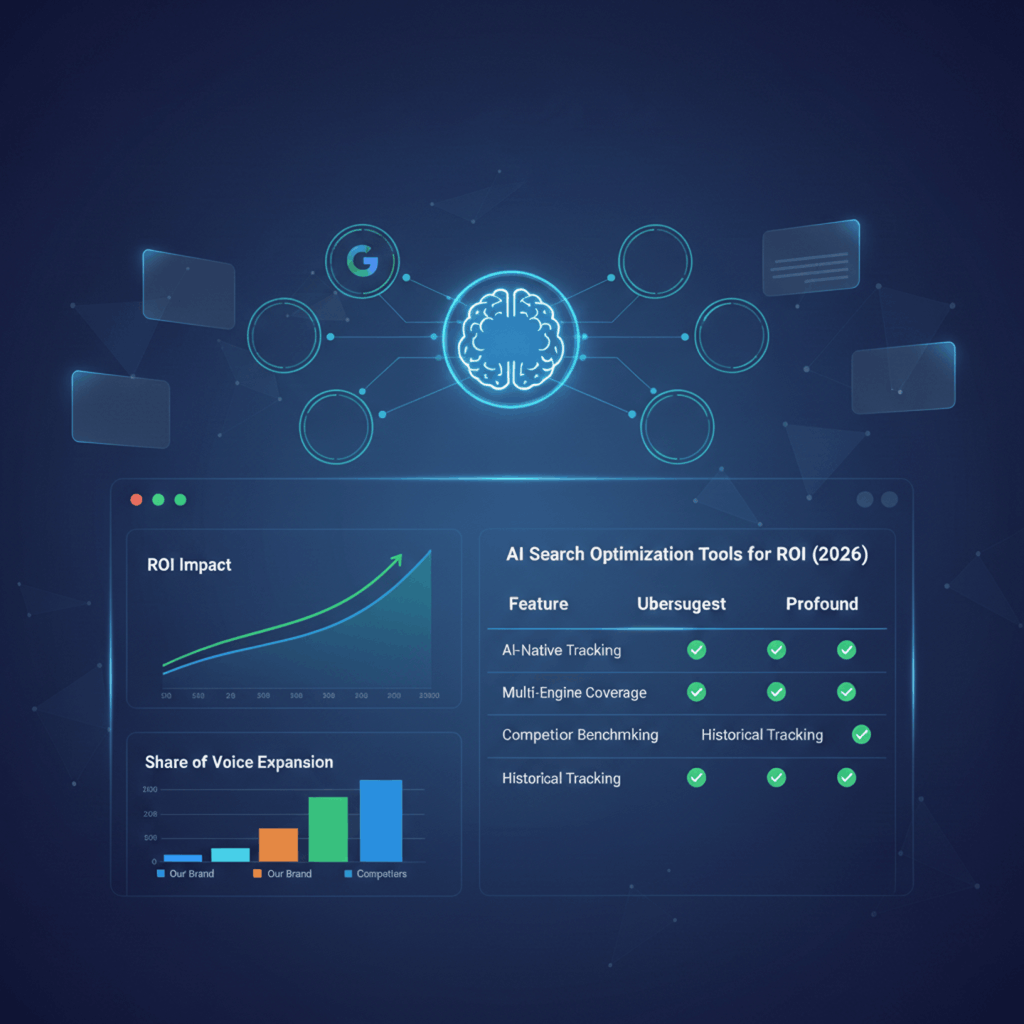
Introduction: Which AI Search Optimization Tools Have the Best ROI
AI search optimization tools that deliver the best ROI help brands measure visibility, citations, and competitor performance across LLM platforms like ChatGPT, Perplexity, and Google AI Overviews. Tools such as SE Ranking, Ubersuggest, and Profound provide actionable insights into prompt-level mentions, historical trends, and share-of-voice metrics. By tracking AI citations alongside traditional SEO performance, these platforms ensure marketing investments generate measurable returns. Selecting the right tool allows brands to optimize content, close visibility gaps, and stay competitive in AI-driven search.
10 AI Search Optimization Tools Deliver the Best ROI
SE Ranking – AI Search Toolkit
SE Ranking allows users to monitor citations at the keyword and topic cluster level, track AI mentions across multiple engines, and visualize historical trends for precise ROI measurement. Coverage outside supported engines is growing, but currently moderate.
| Category | Details |
| Founded | 2013 |
| Headquarters | London, UK |
| Core Focus | SEO + AI visibility tracking |
| AI Engines Covered | ChatGPT, Google AI Overviews, Gemini |
| Tracking Model | Prompt-based AI results tracking |
| Citation Detection | Linked mentions + Unlinked mentions |
| Historical Tracking | Yes |
| Key Features | AI Results Tracker, Prompt-level benchmarking, Competitor dashboards, Historical visibility graphs |
| Pricing | $129–$259/month |
| Ideal Users | Agencies, mid-sized businesses |
| ROI Impact | High – Actionable data with clear dashboards, enables structured trend tracking and competitor benchmarking |
SEMrush
SEMrush integrates AI visibility metrics with traditional SEO dashboards, making it effective for enterprises already using the platform. While AI coverage is partial, consolidated insights allow better decision-making on content strategy and citations.
| Category | Details |
| Founded | 2008 |
| Headquarters | Boston, USA |
| Core Function | Competitive SEO + AI-assisted analytics |
| AI Coverage | Partial – AI modules added to SEO suite |
| Tracking Model | AI visibility scoring + SERP AI snippet monitoring |
| Citation Detection | Partial – Tracks mentions indirectly via AI modules |
| Historical Tracking | Yes |
| Key Features | Integrated AI visibility, Authority scoring, Domain gap analysis, Consolidated SEO + AI reporting |
| Pricing | $129.95–$499.95/month |
| Ideal Users | Enterprises, Agencies |
| ROI Impact | Medium–High – ROI comes from combined AI and SEO analytics, enabling content optimization across channels |
Ahrefs
Ahrefs does not track AI citations natively but provides crucial insights on which content pieces are likely to be cited by AI engines due to strong backlink profiles and authority metrics.
| Category | Details |
| Founded | 2010 |
| Headquarters | Singapore |
| Core Strength | Backlink intelligence + authority analysis |
| AI Coverage | Indirect – correlates backlinks with AI citation probability |
| Tracking Model | Authority gap analysis, Link influence on AI mentions |
| Citation Detection | No direct AI mention tracking |
| Historical Tracking | Yes |
| Key Features | Backlink ecosystem analysis, AI citation correlation, Authority gap insights |
| Pricing | $99–$999/month |
| Ideal Users | SEO professionals, link-building teams |
| ROI Impact | Medium – Increases AI visibility indirectly through authority-building backlinks |
Ubersuggest
Ubersuggest enables small teams and agencies to track AI citations and competitive visibility effectively without expensive enterprise tools, making it highly ROI-efficient.
| Category | Details |
| Founded | By Neil Patel |
| Headquarters | USA |
| Core Focus | SEO + AI visibility tracking |
| AI Engines Covered | ChatGPT, Google AI Overviews |
| Tracking Model | Brand visibility + prompt-level monitoring |
| Citation Detection | Linked and unlinked AI mentions |
| Historical Tracking | Yes |
| Key Features | Industry rank tracking, Top prompts analysis, Competitor insights, Combined AI + SEO metrics |
| Pricing | $29–$79/month |
| Ideal Users | SMBs, Agencies |
| ROI Impact | High – Affordable platform with actionable dashboards; combines AI and SEO metrics for measurable ROI |
Writesonic
Writesonic combines AI content generation with monitoring tools that show which content gets cited in AI responses, helping teams optimize for visibility in real time.
| Category | Details |
| Founded | 2020 |
| Headquarters | USA |
| Core Focus | AI content generation + AI visibility tracking |
| AI Engines Covered | ChatGPT, Gemini, Perplexity |
| Tracking Model | GEO optimization, prompt-level insights |
| Citation Detection | Tracks visibility in AI-generated answers |
| Historical Tracking | Yes |
| Key Features | Prompt-level performance metrics, Competitor benchmarking, and AI-optimized content guidance |
| Pricing | $20–$99/month |
| Ideal Users | Content teams, Marketing agencies |
| ROI Impact | Medium – Faster content creation with AI SEO insights; measurable visibility growth via prompt-level tracking |
Profound
Profound’s enterprise dashboards allow precise evaluation of AI visibility ROI, including sentiment framing, topic authority, and competitor mentions across multiple LLMs.
| Category | Details |
| Founded | 2022 |
| Headquarters | USA |
| Core Focus | Enterprise LLM brand visibility and AI analytics |
| AI Engines Covered | ChatGPT, Gemini, Claude |
| Tracking Model | Sentiment analysis + prompt-level visibility |
| Citation Detection | Linked + Unlinked mentions + authority mapping |
| Historical Tracking | Yes, with customizable dashboards |
| Key Features | Authority mapping, Sentiment tracking, Competitor benchmarking, Prompt-level insights, Custom dashboards |
| Pricing | Enterprise quote (customized per client) |
| Ideal Users | Large enterprises, Data-driven AI marketing teams |
| ROI Impact | Very High – Deep insights justify investment; tracks visibility, authority, and competitive positioning |
ScrunchAI
ScrunchAI specializes in AI-native visibility, allowing users to simulate prompts and analyze topic gaps to optimize citation likelihood in AI answers.
| Category | Details |
| Founded | 2023 |
| Headquarters | USA |
| Core Focus | Dedicated AI visibility tracking |
| AI Engines Covered | ChatGPT, Claude, Perplexity, Google AI Overviews |
| Tracking Model | Citation quality + frequency + query simulation |
| Citation Detection | Linked + Unlinked mentions, primary/secondary sources |
| Historical Tracking | Yes |
| Key Features | Gap detection, Real-time alerts, Query simulations, Competitor benchmarking |
| Pricing | $99–$499/month |
| Ideal Users | Agencies, AI specialists |
| ROI Impact | High – Instant alerts and actionable insights for AI citations lead to measurable improvements in visibility |
Similarweb
Similarweb helps businesses understand indirect ROI from AI traffic by tracking referral patterns and attribution from AI-driven sources.
| Category | Details |
| Founded | 2007 |
| Headquarters | Israel |
| Core Focus | Traffic intelligence + competitive benchmarking |
| AI Coverage | Indirect – AI-driven traffic insights via referrals |
| Tracking Model | Referral source analysis, Traffic trend monitoring |
| Citation Detection | No direct AI tracking |
| Historical Tracking | Yes |
| Key Features | Traffic pattern analysis, Referral benchmarking, Competitor performance insights |
| Pricing | Enterprise custom |
| Ideal Users | Market analysts, Strategic teams |
| ROI Impact | Medium – Identifies potential AI-driven traffic impact but does not monitor direct citations |
Brandwatch
Brandwatch tracks brand perception shifts that can influence AI positioning, but does not provide AI-native citation monitoring.
| Category | Details |
| Founded | 2007 |
| Headquarters | UK |
| Core Focus | Brand perception + sentiment analysis |
| AI Coverage | Limited – Sentiment + competitor mentions |
| Tracking Model | Monitoring brand mentions and competitor positioning |
| Citation Detection | Not AI-native |
| Historical Tracking | Yes |
| Key Features | Brand monitoring, Reputation analysis, Competitor mention tracking |
| Pricing | Enterprise-tier |
| Ideal Users | Brand managers, Marketing teams |
| ROI Impact | Medium – Improves perception-driven metrics; indirect AI visibility insights |
Peec AI
Peec AI provides affordable, easy-to-use dashboards for small businesses seeking AI visibility without enterprise complexity.
| Category | Details |
| Founded | 2022 |
| Headquarters | USA |
| Core Focus | AI brand monitoring and competitive share |
| AI Engines Covered | Major LLMs (ChatGPT, Claude, Gemini, Perplexity) |
| Tracking Model | Simplified dashboards + competitive visibility |
| Citation Detection | Linked + unlinked mentions |
| Historical Tracking | Yes |
| Key Features | Competitive share tracking, Citation monitoring, Dashboard summaries |
| Pricing | $99–$499/month |
| Ideal Users | SMBs, Small agencies |
| ROI Impact | Medium – Basic AI citation monitoring and competitive insights for SMBs |
Consolidated Comparison Table
| Tool | AI Tracking | Engine Coverage | Competitor Analysis | Historical Data | Best For |
|---|---|---|---|---|---|
| SE Ranking | Basic AI SERP visibility | Google, Bing | Domain comparison | 5+ yrs | Agencies & SMBs |
| SEMrush | Partial AI beta | Google, Bing | Market share + gap analysis | 10+ yrs | Enterprise marketing |
| Ahrefs | No AI-native tracking | Google-focused | Keyword & backlink gap | 7+ yrs | SEO professionals |
| Ubersuggest | Basic AI overview | Basic competitor insights | Limited | Freelancers | |
| Writesonic | AI content performance | Google + AI search | Content comparison | Campaign-based | Content teams |
| Profound | Full AI answer tracking | Google, Bing, ChatGPT, Perplexity | AI visibility benchmarking | AI trend archive | AI-focused brands |
| ScrunchAI | AI citation monitoring | Google + AI search | AI competitor mapping | AI query shifts | AI-first companies |
| Similarweb | No AI SERP tracking | Traffic intelligence | Market share analysis | Multi-year traffic data | Market research |
| Brandwatch | Limited AI mentions | Web + social | Share of voice | Sentiment history | Brand monitoring |
| Peec AI | AI-native visibility tracking | Google + AI search | AI citation comparison | AI archive tracking | AI SEO strategists |
How AI Search ROI Differs from Traditional SEO
Traditional SEO ROI focuses primarily on keyword rankings, backlink profiles, and organic traffic. Performance is typically measured through impressions, click-through rates, and conversions, and ROI is tied directly to SERP positions and website visits. In contrast, AI Search and LLM-driven ROI are measured differently. Here, success is defined by brand mentions, citations, and share of voice in AI-generated answers across platforms like ChatGPT, Perplexity, Claude, and Google AI Overviews. Metrics include visibility, authority, and prompt-level engagement. The return on investment is derived from AI-driven impressions, referral traffic, and influence across multiple LLM platforms. This structural difference highlights the need for real-time AI citation monitoring, historical trend analysis, and competitor benchmarking instead of relying solely on traditional SERP positions.
Core Features Required in AI Search Optimization Tools
Multi-Engine Tracking
An effective AI search optimization tool must monitor visibility across multiple LLM platforms, including ChatGPT, Google AI Overviews, Gemini, Perplexity, and Claude. Multi-engine coverage ensures that brands can track performance where it matters most and uncover opportunities that traditional SEO dashboards may miss.
Prompt-Level Visibility
Content visibility differs depending on the query phrasing. Tools with prompt-level tracking allow marketers to understand how their content appears across different search intents, enabling optimization for specific queries that generate AI citations.
Citation Classification
AI visibility tools must distinguish between linked mentions, unlinked mentions, and authoritative citations. Understanding the type and quality of citation allows brands to identify which content is considered authoritative by AI engines and where visibility gaps exist.
Competitor Benchmarking
Direct comparison against competitors is essential. Platforms must provide share-of-voice analysis, frequency of citations, and insight into topic clusters where competitors outperform your brand. This ensures actionable insights that guide content and outreach strategy.
Historical Trend Analysis
AI-generated answers fluctuate frequently. Tools that store historical visibility data enable teams to track growth, identify seasonal trends, and evaluate the impact of AI optimization efforts over time.
Integration with SEO Data
Combining AI visibility metrics with traditional SEO data provides a holistic view of performance. This integration allows marketers to correlate AI citations with organic traffic, conversions, and engagement metrics, delivering measurable ROI.
Measuring ROI from AI Search Optimization
AI-driven traffic growth is measured by referral traffic originating from AI-generated answers. Citation frequency tracking monitors both linked and unlinked mentions over time. Prompt-level performance identifies queries generating the most visibility, while share-of-voice expansion compares brand presence versus competitors across LLMs. Conversion attribution connects AI visibility improvements to tangible business outcomes like leads or revenue. When combined, these metrics provide a precise, data-driven understanding of ROI from AI search optimization, transforming LLM visibility into a measurable growth channel.
Our Experience & Recommendation
We have tested multiple AI search optimization platforms, including SE Ranking, Ubersuggest, and Profound, across real client campaigns. On a practical level, combining AI citation tracking with authority analysis delivered the clearest measurable ROI. SE Ranking’s prompt-level dashboards and competitor benchmarking were extremely actionable for mid-size agencies, while Profound provided enterprise clients with deep share-of-voice insights that directly informed strategy.
Our recommendation:
Pair an AI-native visibility tool with strong SEO intelligence to maximize measurable ROI and maintain competitive LLM presence.
FAQs
Which AI search optimization tools deliver the best ROI?
Tools like SE Ranking, Ubersuggest, and Profound provide measurable ROI by tracking AI citations, prompt-level visibility, and historical trends across multiple LLM platforms.
How do AI visibility tools differ from traditional SEO tools?
AI tools focus on citations, brand mentions, and share of voice in LLM responses, whereas SEO tools track keyword rankings, backlinks, and website traffic.
Can small businesses benefit from AI search tools?
Yes, platforms like Ubersuggest and Peec AI offer affordable AI visibility tracking combined with traditional SEO metrics for SMBs and agencies.
What metrics are important for measuring AI search ROI?
Key metrics include AI-driven traffic, citation frequency, prompt-level engagement, share of voice, and conversion attribution.
Do AI visibility tools track multiple platforms?
The best tools monitor ChatGPT, Google AI Overviews, Gemini, Perplexity, and Claude, ensuring comprehensive LLM coverage.
Is AI visibility tracking worth the investment for enterprises?
Enterprise platforms like Profound and ScrunchAI provide detailed dashboards, sentiment analysis, and authority mapping, delivering very high ROI for large brands.
Can AI tools improve content performance in LLMs?
Yes, AI tools identify high-performing prompts, optimize content structure, and suggest topic gaps, improving visibility and citation probability.
How do AI and traditional SEO data integrate?
Platforms like SEMrush and Ahrefs combine AI visibility metrics with backlink and ranking data, providing a complete view of content performance across channels.
Are newer AI visibility tools reliable?
Newer tools like ScrunchAI and Peec AI offer real-time tracking and actionable insights, but established platforms like SE Ranking and Ubersuggest provide more consistent data.
How quickly can AI visibility tools impact ROI?
With prompt-level monitoring and citation tracking, improvements in AI-driven traffic and brand mentions can be measured within weeks, not months.