




Introduction
Free AI visibility tools help brands understand whether their website, product, or brand name appears inside AI‑generated answers. These tools analyze responses from platforms like ChatGPT, Gemini, Google AI Overviews, and Perplexity to identify mentions, citations, and relative brand visibility, allowing marketers to measure real AI-driven exposure beyond traditional rankings.
What Are Free AI Visibility Tools?
Free AI visibility tools are analytical platforms designed to scan Large Language Model outputs and detect brand, domain, or content references. Unlike traditional SEO tools that focus on rankings, these tools measure how often and in what context a brand is recommended or cited within AI-generated answers.
In practical use, many websites discover that pages with average Google rankings still receive frequent AI mentions. This confirms that AI visibility represents a parallel authority layer rather than a direct extension of classic SEO rankings.
Why AI Search Visibility Is Now Critical
AI assistants increasingly act as the first decision-making layer for users. Instead of browsing multiple results, users receive curated answers where only a few brands are referenced. If a brand does not appear in those answers, it is effectively excluded from early consideration.
AI-driven visibility often delivers high-intent exposure because users engaging with AI assistants are already problem-aware and closer to action. Visibility at this stage directly influences trust and conversion potential.
How Free AI Visibility Tools Work
Free AI visibility tools operate through prompt-based analysis. The platform runs predefined or custom prompts across multiple LLMs and evaluates responses to determine brand mentions, contextual placement, and competitor presence.
Accurate results depend heavily on prompt quality. The most reliable approach is converting real user queries from tools like Google Search Console into conversational AI-style questions, which produces more realistic visibility insights.
Best Free AI Visibility Tools Explained
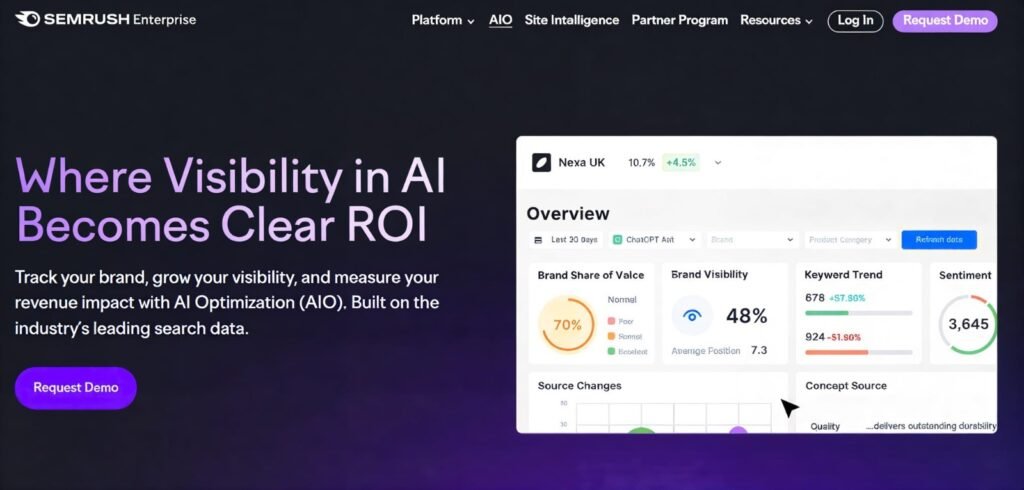
Semrush AI Visibility Toolkit (Free Version)
Semrush provides a free AI visibility snapshot showing brand mentions, AI visibility scores, and high-level competitor comparisons. It is primarily useful for initial benchmarking and directional insights rather than deep analysis.
This tool performs best for websites with established topical authority. While the free version is limited, it clearly highlights whether a brand is present or absent in AI-generated answers.
Mangools AI Search Grader
Mangools AI Search Grader delivers a simplified AI visibility score that reflects how frequently a brand appears in AI-driven search responses. It also identifies structural and entity-level gaps affecting AI visibility.
Testing this tool on low-authority websites often reveals weak AI presence despite reasonable content quality, helping prioritize structural and topical improvements.
SE Ranking AI Overviews Tracker
SE Ranking’s free AI Overviews Tracker monitors brand mentions across Google AI Overviews, Gemini, and ChatGPT. It emphasizes visibility trends rather than single snapshots, making progress tracking easier.
Its strength lies in showing whether AI visibility is improving or declining over time instead of presenting static metrics.
Ubersuggest AI Search Visibility (Free Beta)
Ubersuggest offers a basic AI visibility feature currently available in beta. It provides introductory-level insights into brand mentions and general AI exposure.
This tool is most suitable for beginners who want to explore AI visibility without navigating complex dashboards or advanced configurations.
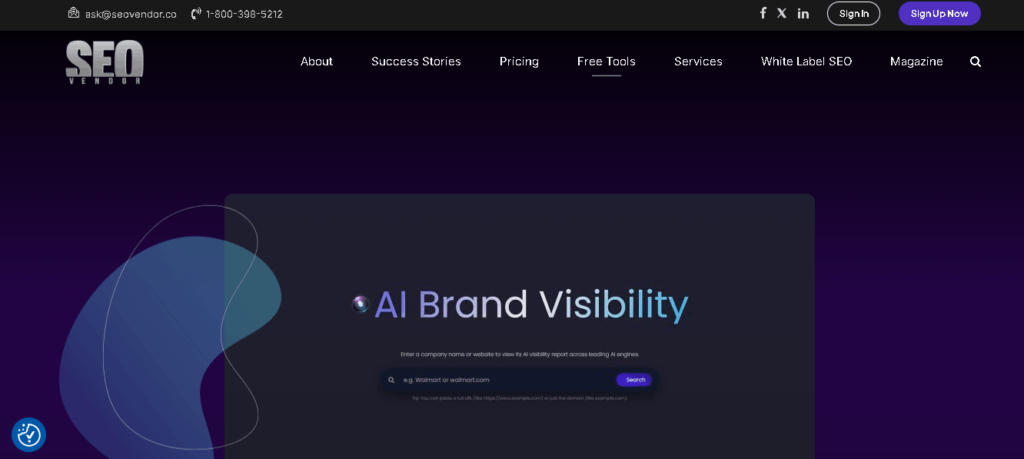
SEO Vendor RankLens (Free Open‑Source Tool)
RankLens is an open-source AI visibility tracker focused on analyzing answer accuracy and brand mentions within AI outputs. It offers flexibility and customization for advanced users.
While technically powerful, it may require technical knowledge to configure and interpret effectively.
Google Analytics 4 as an AI Visibility Alternative
Google Analytics 4 is not a direct AI visibility tool, but it can identify referral traffic from AI platforms. By isolating traffic sources such as ChatGPT or Perplexity, brands can measure real performance impact.
In practice, GA4 often reveals that certain informational pages consistently attract AI-driven traffic, signaling opportunities for targeted optimization.
OmniSEO Citation Tracker (Free Tier)
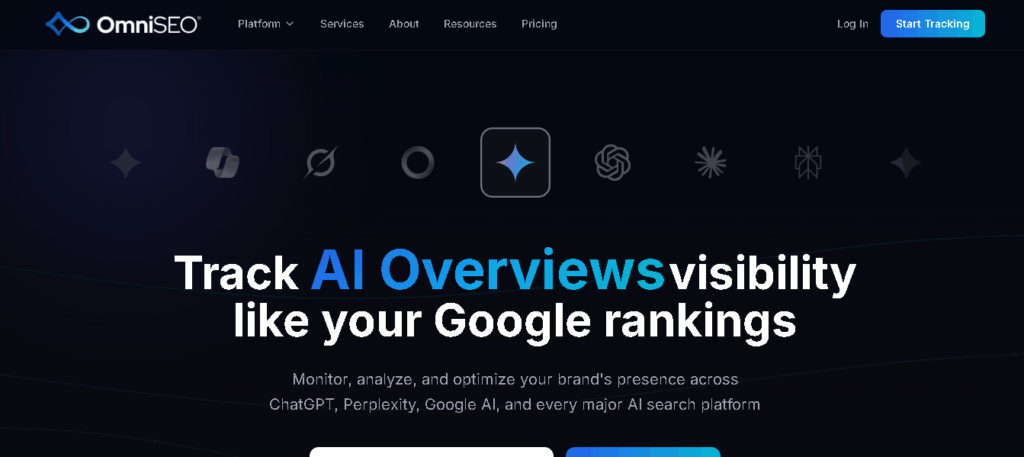
OmniSEO is a specialized 2026 tool that focuses on “Citation Share” across Google AI Overviews and Perplexity. It calculates a specific citation score by analyzing how often your brand is linked as a primary source versus being mentioned as a secondary reference.
This tool is invaluable for GEO (Generative Engine Optimization) because it identifies the exact content snippets that AI models are currently pulling into their answers.
Free AI Visibility Tools Comparison Table
| Tool Name | Free Access | Platforms Covered | Primary Insight | Best Use Case |
| Semrush AI Toolkit | Yes | ChatGPT, Gemini, AIO | Visibility snapshot | SEO‑driven sites |
| Mangools AI Grader | Yes | Multiple LLMs | AI presence score | Quick audits |
| SE Ranking Tracker | Yes | Google AIO, Gemini | Trend analysis | Growth tracking |
| Ubersuggest AI | Yes (Beta) | Limited LLMs | Basic visibility | Beginners |
| RankLens | Yes | Open LLM APIs | Answer accuracy | Advanced users |
| GA4 | Yes | Referral data | Traffic impact | Performance review |
| OmniSEO | Yes | AIO, Preplexity | Citation Share | High-authority blogs |
Benefits of Free AI Visibility Tools
Free AI visibility tools provide practical value for brands that want to understand how AI systems interpret and reference their content. While limited, they offer meaningful insights when used correctly.
Low-Cost Entry Into AI Search Analysis
Free AI visibility tools allow brands to explore AI-driven search behavior without financial risk. This makes them ideal for early-stage testing, learning AI citation patterns, and validating whether a brand is referenced by large language models.
Early Detection of AI Mentions
These tools help identify whether a brand, product, or website appears in AI-generated answers. Early detection allows marketers to recognize emerging visibility before AI traffic or brand recall becomes measurable through traditional analytics.
Directional Insight for GEO and AEO
Free tools provide directional signals that help guide Generative Engine Optimization and Answer Engine Optimization strategies. They reveal whether content structure, entities, and topical authority align with AI model expectations.
Validation of Content Authority Signals
AI visibility tools highlight which pages or topics AI systems consider reliable. This helps confirm whether structured content, factual clarity, and entity consistency are contributing to perceived authority.
Support for SEO and Content Prioritization
Insights from free tools can be used to prioritize content updates. Pages that already receive AI mentions can be strengthened, while invisible topics can be restructured to improve future AI visibility.
Baseline Benchmarking Against Competitors
Even with limited data, free tools enable basic competitive benchmarking. Brands can identify whether competitors are consistently referenced and assess relative visibility gaps at a high level.
Complement to Traditional Analytics
When combined with tools like Google Analytics 4 and Search Console, free AI visibility tools add an additional interpretive layer. Together, they connect AI mentions with actual traffic, engagement, and performance outcomes.
Limitations of Free Tools
Free AI visibility tools are useful for initial discovery, but they come with structural and data-related constraints that limit their effectiveness at scale. Understanding these limitations is essential to avoid misinterpreting AI visibility signals.
Limited Prompt Coverage
Most free AI visibility tools rely on a small, predefined set of prompts. These prompts rarely reflect the full range of real user queries, long-tail questions, or industry-specific language. As a result, brands may appear invisible in reports even when they are mentioned in AI responses triggered by untracked queries.
Delayed or Non-Real-Time Data
Free tools sometimes do not provide real-time AI response monitoring. Data is often cached, sampled, or updated periodically, which means sudden visibility gains or losses may go unnoticed. This delay makes it difficult to respond quickly to algorithmic or model-level changes.
Shallow Competitive Insights
Competitive analysis in free tools is usually limited to surface-level comparisons. They may show whether a competitor appears more frequently, but they rarely explain why. Factors such as entity relationships, content depth, or citation context are not deeply analyzed.
No Sentiment or Context Evaluation
Free AI visibility tools focus on presence rather than perception. They do not assess whether a brand mention is positive, neutral, or critical. Without sentiment and contextual evaluation, brands cannot accurately judge the quality or trust impact of their AI visibility.
Incomplete Platform Coverage
Many free tools support only a subset of AI platforms, often prioritizing Google AI Overviews or ChatGPT. Visibility on emerging or secondary models like Claude or Perplexity may be ignored, resulting in an incomplete understanding of overall AI exposure.
Lack of Historical Trend Depth
Historical data in free tools is either limited or unavailable. This restricts long-term analysis and makes it difficult to correlate AI visibility changes with content updates, SEO improvements, or authority growth over time.
Unsuitable for Competitive Niches
In highly competitive industries, free tools struggle to capture nuanced visibility shifts. Because mentions are sparse and highly selective, partial data can create false negatives, leading brands to underestimate their actual AI presence or miss optimization opportunities.
How to Get Maximum Value From Free Tools
Improving AI visibility requires structured, factual, and entity-rich content. Clear author attribution, updated FAQs, and authoritative references provide strong signals for AI models. Consistent monitoring helps identify emerging visibility patterns.
Boosting AI Visibility with Schema Markup
While tracking tools provide the data, Structured Data (Schema) is what actually secures your spot in AI answers. In 2026, Large Language Models (LLMs) rely heavily on “Entity Linking.” By using specific schema markups, you bridge the gap between being a “web page” and being a “trusted source” for AI.
FAQ Schema for Direct Answer Wins
The FAQ schema is the most powerful tool for Answer Engine Optimization (AEO). It provides AI models with a clear “Question-and-Answer” pair, making it significantly easier for platforms like Google AI Overviews or ChatGPT to extract your content and display it as the primary answer.
Organization and Person Schema for E-E-A-T
AI models prioritize content from verified entities. By implementing the Organization and Person schema, you define who you are and what your expertise is. This builds the trust required for AI to recommend your brand in high-intent “What is the best…” or “Who is the expert in…” queries.
Product and Review Schema for AI Recommendations
For commercial visibility, Product and Review schemas are essential. They provide AI with structured data, such as pricing, star ratings, and availability, allowing AI assistants to accurately compare your offerings against competitors in conversational search.
The 2026 GEO Success Checklist
To stay ahead of competitors who are still using traditional SEO tactics, follow this checklist to ensure your site is optimized for Generative Engine Optimization (GEO).
Adopt the “Answer-First” Writing Style
Ensure your content provides a direct, factual answer within the first 50 words of a page. AI models are trained to prioritize concise, front-loaded information for their summary snippets.
Enhance Data Density and Citations
AI models favor “Information Density.” Use specific statistics, numbers, and expert citations. The more data-rich your content is, the more likely an AI is to view it as a high-value source worth citing.
Optimize for Conversational Long-Tail Keywords
Shift your focus from short-form keywords to conversational “prompts.” Use tools like Google Search Console to find questions users are asking and create content that mirrors the natural language of AI interactions.
Maintain a Strong Presence on Citational Platforms
In 2026, AI models heavily weigh “social proof” from platforms like Reddit, Quora, and industry-specific forums. Actively participating in these communities increases the chances of your brand being mentioned in AI-generated “community consensus” answers.
Are Free Visibility Tools Enough?
For early-stage brands and content publishers, free AI visibility tools provide sufficient direction and awareness. They reveal blind spots and clarify how AI platforms interpret brand authority.
However, without strong SEO fundamentals, even advanced AI visibility tools deliver limited results. AI visibility amplifies authority rather than replacing it.
Our Practical Experience Using Free AI Visibility Tools
At Techniver, we tested multiple free AI visibility tools to evaluate how our content and brand appear inside AI-generated answers across ChatGPT, Google AI Overviews, Gemini, and Perplexity. Our approach was practical rather than tool-driven, we focused on whether the data aligned with real AI behavior.
Instead of relying only on visibility scores, we validated results through manual AI prompt testing and AI referral traffic analysis in Google Analytics 4. This helped us separate estimated visibility from actual AI recognition.
What We Learned From Real-World Testing
During testing, we observed that AI visibility was not strongly correlated with traditional keyword rankings. Several pages with average Google positions still appeared consistently in AI answers because they had:
- Clear entity definitions
- Direct, answer-first content structure
- Strong topical relevance
This reinforced that AI visibility functions as a parallel authority layer, not a ranking-based extension of SEO.
The Free AI Visibility Tool That Worked Best for Techniver
After testing multiple platforms, Mangools AI Search Grader delivered the most reliable and actionable insights for us at Techniver.
Why Mangools Delivered the Clearest Signals
The AI visibility scores and competitor comparisons from Mangools closely matched what we observed manually inside ChatGPT and Google AI Overviews. Instead of surface-level metrics, it helped us identify:
- Which competitors’ AI systems are preferred
- Where entity and structural gaps existed
- Why certain topics failed to gain AI visibility
This clarity made it easier to prioritize content restructuring and topical authority improvements rather than chasing isolated optimizations.
How We Use Free Tools Together in Practice
Our experience confirmed that no single free tool is sufficient on its own. The most accurate visibility insights came from combining:
- Mangools AI Search Grader for quick AI presence checks
- Manual AI searches for real response validation
- Google Analytics 4 to measure actual AI-driven traffic
This layered approach allowed us to identify repeatable AI visibility patterns instead of relying on temporary mentions.
Final Verdict
Free AI visibility tools offer a practical entry point into the AI-driven search ecosystem. When combined with solid SEO foundations and topical authority, they support sustainable AI visibility and long-term brand credibility.
Frequently Asked Questions
What are AI visibility tools?
AI visibility tools track whether a brand, website, or content is mentioned in AI-generated answers from platforms like ChatGPT, Gemini, Google AI Overviews, and Perplexity. They focus on citations and recommendations rather than traditional rankings.
Are free AI visibility tools accurate?
Free AI visibility tools are directionally accurate but not exhaustive. They reliably indicate presence or absence in AI answers, but limited prompts and delayed updates mean results should be interpreted as signals, not absolute measurements.
How do AI visibility tools differ from SEO tools?
SEO tools track keyword rankings and organic traffic, while AI visibility tools analyze how AI models reference entities, brands, and sources. AI visibility is entity-based, whereas SEO is primarily ranking-based.
Can free AI visibility tools track ChatGPT mentions?
Some free tools can detect ChatGPT mentions indirectly through prompt testing or referral traffic analysis. However, full and consistent ChatGPT monitoring is usually limited to paid or advanced platforms.
Do AI visibility tools help with GEO and AEO?
Yes. AI visibility tools support Generative Engine Optimization and Answer Engine Optimization by revealing how AI systems interpret content structure, authority signals, and entity relevance within generated answers.
Is Google AI Overviews tracking possible with free tools?
Basic Google AI Overviews tracking is possible with certain free tools, but coverage is limited. Most free versions track snapshots or trends rather than comprehensive, real-time AI Overview visibility.
Can AI visibility tools replace traditional SEO tools?
No. AI visibility tools complement SEO tools but do not replace them. Strong SEO foundations are required for consistent AI visibility, as AI models heavily rely on authoritative, well-structured web content.
Which free AI visibility tool is best for beginners?
For beginners, tools that provide simple visibility indicators and pair well with Google Analytics 4 are most effective. The goal should be understanding presence, not deep competitive modeling.
How often should AI visibility be checked?
Monthly monitoring is sufficient for most websites using free tools. Frequent checks may not provide new insights due to delayed data refresh cycles in free versions.
Why does my site rank well on Google but not appear in AI answers?
AI systems prioritize entity clarity, factual consistency, and authority over rankings alone. A site can rank well but still lack the structured signals AI models use for citation and recommendation.